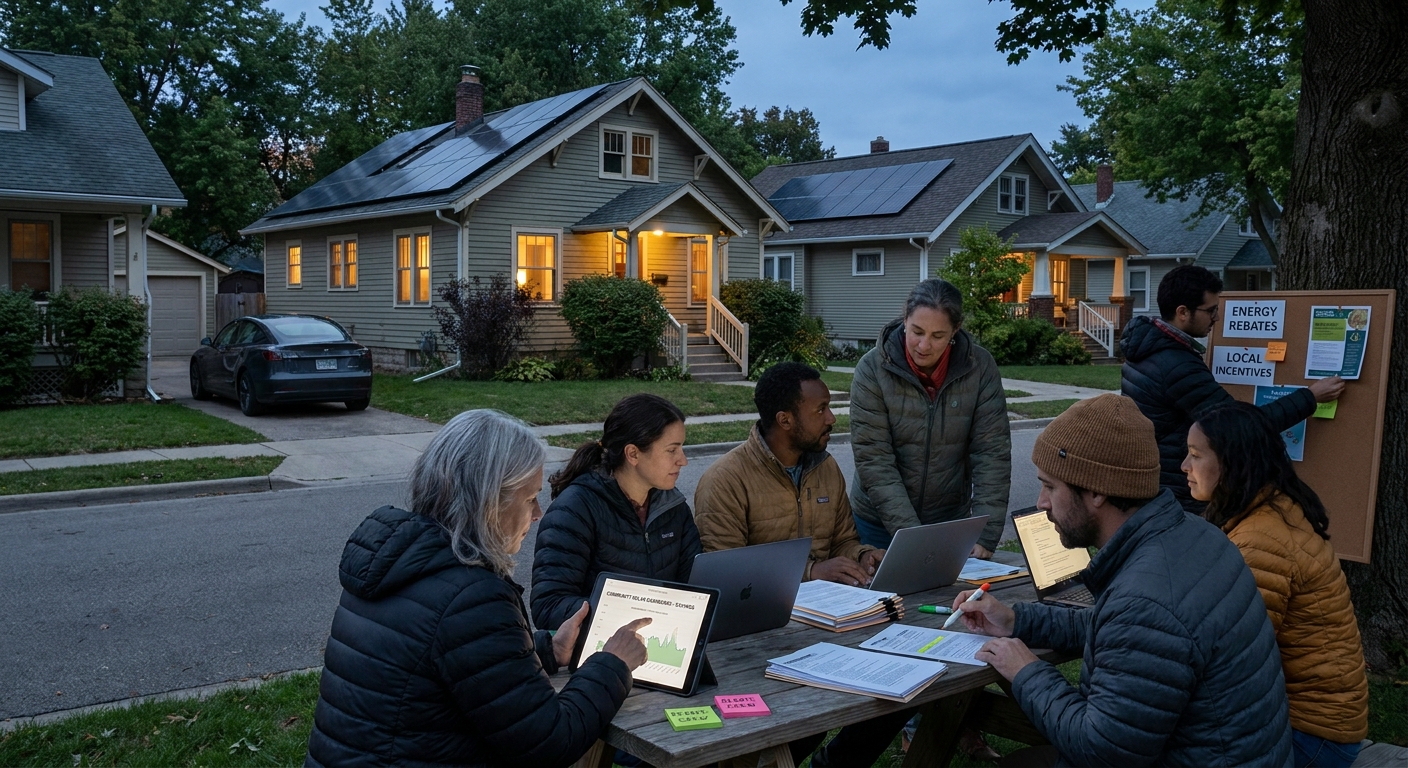
High power bills are frustrating enough. What really pushes people over the edge is when every “save money” program sends you to another portal, another PDF, and another page full of fine print that seems written for utility lawyers. Community solar, EV charging rewards, weatherization help, heat pump rebates. They sound great until you try to sign up and realize you are doing it alone.
Here is the shortcut. Stop thinking of these as one-off rebates and start treating them like group projects. In many cities and states, the people getting the best results are not just filling out forms. They are joining local subscriber groups, nonprofit info sessions, utility partner meetups, and neighborhood chats where people share approved installers, post screenshots of successful applications, and warn each other before funding runs out. If you want to know how to join community solar and energy rebate groups, the answer is usually not hiding on the rebate page itself. It is in the local network around the program. That is where the real money-saving team lives.
⚡ In a Hurry? Key Takeaways
- To join community solar and energy rebate groups, start with your utility, state energy office, and local nonprofit partners, then look for subscriber events or online groups tied to those programs.
- Ask for three things right away: approved contractor lists, application timing tips, and proof of what combinations of rebates can be stacked.
- Move early and verify every offer. Real programs can save hundreds, but funds are limited and scam ads often copy official rebate language.
Why doing this alone usually costs you money
Most people do one sensible thing. They find the obvious rebate, apply, and hope for the best. That is not wrong. It is just incomplete.
The bigger savings often come from stacking programs. A community solar subscription might lower your electric costs. That same utility may also offer a smart thermostat incentive, EV charging credits, demand response payments, or home efficiency rebates. Your state may add another layer. A city, county, or nonprofit may add one more.
The problem is that none of these systems talk like normal people. They rarely say, “Here is the best order to apply.” They rarely say, “Use this contractor because their paperwork gets approved fast.” That kind of advice usually comes from other residents who already went through it.
What a real rebate team looks like
It does not have to be formal. You are not joining a secret society with jackets and handshakes.
A rebate team can be:
- A community solar subscriber Facebook group
- A nonprofit workshop for clean energy signups
- A neighborhood email chain swapping utility screenshots
- A local library or town energy committee event
- An HOA or condo board thread where people compare installer quotes
- A WhatsApp or text group started by a few neighbors on the same utility plan
The value is simple. One person finds the right link. Another figures out the income-verification step. Someone else learns which installer actually returns calls. Suddenly the process gets much easier for everyone.
How to join community solar and energy rebate groups
1. Start with your utility, not Google ads
Your power company is often the cleanest first stop. Go to the official utility website and look for pages labeled community solar, renewable energy, energy savings, demand response, EV programs, or customer rebates.
You are not just looking for the program details. Look for the words “partners,” “approved vendors,” “community outreach,” “events,” “webinars,” or “subscriber resources.” Those are clues that a real support network exists.
If there is a phone number or chat, ask directly: “Are there subscriber info sessions or community groups for this program?” That one question can save you hours.
2. Check your state energy office and public utility commission
State agencies are not always exciting to browse. Fair warning. But they are often where the master list lives.
Look for:
- State clean energy programs
- Home energy rebate rollouts
- Income-qualified assistance programs
- Approved community solar providers
- Consumer protection pages
These pages often link to local administrators, nonprofit partners, and official outreach events. That is the doorway to the group side of the program.
3. Find the nonprofit partner behind the program
This is the part many people miss. A lot of energy programs are promoted or explained by local nonprofits, community action agencies, sustainability groups, and housing organizations. They host the workshops. They answer the practical questions. They know which forms trip people up.
Search your city or county name with terms like:
- community solar enrollment assistance
- energy rebate workshop
- home energy nonprofit
- weatherization sign up help
- clean energy community meeting
If you see free info sessions, that is a very good sign. Go to one. Even if it feels small, that is often where you meet the people who know the real process.
4. Look for neighborhood channels already hiding in plain sight
If your area has an HOA, condo board, block association, or neighborhood email list, check there too. People often ask about solar subscriptions, insulation rebates, or charger installs long before they post anywhere else.
If you need ideas for spotting those hidden local conversations, this piece is worth a read: The ‘Neighborhood Thread’ Shortcut: Turn Quiet HOA Chats Into Real Rebate Groups You Can Join.
5. Ask the right questions when you find a group
Not every group is equally useful. Some are mostly complaints. Some are basically marketing funnels. You want practical, trackable help.
Ask these questions:
- Which provider or installer actually completed your paperwork correctly?
- How long did approval take?
- What documents did you need?
- Which rebates stacked together?
- Did anyone get denied, and why?
- Are there income limits or waitlists?
- Is there a deadline or funding cap?
If people can answer with specifics, you have found a useful crew.
What “community solar” actually means for regular households
Community solar usually means you subscribe to a shared solar project instead of putting panels on your own roof. That matters if you rent, live in a condo, have too much shade, or simply do not want the hassle of rooftop installation.
In many programs, the solar farm sends credits to your utility bill. You still get power through your regular utility. You are not unplugging from the grid or changing how your house is wired. You are joining a billing and credit arrangement tied to a larger solar project.
That is why group knowledge matters. The paperwork can be simple in one state and messy in another. Some offers promise savings that vary. Some have cancellation rules. You want other subscribers to tell you what the sales page leaves fuzzy.
How rebate stacking works in the real world
Here is a common pattern. A household joins community solar and saves something on monthly electricity. Then they learn from the group that their utility also pays for peak-time usage reduction. Then a neighbor shares a successful heat pump rebate application. Then someone posts a city incentive for panel upgrades or EV charger installation.
None of that is magic. It is just information moving between people who are paying attention at the same time.
The timing matters a lot. Some rebate funds are first come, first served. Early groups tend to figure out the forms before the rush starts. Late applicants get stuck on waiting lists or run into budget caps.
Red flags to watch for
Sales pressure that replaces clear answers
If someone wants you to sign today but cannot explain the billing credit, contract term, cancellation policy, or who administers the rebate, slow down.
Unofficial links that mimic state or utility programs
Scammy sites love energy keywords. Before you upload a bill or income document, verify that the program is listed by your utility, state agency, or a known nonprofit partner.
Promises that sound too clean
“Free solar” and “guaranteed rebates” can hide strings. Community solar can be a good deal, but it still deserves the same caution you would use with any financial offer.
A simple starter plan for this week
If this all feels like a lot, here is the coffee-table version.
- Pull out your latest electric bill.
- Visit your utility’s official website and search community solar and rebates.
- Write down every program that might apply to your home, car, or heating system.
- Search your city or county plus “energy nonprofit” or “community solar workshop.”
- Join one local online group or attend one info session.
- Ask for approved contractors, screenshots, and timeline tips.
- Apply to the time-sensitive programs first.
That is enough to get momentum without turning this into a part-time job.
At a Glance: Comparison
| Feature/Aspect | Details | Verdict |
|---|---|---|
| Applying solo | You may find the basic rebate, but you will likely miss stacking tips, trusted contractors, and deadline warnings. | Fine for a start, not best for maximum savings |
| Joining a local rebate or subscriber group | Members share real application results, screenshots, and local provider feedback that make confusing programs easier. | Best path for faster, smarter signups |
| Moving early vs waiting | Many rebate pools are limited. Early organized applicants often get smoother approvals before funding tightens. | Early action usually wins |
Conclusion
Right now, a wave of home energy and community solar programs is spreading across the U.S., and many households are only collecting the easiest one-time discount. The bigger opportunity is joining the community side of these offers. That is where neighbors swap approved contractor lists, share “worked for me” screenshots, and coordinate timing so everyone can stack the best credits before the money dries up. If you want to know how to join community solar and energy rebate groups, think less like a lone applicant and more like someone joining a local team. Start with your utility, verify the official partners, find the nonprofit or neighborhood channel around the program, and ask practical questions. The people who organize early tend to get the smooth approvals. The people who wait often get the waitlist. Your power bill is already a monthly expense. You might as well turn it into a way to join a rebate crew that keeps saving you money.