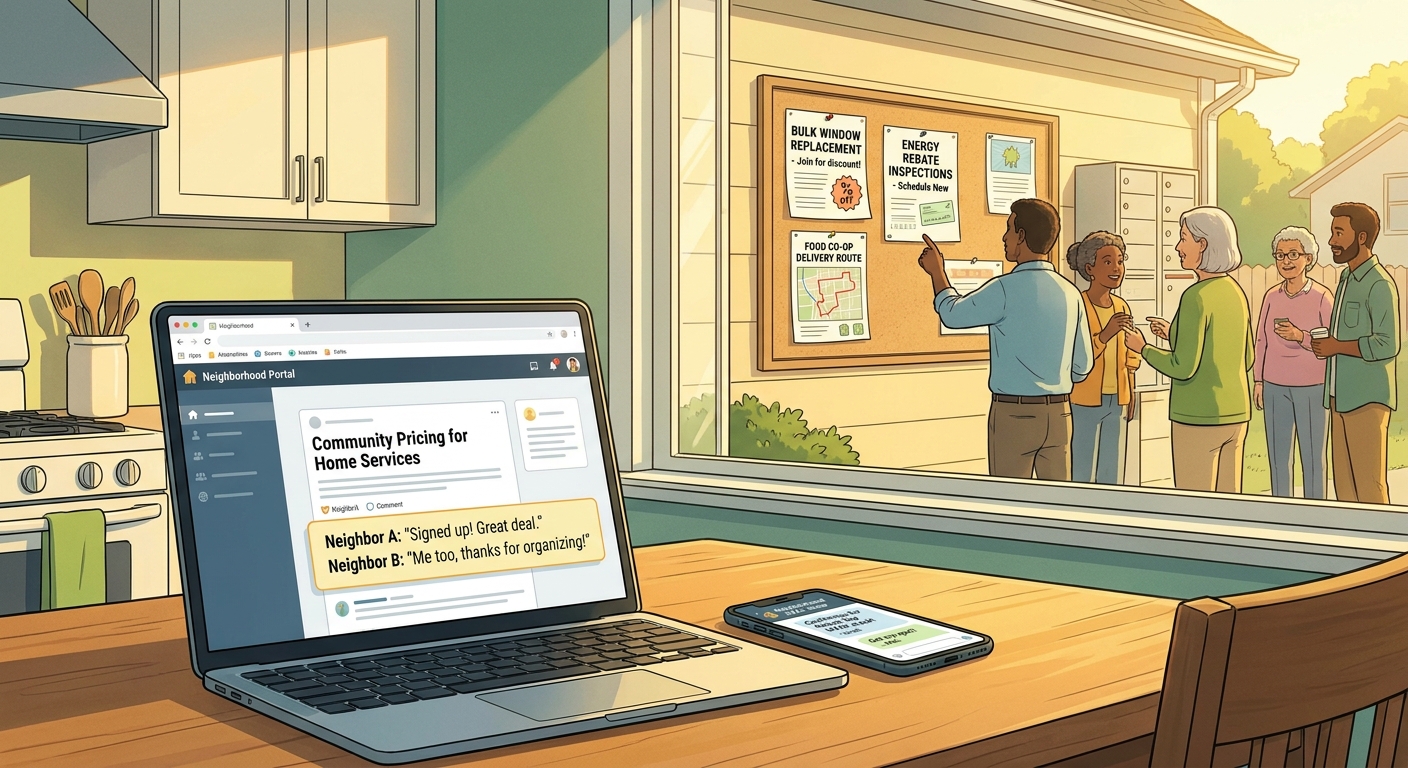
Most people ignore HOA emails and neighborhood posts for the same reason they ignore airline terms and conditions. It looks boring, vague, and not worth the effort. That is fair. The frustrating part is that those quiet little updates often hide the easiest answer to how to join neighborhood rebate groups. The clue usually is not a big sign-up button. It is a throwaway line about “preferred vendors,” “resident pricing,” “bulk service week,” or “approved contractor specials.” That is often your opening. If you know what to look for, those one-off notices can lead to invite-only savings groups for energy audits, HVAC tune-ups, internet deals, lawn care, solar consultations, grocery co-ops, and more. Better yet, once you spot the pattern, you can help turn a random discount into an ongoing rebate circle for your block or building. That means lower prices, less paperwork confusion, and actual group buying power instead of endless promo-code hunting.
⚡ In a Hurry? Key Takeaways
- Neighborhood rebate groups are often hidden inside HOA emails, resident portals, and community posts under labels like “community pricing” or “preferred rate for residents.”
- Ask one simple follow-up question: “Is this a one-time discount, or is there a resident group or coordinator I can join?” That is usually the fastest path in.
- Stick with transparent vendors, clear rebate terms, and group organizers who can explain pricing, deadlines, and privacy rules before you share your info.
Why these rebate groups stay hidden
Search engines are great at finding big public offers. They are terrible at finding neighborhood-only deals.
A lot of local rebates live inside HOA newsletters, Facebook groups, condo portals, Nextdoor threads, email chains, bulletin boards, and resident meeting notes. Some are handled by a board member. Some by a property manager. Some by that one neighbor who somehow knows every contractor in town.
So when people ask how to join neighborhood rebate groups, they often assume the answer is “Google it.” Usually, that is the wrong starting point.
The better starting point is to read neighborhood messages like they are hiding a coupon in plain sight. Because often, they are.
The code words that usually signal a real group offer
These offers rarely say, “Click here to join the rebate club.” They use softer language.
Watch for these phrases
If you see any of these, slow down and read the full post:
- Preferred vendors
- Community pricing
- Resident rate
- Bulk discount
- Seasonal signup window
- Group service day
- Neighborhood package
- Board-approved contractor
- Special pricing for residents
- Cluster scheduling
- Minimum homes required
Those phrases usually mean one of three things. There is already a group deal. A group deal almost exists but needs more households. Or there is a vendor relationship that can be turned into a rebate circle with a little coordination.
How to join neighborhood rebate groups without sounding pushy
You do not need to become the neighborhood sales captain. You just need to ask the right questions.
Start with one reply
When you see a post or email, send a short message:
“Hi, is this just a one-time resident discount, or is there a neighborhood group, coordinator, or mailing list for future rebates too?”
That one question does a lot of work. It tells you whether there is an actual group behind the offer. It also tells organizers that residents want something more ongoing.
Ask who manages the deal
You want to know where the thread leads. Ask:
- Who is the contact person?
- Is there a resident signup list?
- How many homes are already participating?
- Does the discount repeat each season or quarter?
- Is there paperwork for rebates or utility credits?
If nobody can answer those questions, the “deal” may just be a vendor ad with a neighborhood label on it.
Turn a one-off discount into a real rebate circle
This is where things get interesting.
Let’s say your HOA mentions discounted HVAC tune-ups for spring. Nice. But instead of treating it like a single coupon, you can help turn it into an ongoing neighborhood rebate group.
Step 1: Find out if the vendor will reward volume
Ask whether pricing improves at 10, 20, or 30 homes. Many vendors already think this way. They just do not advertise it publicly.
Step 2: Create a simple resident list
This can be a shared email thread, a Google Form, or a message list approved by the community manager. Keep it basic. Name, address, service interest, and best contact method.
Step 3: Track repeat categories
The best neighborhood rebate circles are built around services people need again and again:
- Lawn care
- Snow removal
- Pest control
- Window washing
- Driveway sealing
- HVAC maintenance
- Solar consultations
- Internet or utility switching help
- Grocery co-op ordering
If the same need keeps coming up, that is not a random discount. That is a group buying opportunity.
If you want a related example of how local platforms can turn into organized savings, read The ‘Local Loop Key’ Shortcut: Turn Neighborhood Service Apps Into Real Rebate Circles. It fits the same idea. The deal often starts with a practical local service, not a flashy rebate ad.
Best places to look before the offer disappears
Some of these deals have short signup windows. So check the places people usually skim.
Neighborhood sources worth checking
- HOA newsletters
- Condo resident portals
- Property management emails
- Meeting minutes
- Nextdoor neighborhood posts
- Community Facebook groups
- Clubhouse bulletin boards
- Pool or gym notice boards
- Email lists for block captains or committee leads
One useful habit is to search your inbox for words like “resident pricing,” “vendor,” “special rate,” “bulk,” “service day,” or “approved contractor.” You may already have the invite sitting there.
How to tell the difference between a real rebate group and a dressed-up ad
Not every neighborhood offer is worth joining.
Green flags
- Clear pricing or discount terms
- A named community contact
- A minimum participant number
- Repeat scheduling or seasonal rounds
- Shared instructions for rebate forms or utility claims
Red flags
- Vague promises with no actual numbers
- Pressure to sign immediately
- No explanation of who collected resident info
- No written terms for cancellations or follow-up service
- Claims that sound exclusive but cannot be verified
If the organizer cannot explain how the pricing works, pause. Group buying should reduce confusion, not add to it.
Use neighborhood trust to get better results
The biggest benefit is not just saving a few dollars. It is reducing risk.
When neighbors compare notes, bad vendors get exposed quickly. Good vendors earn repeat business. Rebate paperwork gets easier because somebody has already done it once and can say, “Here is the form. Here is the deadline. Here is what they asked for.”
That is a big deal, especially for utility rebates, appliance upgrades, insulation work, and home energy programs where the forms can be annoying.
Simple questions to ask the group
- Did the vendor honor the resident rate?
- How long did the rebate take?
- What documents were needed?
- Were there surprise fees?
- Would you use them again?
If your HOA is quiet, start small anyway
Some boards are active. Some are basically silent unless the mulch color changes. That does not mean you are stuck.
If there is no official rebate channel, start with three to five interested households. That is enough to test demand.
A simple starter plan
- Pick one category people already need.
- Ask two or three vendors for neighborhood pricing.
- Request written group terms.
- Share the best option with neighbors.
- Keep a list for future rounds.
You do not need a fancy platform at first. You need a clear offer, a trusted contact, and a way to keep the list alive after the first deal closes.
Good rebate categories to target first
Some categories are easier than others because vendors like clustered work and repeat customers.
- Energy audits
- Smart thermostat installation
- HVAC service
- Pest control plans
- Lawn and landscaping bundles
- Roof and gutter inspections
- Pressure washing
- Internet and wireless community plans
- Grocery co-op or produce box discounts
- Solar education sessions with resident incentives
These are easier to organize because they solve a common neighborhood need. That makes it easier to keep the group going after the first round.
At a Glance: Comparison
| Feature/Aspect | Details | Verdict |
|---|---|---|
| Where to find groups | HOA emails, resident portals, neighborhood apps, meeting notes, and community bulletin posts often mention resident-only pricing without a public signup page. | Best starting point for how to join neighborhood rebate groups. |
| Best way to get in | Reply and ask whether the deal is one-time or tied to a resident list, coordinator, or recurring program. | Simple, low-pressure, and usually effective. |
| Long-term value | Ongoing neighborhood circles help members compare vendors, share rebate steps, and negotiate better terms as a group. | Much stronger than chasing random promo codes alone. |
Conclusion
The quiet HOA post you almost deleted might be the front door to a real savings network. Right now, energy, utilities, home services, and even grocery co-ops are quietly organizing resident-wide rebates through neighborhood coordinators and HOA boards, but most of those groups never get indexed by search engines. Once you learn to spot phrases like “community pricing,” “preferred rate for residents,” or “group service days,” it gets much easier to find the real opportunities. Better still, you can help turn one-time discounts into recurring neighborhood rebate circles that save money again and again. That means faster access to collective buying power, better vendor accountability, and a stronger local network where people share trusted recommendations and rebate paperwork tips. That is the kind of strength-in-numbers setup Rebate Clubs is built to support, and it is often hiding in the neighborhood thread you almost scrolled past.