Blog

  • The ‘Screenshot-to-Invite Shortcut’: Turn Random Buying Group Receipts Into Community Rebate Clubs You Can Actually Join

    The ‘Screenshot-to-Invite Shortcut’: Turn Random Buying Group Receipts Into Community Rebate Clubs You Can Actually Join

    You are not imagining it. Trying to figure out how to find legit community rebate buying groups can feel weirdly shady. One minute you see a screenshot of a receipt with a payout note. The next minute someone wants you to join a private Discord, download an app you have never heard of, or send money to a stranger “to hold your spot.” That is where most normal people tap out. Fair enough.

    A safer shortcut is to start with the screenshots people already post. Not the polished promo graphics. The messy, everyday proof shots. A receipt, a rebate confirmation, a payout screenshot, a chat thread where several members confirm they got paid this week. Those little bits of proof can lead you to real, active rebate communities that already have trust built in. Instead of asking, “What group is promising the most?” ask, “What group has recent proof from regular people, clear rules, and low-risk entry?” That simple switch can save you time, money, and a lot of headaches.

    ⚡ In a Hurry? Key Takeaways

    • Start with user-posted screenshots of recent payouts and receipts, not flashy landing pages or vague promises.
    • Join groups that let you observe first, read pinned rules, and test one small rebate before doing anything bigger.
    • If a group hides proof, pressures you to pay upfront, or rushes you off-platform, skip it.

    The Screenshot-to-Invite Shortcut, in Plain English

    Here is the basic idea. When you spot a random receipt screenshot, order confirmation, or payout post in a Facebook group, Reddit thread, Discord server, or comment section, treat it like a breadcrumb.

    Do not focus only on the product. Focus on the community around the screenshot.

    Ask simple questions. Who posted it? Did other people reply with their own results? Is there a visible pattern of recent activity? Does the post mention a server, club, app, or organizer by name?

    If yes, you may have found something much more useful than a one-off deal. You may have found a working rebate circle with real members.

    Why This Works Better Than Searching Official Pages

    Official sites tell you what a group wants to be. Community proof shows you what it actually is.

    That matters because many new buying groups look polished. Nice logo. Clean sign-up page. Big earnings claims. But when you dig a little deeper, there is no visible member chatter, no recent proof of payouts, and no clear trail showing that normal people are actually using it.

    Receipts and payout screenshots posted by members are harder to fake at scale, especially when they show up over time from different people. One screenshot proves very little. Ten screenshots across two weeks, with comments, follow-ups, and timestamps, start to tell a real story.

    How to Find Legit Community Rebate Buying Groups Step by Step

    1. Start where people casually share wins

    Look in places where users brag a little. Small deal forums, Facebook comments, subreddit threads, Discord channels, and niche shopping groups are all fair game.

    You are looking for unpolished proof. Think “Got my rebate today” or “This one cleared in 48 hours,” not “Join now for massive passive income.”

    2. Zoom in on recent screenshots

    Recency matters. A screenshot from eight months ago is basically ancient history in rebate-land.

    Look for posts from the last few days or weeks. If a group paid people recently, that is a strong sign it is still functioning.

    3. Follow the invite trail carefully

    Sometimes the screenshot itself mentions the group name. Sometimes it is in the comments. Sometimes the poster says, “DM me for the invite.”

    That is your next step, but go slow. Ask for the group name and rules first. You do not need to hand over money or personal details just to look around.

    4. Lurk before you leap

    A good community will usually let you read, watch, and get a feel for how things work before asking you to do much.

    Read the pinned posts. Scan recent deal threads. Check whether moderators answer beginner questions without getting defensive.

    This is also where our guide on The ‘Pinned Proof Shortcut’: Turn Random Deal Servers Into Real Rebate Crews You Can Trust fits nicely. If screenshots get you in the door, pinned proof helps you decide whether to stay.

    5. Test with one tiny transaction

    Never start big. Pick the smallest, simplest offer you can.

    Maybe that means one low-cost item with a clear rebate path. Maybe it means a club with no upfront fee where you can try one order and wait for payout. Either way, your first goal is not profit. It is verification.

    What Good Rebate Communities Usually Have in Common

    Legit groups are rarely perfect, but they tend to share a few traits.

    Visible proof from multiple members

    You want to see more than one success story. Better still, you want a trail of them.

    Clear rules

    How do offers work? When do rebates pay? What gets you disqualified? If the rules are fuzzy, that is a problem.

    Moderators who answer normal questions

    If every basic question gets brushed off with “Just trust the process,” move on.

    Low-pressure onboarding

    Healthy groups do not need to trap you. They know people will stay if the deals are real.

    Recent activity

    An active group leaves fingerprints everywhere. New posts. New payout confirmations. New member questions. Ongoing chatter.

    Red Flags You Should Treat Like a Stop Sign

    Some warning signs are subtle. Others are basically neon.

    Upfront payment to a person, not a platform

    If someone wants Venmo, Cash App, or crypto before you can even see how the system works, be careful.

    No proof beyond testimonials

    Words are cheap. Screenshots can be faked too, but a total lack of proof is worse.

    Constant urgency

    If every message sounds like “Join in the next 10 minutes or lose out forever,” that is pressure, not community.

    Off-platform pressure

    If a group immediately pushes you into private messages and avoids public questions, that is a bad sign.

    Messy payout explanations

    If nobody can clearly explain when money arrives, where it comes from, or why members sometimes do not get paid, step back.

    What to Screenshot Yourself Before Joining

    This part is easy to overlook, but it helps a lot.

    Before you try any offer, take your own screenshots of the rules, payout terms, item requirements, and chat instructions. Save invite links too.

    If something changes later, you have a record. That protects you if there is confusion and helps you compare one group against another.

    Think of it as making your own paper trail, just with your phone.

    A Low-Risk Way to Compare Two or Three Groups

    If you are choosing between communities, keep it simple. Compare them on three things only.

    1. How much recent user proof can you see?
    2. How easy is it to understand the rules?
    3. Can you start small without sending money to a stranger?

    That is enough to weed out a lot of junk.

    You do not need a giant spreadsheet. You just need a calm head and a willingness to skip anything that feels rushed or murky.

    Why Small Communities Can Be Better Than Big Public Hype

    The biggest groups get attention first, but that is not always where the best opportunities live.

    Smaller rebate communities often have tighter moderation, more recognizable members, and a stronger culture of posting proof because trust matters more there. You can see who is helping, who is getting paid, and who has been around for a while.

    That kind of visible history is often more useful than a slick app store listing.

    At a Glance: Comparison

    Feature/Aspect Details Verdict
    Recent screenshot proof Multiple members show recent receipts, rebates, or payout confirmations in public channels. Strong positive sign
    Entry process You can read rules, observe chats, and test a small offer before making any bigger commitment. Safer and more beginner-friendly
    Pressure level Low-pressure groups explain clearly. Risky groups rush you, hide details, or ask for direct payment fast. High pressure is a warning sign

    Conclusion

    If you have been wondering how to find legit community rebate buying groups without stumbling into something sketchy, the easiest place to start is not a fancy homepage. It is the humble screenshot. Real receipts, real member chatter, and real recent payouts tell you far more than glossy promises do. In a market crowded with new buying groups, apps, and private servers all asking for your attention, this approach helps you spot the communities that already have trust and momentum. That keeps you safer from bad actors, gets you into working rebate circles faster, and helps you grow from a cautious deal lurker into someone who can recognize a solid rebate club before everyone else piles in.


  • The ‘Loyalty Stack Shortcut’: Turn Boring Store Rewards Apps Into Real Rebate Clubs You Can Join In One Weekend

    The ‘Loyalty Stack Shortcut’: Turn Boring Store Rewards Apps Into Real Rebate Clubs You Can Join In One Weekend

    You are not imagining it. Store rewards feel messy on purpose. One app has points. Another has a digital coupon that expires tonight. A third promises cashback, but only if you upload the receipt, wait a month, and remember which email you used. Most people end up with a junk drawer of half-used loyalty programs instead of anything that feels like real savings. The good news is that you do not need a finance degree or a formal buying club to fix this. If you have a few friends, neighbors, relatives, or coworkers who already shop at the same handful of stores, you can turn that pile of random rewards into a small, workable system in one weekend. That is the Loyalty Stack shortcut. It is simply a way to coordinate loyalty apps, weekly promos, and cashback offers as a tiny community rebate group, so the discounts stop being accidental and start showing up on purpose.

    ⚡ In a Hurry? Key Takeaways

    • A Loyalty Stack is a small group system where people coordinate store apps, coupons, and cashback offers to create more regular rebates.
    • Start with just 2 to 5 people, 3 stores, and one shared tracking sheet so the whole thing stays simple.
    • Do not share passwords or payment info. Coordinate offers, split purchases clearly, and keep screenshots of promos and receipts.

    What “how to stack loyalty apps into a community rebate group” really means

    It sounds more technical than it is.

    A Loyalty Stack is just your combined savings setup. Think of it as a small pile of discounts that work better together than alone. One person spots a buy-one-get-one grocery deal. Another has a store coupon in the app. Someone else has a cashback offer through a receipt app or a card-linked reward. Instead of each person using those bits at random, the group lines them up around the same weekly purchases.

    That is the whole idea behind how to stack loyalty apps into a community rebate group. You are not creating a corporation. You are not negotiating with stores. You are simply organizing what already exists.

    Why this works better than solo bargain hunting

    Most store rewards are too small to feel exciting on their own. Fifty cents here. Three dollars there. A free item after five visits. Alone, that is easy to ignore.

    In a group, those tiny pieces start to matter. One household may never buy enough to trigger a bonus. Three households might. One person may miss a one-day coupon. Another catches it and shares it. One member may prefer drugstores. Another knows every grocery app trick in town. You stop depending on one person to do everything.

    That is why this feels more like a rebate club than a coupon hobby. You are building a repeatable flow, not chasing a one-time score.

    What a basic Loyalty Stack looks like

    Keep it boring. Boring is good. Boring means people will actually keep doing it.

    Start with just three layers

    Layer 1 is the store loyalty app. Think grocery chains, warehouse clubs, pharmacies, office supply stores, or home improvement chains.

    Layer 2 is the store’s own weekly promos. Digital coupons, points multipliers, member pricing, free pickup offers, and category bonuses all count.

    Layer 3 is the outside rebate layer. That could be cashback apps, receipt rewards, browser cashback tied to online orders, or card-linked deals from a bank or payment app.

    If your group can coordinate those three layers, you already have a real system.

    Keep the store list short

    Pick three stores max for your first month. For example:

    1. One grocery store
    2. One pharmacy or big-box store
    3. One household goods or hardware store

    If you try to include every place everyone shops, the whole thing falls apart by Tuesday.

    How to set this up in one weekend

    Saturday morning: Pick your group

    Choose 2 to 5 people who already trust each other. Family works. Neighbors work. Coworkers can work if you keep money handling clean and simple.

    This is not the time to build a giant online community. Start with people who answer texts.

    Saturday afternoon: Inventory the apps you already use

    Make a quick list in a shared note or spreadsheet:

    • Store name
    • Which group members already have the app
    • What type of rewards it offers
    • Whether it allows digital coupons, points, or member pricing
    • Whether receipts can also be used for cashback elsewhere

    You will probably notice overlap fast. That overlap is your starting point.

    Saturday evening: Assign “watchers”

    Each store needs one person who checks it once or twice a week. Not all day. Not obsessively. Just enough to catch useful deals.

    For example:

    • Person A watches the main grocery app
    • Person B watches the pharmacy and big-box app
    • Person C checks cashback and receipt offers

    This is where many half-finished savings schemes fail. Everyone assumes someone else is checking.

    Sunday: Build one simple buying plan

    Pick 5 to 10 items your group buys often. Paper towels. Laundry detergent. Pasta. Yogurt. Cat litter. Cleaning products. Snacks for kids. Printer paper. Whatever is normal for your group.

    Then ask one question: where do these items hit the best combo of app reward, promo, and rebate this week?

    You are not trying to optimize every penny. You are trying to create a weekly habit.

    The easiest way to split purchases without making it weird

    This is where people get nervous, and fairly so.

    The safest way is to avoid pooling large amounts of money at first. Let one person buy one category when the deal is strong, then reimburse that exact amount through the payment method your group already trusts.

    Good examples:

    • One person buys the detergent bundle because they have the best coupon stack
    • Another person buys the cereal and snack items because their store app has the better member pricing
    • Another claims the qualifying receipt rebate and notes it in the shared sheet

    Keep screenshots. Keep the math visible. Round only if everyone agrees.

    What not to do

    • Do not share account passwords
    • Do not hand out full card numbers
    • Do not create fake households or duplicate accounts that break store terms
    • Do not assume every app lets multiple people use one profile

    The point is coordination, not gaming the system.

    How the rebate flow becomes “real”

    The turning point is when your group stops focusing only on instant discounts at checkout.

    Real rebate flow comes from tracking the full cycle:

    • Member price at purchase
    • Digital coupon at checkout
    • Points earned for a future trip
    • Cashback pending from a receipt app or card-linked offer
    • Bonus thresholds hit because the group bought in a more organized way

    That means a $40 household run might produce:

    • $6 off through the store app
    • $4 in points for next time
    • $3 from a cashback receipt app
    • $2 from a card-linked offer

    Now it stops looking like random savings and starts looking like a pattern.

    A sample mini Loyalty Stack for a neighborhood group

    Say three households regularly buy groceries and basics.

    They choose one supermarket, one pharmacy, and one warehouse club.

    • The supermarket app offers digital coupons on pantry items and points on gas
    • The pharmacy app offers weekly personal care coupons and bonus store cash
    • The warehouse club app offers member pricing on bulk paper goods
    • A cashback app covers select snack items, cleaning products, and baby supplies

    Each week, one person posts the best overlap. Not every deal. Just the useful overlap.

    By the end of the month, each household has spent on things they were already going to buy, but the combined planning creates a better result. More points get used. Fewer coupons expire unused. Cashback submissions happen on time. The group learns which stores are worth attention and which ones are just noise.

    Why this is a low-risk rehearsal for bigger buying groups

    A lot of people hear about collective buying power, formal purchasing groups, and community discount programs and assume they need special access. Usually they do not know where to begin, so they do nothing.

    A Loyalty Stack is the beginner version. It teaches the same habits on a smaller scale.

    • Tracking offers
    • Comparing channels
    • Timing purchases
    • Assigning roles
    • Splitting benefits fairly
    • Keeping records

    Those are the exact habits that make larger rebate communities work later.

    If your group wants an in-person version of this kind of organizing, the piece The ‘Library Laptop Shortcut’: Turn Quiet Computer Labs Into Real Rebate Clubs You Can Join In Person is a smart next read. It shows how people can use familiar public spaces to compare deals and build a real routine without needing a giant online group.

    Common mistakes that kill a Loyalty Stack fast

    Trying to save on everything

    Do not do a full life overhaul. Start with repeat purchases. The toothpaste and cereal crowd beats the “let’s optimize all spending” crowd every time.

    No one owns the routine

    If there is no weekly checker, no one notices expiring promos. You need at least one person nudging the system along.

    Making the rules fuzzy

    Decide early how points, rebates, and bonuses are handled. If one person pays, do they keep the future points? Does the group subtract expected cashback from reimbursements later or only after it clears? Write it down.

    Ignoring store policies

    Some stores are generous. Some are strict. Stay inside the rules. It keeps the system sustainable.

    A simple template you can copy

    Use a note, spreadsheet, or family group chat with this format:

    • Store watched this week
    • Top 3 stackable deals
    • Who is buying
    • Total paid
    • Instant discount used
    • Points earned
    • Cashback pending
    • Who gets what

    That is enough. You do not need software. You need consistency.

    At a Glance: Comparison

    Feature/Aspect Details Verdict
    Setup difficulty Needs only a small trusted group, a few store apps, and one shared tracking method. Easy enough to start in one weekend.
    Savings potential Best on repeat household items where member pricing, coupons, and cashback can overlap. Stronger than solo app use, especially over a month.
    Risk and complexity Problems usually come from unclear money splitting, shared logins, or chasing too many stores at once. Low risk if you keep accounts separate and rules simple.

    Conclusion

    Right now, plenty of people are talking about buying groups, pooled demand, and formal rebate systems, but regular shoppers are often left staring at giant utility programs and government-style portals that feel too slow or too technical to touch. A Loyalty Stack is the practical version you can actually start this week. No negotiations. No special access. Just a few people, the apps you already have, and a shared plan for using them better. When you coordinate store rewards and promos as a micro-community, those scattered points and tiny coupons start turning into a more predictable rebate flow. Just as important, you get a low-risk practice run for bigger community-based rebate groups later. Start small, keep it tidy, and let the routine do the work.

  • The ‘Trash Day Group Buy’ Shortcut: Turn Boring Utility Bills Into Real Rebate Clubs You Can Join On Your Block

    The ‘Trash Day Group Buy’ Shortcut: Turn Boring Utility Bills Into Real Rebate Clubs You Can Join On Your Block

    Your trash bill goes up. Your internet promo ends. Lawn care quietly costs more than it did last spring. Meanwhile, two houses over, someone is paying less for the exact same service. That is the part that really gets under your skin. The good news is this is not magic, and it is not reserved for HOAs or coupon super-users. Vendors for recurring services love tight neighborhoods because clustered customers are cheaper to serve and less likely to cancel. That gives regular neighbors real bargaining power. If you have ever wondered how to start a neighborhood group buying rebate club for trash and utilities, the simplest answer is this: gather a small group, compare real prices without oversharing personal info, then ask providers to bid on the whole block instead of one home at a time. It sounds formal. It is actually very doable, and you can start with a five-minute walk on trash day.

    ⚡ In a Hurry? Key Takeaways

    • You can start a neighborhood rebate club for trash, internet, lawn care, and similar bills with just 8 to 20 interested homes and a simple price survey.
    • Use a privacy-safe signup sheet, collect current rates and contract dates, then ask 3 to 5 local providers for group pricing based on your street or subdivision.
    • Do not collect account passwords, full bills, or banking details. Keep it simple, neighborly, and focused on rates, service terms, and rebate options.

    Why this works better than calling for a “loyalty discount”

    One customer asking for a break is easy to brush off. Fifteen homes on the same route are not.

    That is the basic idea. Trash companies, internet resellers, pest control outfits, and lawn crews make more money when jobs are packed close together. Less driving. Fewer missed appointments. Lower marketing costs. Lower churn.

    In plain English, your block is worth more as a bundle than as scattered one-off customers.

    That is why neighborhood and subdivision based group buying for recurring services is growing so fast right now. The discount can land in the 15 to 35 percent range, and sometimes the better deal is not even the monthly rate. It can be a sign-up rebate, free upgrades, no fuel surcharge, locked pricing for 12 months, or better service terms.

    What a neighborhood rebate club actually is

    Do not picture meetings, bylaws, or somebody printing name tags.

    A rebate club can be very simple. It is just a loose group of neighbors who agree to compare prices, ask vendors for block-level pricing, and join the best offer if it makes sense.

    You do not need any of these to get started

    You do not need HOA authority. You do not need nonprofit status. You do not need a giant app. You do not even need everybody to switch.

    You just need enough interested homes that a provider sees an efficient route and steady business.

    The best services to start with

    Start with the bills where route density matters most:

    • Trash and recycling
    • Lawn mowing
    • Pest control
    • Snow removal
    • Pool service
    • Internet, especially if multiple resellers serve your area

    Trash is often the easiest first win because everyone can literally see who uses which company.

    The “trash day” shortcut

    This is the low-drama, weekend-friendly way to begin.

    Step 1: Take a five-minute walk on pickup day

    Walk your street or a few nearby streets when bins are out. You are not snooping. You are just noting which providers already serve the area and how dense each route looks.

    Write down:

    • Company names on bins or trucks
    • How many homes appear to use each company
    • Whether some homes still use city service or private service

    This tells you who is already nearby and who might sharpen a pencil to win more homes on the same route.

    Step 2: Do a privacy-safe price check

    Now ask a few neighbors a very specific, low-pressure question:

    “A few of us are comparing trash and utility rates on the street. Would you be open to sharing your monthly price, contract end date if there is one, and whether you would switch for a better block rate?”

    That is it. No full bill copy required. No account number. No payment info.

    People are far more willing to answer when the ask is small and the privacy line is clear.

    Step 3: Use a simple interest list

    You can do this on paper, in a basic Google Form, or in a neighborhood Facebook group post if your block actually uses one. Keep the form short:

    • Name
    • Street only, or house number optional
    • Best contact method
    • Current provider
    • Current monthly or quarterly price
    • Contract end date, if known
    • Interested in a group deal? Yes, maybe, no

    If you are collecting online, make it clear that you are not creating a public spreadsheet. You are simply counting interest and comparing rates.

    How many homes do you need?

    Less than most people think.

    For trash or lawn care, 8 to 12 homes on one street can be enough to get a serious quote. For internet, it depends on who serves your address and whether installation work is needed, but 15 to 30 homes can still get attention, especially in a newer subdivision or a dense older neighborhood.

    More matters, of course. But the key is concentration, not just raw numbers.

    How to run a mini request for proposals without sounding like a city government

    “Request for proposals” sounds fancy. Here it just means sending the same short note to several providers so you can compare apples to apples.

    What to include in your message

    Keep it brief and practical:

    • Your neighborhood or street name
    • Rough number of interested homes
    • Service you want quoted
    • Any must-haves, like weekly pickup or no contract
    • Deadline for quotes
    • Ask for pricing, fees, term length, and any group rebate

    Here is a sample:

    “Hi, I am coordinating interest from about 14 homes on Oak Ridge Lane for weekly trash and recycling service. We are comparing providers for a possible neighborhood group rate. Please send your best pricing for 10, 15, and 20 homes, including cart fees, fuel/environmental fees, contract length, cancellation terms, and any sign-up rebates or referral credits. Thanks.”

    Send it to 3 to 5 providers

    That is enough to create competition without turning it into a part-time job.

    Try a mix of bigger names and smaller local companies. The local provider is often the one most willing to make a creative offer if your route is attractive.

    What to compare besides the sticker price

    This is where people get tripped up. A lower monthly number is nice, but it is not the whole story.

    Look closely at these items

    • Setup fees
    • Cart rental fees
    • Fuel or environmental surcharges
    • Price lock period
    • Auto-renew terms
    • Missed pickup policy
    • Cancellation fee
    • Rebate or referral credit structure

    For internet, also compare upload speeds, equipment fees, promo expiration dates, and whether the quoted rate requires autopay or paperless billing.

    How rebates can work on a block

    There are a few common setups.

    Option 1: Lower rate for every home

    This is the cleanest and often the best. Everybody simply pays less each month.

    Option 2: Sign-up bonus or bill credit

    The provider offers a one-time credit if a certain number of homes join.

    Option 3: Coordinator credit shared with the group

    Sometimes a company offers the organizer a referral bonus. If you want to keep trust high, be transparent and suggest one of three approaches:

    • Split it among all participating homes as a rebate
    • Use it for a neighborhood need, like block event supplies
    • Keep it only if everyone is told up front and agrees

    If you hide side incentives, the club will fall apart fast.

    Privacy and trust rules that keep this from getting weird

    This part matters.

    Do collect

    • General prices
    • Provider names
    • Contract end dates
    • Interest level

    Do not collect

    • Full account numbers
    • Photos of complete bills unless necessary
    • Social Security numbers
    • Payment card details
    • Passwords or login info

    Also, do not post everybody’s rates publicly with names attached. Share results in summary form. For example: “Current trash pricing on our street ranges from $23 to $41 a month.” That gives the group useful information without putting anyone on display.

    A simple weekend plan you can actually follow

    Friday

    Pick the service. Trash is usually easiest. Draft a short neighbor message.

    Saturday

    Talk to 5 to 10 neighbors or drop a note at doors. Create the interest list.

    Trash day

    Walk the block. Count existing providers and route density.

    Monday

    Email 3 to 5 providers with the same quote request.

    Wednesday

    Put the quotes into one simple comparison sheet.

    Thursday

    Share the top two offers with neighbors and ask who is ready to join.

    That is the whole play. It is much smaller and more realistic than people expect.

    What if not everyone wants to participate?

    That is normal. You do not need unanimous support.

    Some neighbors are under contract. Some hate change. Some are too busy. Fine.

    Build around the willing middle. If 10 homes join and save money, the holdouts often come around at the next renewal cycle.

    Common mistakes that sink these deals

    Starting too big

    Do not launch with the whole subdivision unless you already have a strong communication channel. One street or one cluster of homes is easier.

    Being vague with providers

    If you say, “We have lots of people interested,” you will get mushy quotes. Give a realistic number range.

    Ignoring contract dates

    A great group rate does not help much if most people are locked in for 10 more months. Track timing.

    Picking only the cheapest offer

    Reliable recurring service is worth something. The lowest price with lousy support can become a neighborhood headache.

    Acting like an unofficial billing middleman

    Do not collect money on behalf of the group. Each home should still contract and pay the provider directly.

    How this can grow beyond trash

    Once neighbors see one real win, the club becomes easier to reuse.

    Maybe the next target is lawn care. Then pest control. Then internet. The hardest part is not the spreadsheet. It is proving that a handful of neighbors can act together without drama.

    After that, you have a repeatable model. A standing rebate club. Not a formal institution. Just a practical habit.

    At a Glance: Comparison

    Feature/Aspect Details Verdict
    Best first service to group-buy Trash and recycling are easy to survey because providers are visible and route density matters a lot. Best place to start for most neighborhoods
    Minimum group size Often 8 to 12 homes for route-based services, more for internet depending on local options. Smaller than most people assume
    Privacy and admin burden Keep data to rates, provider names, and contract dates. Do not handle payments or collect sensitive account details. Very manageable if you keep the process simple

    Conclusion

    You do not have to sit there and accept rising household bills like the weather. Neighborhood and subdivision based group buying for recurring services like trash, internet and lawn care is exploding right now because vendors want dense, low-churn routes, and many will trade that for 15 to 35 percent off plus rebates. The big surprise is how ordinary this can be. No nonprofit. No HOA title. No giant app. Just a five-minute walk on trash day, a privacy-safe price survey, a small interest list, and a simple quote request to local providers. That gives you a practical play you can run this weekend. If it works, you cut real monthly costs, keep more money with good local providers, and turn a bunch of isolated bill-payers into a standing rebate club that can negotiate future services together. That is the part worth remembering. Your block has more buying power than any one household does alone.

  • The ‘Comment Trail Shortcut’: Turn Throwaway Deal Replies Into Real Rebate Groups You Can Join Quietly

    The ‘Comment Trail Shortcut’: Turn Throwaway Deal Replies Into Real Rebate Groups You Can Join Quietly

    You are not imagining it. The comments under hot deal posts can feel like a junk drawer. Half the replies look useless. “Worked for me.” “Dead now.” “Check PM.” Easy to skip. But that messy little comment trail is often where the real rebate groups quietly sort people out. If you are wondering how to find real rebate groups in facebook comments, this is one of the safest places to start. Not by posting “invite me” everywhere, but by watching who consistently leaves useful updates, rebate screenshots, product limits, and checkout fixes. Those are usually the people tied into smaller, tighter circles. The big public groups are loud. The comment section under a strong deal post is where the serious shoppers test each other in plain sight. If you learn to read that trail, you can stop hopping between random servers and start finding smaller groups that actually know what is still working right now.

    ⚡ In a Hurry? Key Takeaways

    • Real rebate groups often recruit quietly through high-signal comments under strong deal posts, not through big public invites.
    • Track the same helpful commenters across several threads, then start with low-pressure interaction before asking to join anything.
    • Avoid groups that push urgency, hide proof, or ask for money, gift cards, or account access up front.

    Why the comments matter more than the main post

    The main post gets attention. The comments reveal the real operators.

    Anyone can repost a coupon. Fewer people can explain whether it stacks with a store rebate, whether the checkout limit changed, or whether the offer only works in certain regions. Those details usually show up in the replies, often from the same small cluster of people.

    That is your clue.

    The best rebate groups are not always trying to look big. They are trying to stay useful. That means they pay attention to who contributes smart, calm, consistent information. A comment thread becomes a soft filter. The loud people burn out. The solid people keep posting proof.

    How to find real rebate groups in Facebook comments

    1. Start with the best deal posts, not random ones

    Look for posts with a lot of genuine engagement around a deal that requires some coordination. Think rebate stacks, quantity limits, store-specific markdowns, or checkout timing.

    These are better than generic “50% off” posts because real shoppers have something to add. You want threads where people are comparing receipts, timing, and results.

    2. Ignore the first wave of noise

    The earliest comments are often the least useful. You will see tag spam, reaction bait, and people asking questions already answered in the post.

    Scroll deeper.

    The good stuff often starts a little lower down, once actual buyers begin reporting back.

    3. Look for high-signal comments

    These are the replies that tell you someone is plugged into a real working circle. Examples include:

    • “This still works if you switch to store pickup.”
    • “Limit dropped from 5 to 2 in my cart at 11:20.”
    • “Rebate tracked after the second refresh.”
    • “Do not use the public code. The in-app one stacks better.”
    • “Check the comments in the sister group. They found a better SKU.”

    That is not throwaway chatter. That is live field data.

    4. Watch for repeat names

    This is the real shortcut.

    If the same people show up under multiple strong posts, leaving useful updates without sounding frantic or salesy, pay attention. Tight rebate crews often move quietly through comment sections before they ever share a private invite.

    You are not just looking for one smart comment. You are looking for a pattern.

    5. Check their profile behavior carefully

    Before you message anyone, do a quick sanity check.

    • Do they look like a real person?
    • Do they comment on several deal topics, not just one miracle offer?
    • Do they post proof, screenshots, or follow-up results?
    • Do other experienced commenters reply to them like they know them?

    If yes, that is much better than joining a giant chat from a random invite link.

    What “quiet recruiting” usually looks like

    It rarely looks like a formal invitation.

    More often, it starts small. Someone replies with a helpful detail. Another person answers back. A few familiar names keep comparing notes. Then one of them says something like “check your messages” or “we posted the update in the smaller group.”

    That is the handoff.

    Good groups do this because they do not want 5,000 people rushing in, killing the deal, and turning the chat into a mess.

    If you want a good example of why smaller, proof-driven spaces matter, read The ‘Pinned Proof Shortcut’: Turn Random Deal Servers Into Real Rebate Crews You Can Trust. It pairs well with this method because once you spot a smaller group through comments, you still need a fast way to judge whether it is worth your time.

    How to join without looking spammy

    Be useful before you ask for anything

    This matters more than people think.

    Do not jump in with “invite me” on your first comment. That is the fastest way to get ignored. Instead, contribute something small and real. Maybe you confirm that a code worked on mobile but not desktop. Maybe you share that your rebate tracked after a delay.

    That tells people you are there to help, not just grab.

    Send a normal message

    If you decide to reach out, keep it simple.

    Something like: “Hey, I have seen your updates on a few rebate threads. They have been really helpful. If you know of a smaller group that focuses on verified deals, I would appreciate a pointer.”

    No pressure. No begging. No giant backstory.

    Be patient

    Smaller groups are often careful for a reason. They may not answer right away. They may watch how you behave in public threads first. That is a good sign, not a bad one.

    Red flags in comment-thread recruiting

    Not every quiet invite is a good one.

    Watch out for these:

    • Anyone asking for payment just to access “secret deals”
    • People who never show proof, only hype
    • Urgent messages pushing you to act before you can verify anything
    • Requests for account logins, gift cards, or unusual personal details
    • Groups built around one person who always has a “special source” but no receipts

    A healthy rebate crew shares evidence. It does not demand blind trust.

    What the best micro-communities usually share

    Once you get into a solid smaller group, the difference is obvious.

    You tend to see:

    • Live checkout reports
    • Rebate tracking updates
    • Item substitutions that still qualify
    • Store-by-store success reports
    • Warnings when a code dies or a limit changes
    • Fewer reposts and less fake urgency

    That is where the time savings come from. You spend less energy chasing old codes and more time on deals that are actually alive.

    A simple routine you can use this week

    If you want a practical system, try this:

    1. Pick 3 active Facebook deal posts with real rebate potential.
    2. Read past the top comments and screenshot the most useful replies.
    3. Write down the names of 5 to 10 commenters who consistently add proof or updates.
    4. Check whether those same people appear in other deal threads.
    5. Interact lightly and helpfully where you have something real to add.
    6. Only after that, send one or two polite messages to the most credible people.

    This is slower than smashing every invite link you see. It is also much cleaner, and usually much safer.

    At a Glance: Comparison

    Feature/Aspect Details Verdict
    Public deal groups Fast-moving, easy to join, but often full of spam, repeated posts, dead codes, and bait comments. Good for spotting deals early, poor for trust.
    Comment trail method Focuses on repeat helpful commenters who share proof, fixes, and live results under strong posts. Best path for finding real rebate groups quietly.
    Random private invites Can look exclusive, but often lack proof and may push hype or risky requests. Use caution. Verify before joining.

    Conclusion

    If the big deal spaces are wearing you out, that is not a sign you are bad at this. It just means the loudest places are not always the most useful. Right now community shoppers are overwhelmed by noisy Facebook, Telegram and Reddit deal spaces where half the posts are spam or bait. Focusing on the tiny group of people who keep leaving high-signal comments under the best deals lets Rebate Clubs readers skip the chaos and go straight to the micro-communities that actually coordinate bulk buys, stack rebates and share live checkout data. That means faster access to working offers, less time wasted on dead codes, and a much safer path into real rebate groups than joining every random deal server you see. Start with the comments. That is often where the real door is hiding.

  • The ‘Pinned Proof Shortcut’: Turn Random Deal Servers Into Real Rebate Crews You Can Trust

    The ‘Pinned Proof Shortcut’: Turn Random Deal Servers Into Real Rebate Crews You Can Trust

    You are not wrong to feel a little buried right now. One minute you are looking for a coupon or rebate tip, and the next you are staring at five Discord invites, three Telegram channels, a “glitch deal” post, and a stranger telling you to hurry before the offer disappears. That is exhausting. It is also how people get pulled into fake deal groups that look busy but never seem to help anyone get paid. If you want to know how to find legit rebate groups on Discord and Telegram, start with one simple idea. Do not trust the hype. Trust the proof that stays visible after the excitement fades. Good groups leave clues. Bad ones leave noise. The fastest way to sort them is what I call the pinned proof shortcut. It is a quick scan of the group’s pinned messages, member behavior, and outside connections to see whether you are joining a real rebate crew or just another promo funnel.

    ⚡ In a Hurry? Key Takeaways

    • Legit rebate groups usually show old, consistent proof of payouts, real member chat, and clear admin history.
    • Check pinned posts, joined dates, reactions, and links to sister communities before you follow any deal or hand over personal info.
    • If a server is all urgency, no conversation, and no visible payment proof, treat it like promo spam and move on.

    The problem with deal servers right now

    There has been a fresh wave of Telegram and Discord money-saving communities pushing cash back promos, airdrops, and “loot offers.” At the same time, Facebook has been quietly retiring older community chat features, so more shoppers are drifting into chat-based spaces.

    That sounds fine until you see what came with it. Fake members. Paid shoutouts. Copy-paste “success stories.” Bots that make a dead room look alive. Groups that mainly exist to push affiliate links, collect data, or build hype around deals that never really worked for regular people.

    The result is simple. People waste time. Sometimes money. And often a lot of patience.

    What the pinned proof shortcut actually means

    The shortcut is not fancy. You join a group, then resist the urge to chase the newest post. Instead, tap or click the pinned messages first.

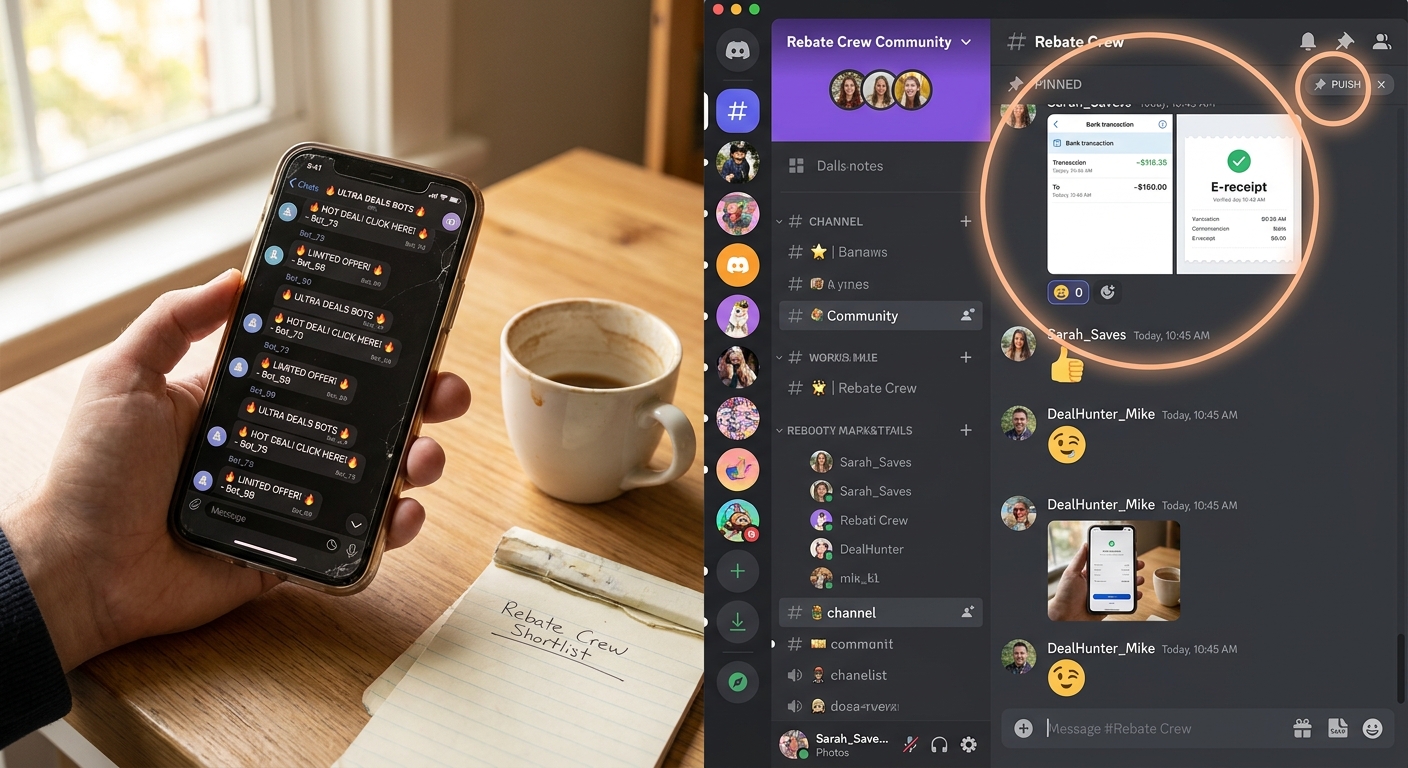
    Pinned posts are the closest thing a community has to a public record. A legit rebate group tends to pin things that help members: payment proof, rules, how-to guides, retailer limits, screenshots of completed cash back, and updates when deals die.

    A bad group often pins hype. “Massive drop now.” “Act fast.” “Limited spots.” “DM admin.” That is marketing, not community building.

    What good pinned proof looks like

    Look for screenshots that have context. A solid proof post does not just show a random payment image. It usually shows the store name, order timing, rebate platform, expected payout window, and follow-up comments from other members confirming the same result.

    Even better, the proof is spread across time. A channel full of payout screenshots from one afternoon is not nearly as useful as a month of normal-looking member wins.

    What fake pinned proof looks like

    Be careful if every proof image looks cropped the same way, has no timestamps, or shows big earnings with zero explanation. Also be skeptical if all the replies are one-word reactions like “wow,” “paid,” or fire emojis from accounts that never say anything else.

    Check joined dates and posting history

    This is one of the easiest tells, and people skip it all the time.

    On Discord, look at when members joined, especially mods and frequent posters. On Telegram, scan message history and see how far back the chat really goes. A “huge” community that appears to have come alive three days ago is not automatically fake, but it has not earned your trust yet either.

    Healthy groups usually have a pattern. Some older members. Some recent arrivals. Conversations that rise and fall during the day. Questions from beginners. Corrections from regulars. Maybe even complaints when a deal fails.

    That last part matters. Real communities are not spotless. They have mixed results because shopping deals are messy in real life.

    Green flags in the timeline

    Look for these signs:

    • Members discussing deals from weeks or months ago
    • Admins posting updates when a retailer changes terms
    • Old pins that still match current advice
    • Regular members answering questions, not just admins

    Red flags in the timeline

    • Long silent gaps, then sudden bursts of deal spam
    • Most members joining in a tight cluster
    • Only admins posting links
    • Deleted message trails or missing context around “proof”

    Watch the reactions, not just the member count

    Big numbers fool people. A Telegram channel can show thousands of subscribers and still be useless. A Discord server can list a crowd and feel like an empty mall.

    Reactions tell a better story than raw size.

    In a real rebate group, member response changes depending on the deal. A grocery rebate may get practical questions. A tech item might draw caution about returns, tax, or stock. A dead group, or a botted one, often shows the same flat pattern on everything. The same handful of emoji. The same “thanks” comments. The same instant praise no matter what was posted.

    How to spot human behavior

    Humans ask annoying but useful questions. “Did this track?” “Which card worked?” “Can I do it twice?” “Is this dead on Android?” “Anyone in Texas try this?”

    Those little questions are gold. They show a group is being used by real shoppers with real friction.

    If you see only polished promo posts and no messy follow-up, slow down.

    Cross-linked communities are a strong trust signal

    One of the best clues is whether a group is connected to other real spaces. Good rebate communities often overlap with hobby groups, deal forums, cashback circles, or regional shopping chats. They do not live in total isolation.

    If a server mentions a Telegram group, a private Facebook backup, a subreddit, or a second Discord used for receipts and proof, that can be a good sign. It means the community exists beyond one funnel.

    This is where a softer entry can help. If you are still getting your bearings, The ‘DM Warm‑Up Shortcut’: Turn Quiet Hobby Groups Into Real Rebate Circles You Can Join Fast is a smart companion read. It is especially useful if the big public groups feel too chaotic and you want a more human way in.

    Cross-links that help

    • Shared moderators with visible identities across groups
    • Members referencing older communities by name
    • Backup invite links that have been around a while
    • Outside proof, like screenshots reposted and discussed elsewhere

    Cross-links that should make you nervous

    • A web of clone groups with nearly identical names
    • Admins who keep changing channels after complaints
    • Invites that lead to “VIP access” upsells
    • Communities that exist only to send you into DMs

    Your five-minute checklist before trusting any deal group

    1. Open the pinned posts first

    If the pins are all urgency and no substance, leave.

    2. Scroll backward at least a week

    A real group can survive being viewed in reverse. A fake one often falls apart fast.

    3. Check whether members talk to each other

    Not just to the admin. To each other.

    4. Look for proof with detail

    Payment screenshots, deal explanations, and updates when terms change all matter.

    5. Never rush into DMs or forms

    If the group quickly pushes you to message someone privately, fill out a mystery form, or connect a wallet before you understand the process, back away.

    What to do when a group passes the test

    Even if a group looks legit, start small. Follow one low-risk offer first. Watch how the community handles tracking problems. See if anyone reports actual payouts. Ask a question and notice whether the answer is patient, specific, and consistent with the pinned guidance.

    That is how trust gets built. Not from one flashy screenshot, but from repeatable results.

    At a Glance: Comparison

    Feature/Aspect Details Verdict
    Pinned proof quality Detailed payout screenshots, retailer context, old and new member confirmations, updates when deals die Strong sign of a legit rebate group
    Member activity pattern Mixed questions, normal delays, practical comments, different reactions depending on the offer Looks human and worth testing carefully
    Promo pressure and DM pushing Constant urgency, clone proof posts, little public discussion, quick moves to private chat or outside forms High risk, best avoided

    Conclusion

    The good news is you do not need to become a detective to avoid the worst rebate traps. You just need a simple habit. Check the pins. Check the dates. Check the reactions. Check whether the group has real ties to other communities. In the last day alone, more Telegram and Discord money-saving groups have been pushing cash back promos, airdrops, and loot offers while Facebook keeps stepping back from older community chat tools. That shift is sending more shoppers into chat spaces where scams, fake members, and paid shoutouts are growing fast. A quick human checklist helps you skip the loudest junk and find the smaller number of groups that actually pay. When you use the pinned proof shortcut, your buying power has a much better chance of turning into cash back instead of noise.

  • The ‘Mutual Aid Shortcut’: Turn Quiet Help Groups Into Real Rebate Circles You Can Join Today

    The ‘Mutual Aid Shortcut’: Turn Quiet Help Groups Into Real Rebate Circles You Can Join Today

    You are not imagining it. A lot of mutual aid spaces feel warm, generous, and useful, right up until you try to answer one simple question. How do I actually save money here on something I need every month? People post food pantries, emergency asks, free furniture, and rides to appointments. That help matters. But if you are trying to figure out how to join mutual aid groups for rebate and group buying, the path is rarely spelled out. That is the gap. The good news is you usually do not need to build a new club from scratch. The smartest move is to find a group that already trusts each other, then turn one repeat expense, like power bills, internet, cleaning, lawn care, diapers, or groceries, into a small standing rebate circle. Once you know what to look for, those “quiet help” groups can become real buying groups with shared discounts, cash back, and less financial stress.

    ⚡ In a Hurry? Key Takeaways

    • The easiest way to join mutual aid groups for rebate and group buying is to start inside an existing trusted community, then focus on one shared recurring expense.
    • Ask for a simple pilot first, such as 5 to 15 households pooling quotes for groceries, utility upgrades, or home services for 30 days.
    • Keep it safe by using transparent rules, public savings screenshots, no upfront cash to one person, and vendors that bill each household directly when possible.

    Why mutual aid groups are perfect for group buying, even if they do not call it that

    Most people hear “group buying” and picture coupon sites from years ago or giant warehouse stores. But the real engine behind group buying is not a website. It is trust.

    That is why mutual aid groups, Buy Nothing style communities, tenant chats, school parent groups, church message boards, and neighborhood Signal threads are such a good fit. They already have people with shared needs. They already have some level of local trust. They already talk about money pressure in a real way.

    What they often do not have is a repeatable system.

    So the shortcut is simple. Do not treat the group like a donation stream. Treat it like a ready-made circle of people with overlapping bills.

    What a “rebate circle” actually looks like

    A rebate circle is not fancy. It is just a small group of people who agree to aim one purchase category in the same direction so everyone gets a better deal.

    Common examples

    It might look like:

    • 10 neighbors requesting quotes from the same lawn care company
    • 8 families using the same grocery pickup promo cycle and sharing the best stackable offers
    • A tenant group applying together for utility weatherization or appliance rebates
    • Parents pooling for after-school care, tutoring, or kids’ activity discounts
    • Households timing internet plan switches to match referral bonuses or promo periods

    The key is that the need repeats. One-time gifts help in a pinch. Repeat savings help every month.

    How to join mutual aid groups for rebate and group buying

    If you are searching for how to join mutual aid groups for rebate and group buying, do this in order.

    1. Start where people already gather

    Look first at places where people are already asking for practical help:

    • Neighborhood Facebook groups
    • Buy Nothing groups
    • Local Reddit communities
    • Apartment or condo chats
    • School PTA or parent WhatsApp groups
    • Church or community center message boards
    • Mutual aid spreadsheets or local Discord servers

    You are not hunting for a group with “rebate” in the name. You are hunting for signs of recurring need.

    2. Look for repeat problems, not random requests

    The best rebate circles usually start around problems that keep showing up:

    • “Electric bill is brutal this month”
    • “Does anyone know a cheaper cleaner?”
    • “Any low-cost internet options?”
    • “We need bulk diapers”
    • “Who has a good handyman that is not overpriced?”

    If the same pain pops up three or four times, you have your opening.

    3. Suggest a tiny pilot, not a grand plan

    This is where many people get stuck. They pitch a giant system and everyone goes quiet.

    Keep it small. Try language like:

    “A few of us keep asking about high utility bills. Would anyone want to do a 2-week savings thread where we compare rebates, referral bonuses, and group quotes for the same upgrade or service?”

    Or:

    “If 5 to 10 households need the same thing, we may be able to get a better price together. Want to test this with grocery staples or yard service first?”

    That sounds doable. Because it is.

    4. Use direct-bill deals when possible

    The safest setup is one where each household pays the company directly. That removes the biggest trust problem right away.

    Good categories for this:

    • House cleaning
    • Lawn care
    • Snow removal
    • Pest control
    • Internet and phone plan switching
    • Window, gutter, or duct cleaning
    • Energy audits and home efficiency upgrades

    When vendors know they are getting multiple homes in one area, they often cut travel fees, lower per-home pricing, or add a service extra.

    5. Stack public rebates with local group demand

    This is where real savings start to show up. A mutual aid group may already have enough people to qualify for a local offer that nobody noticed.

    For example, your city or utility company may offer:

    • Smart thermostat rebates
    • Low-income weatherization help
    • Discounted LED or insulation programs
    • Water-saving device kits
    • Community solar sign-up bonuses

    If you want to spot these hidden local deals faster, this guide is worth reading: The ‘Neighborhood Flyer Shortcut’: Turn Boring Community Notices Into Real Rebate Groups You Can Join. It is especially useful if your town communicates through dusty flyers, city emails, or bulletin-board notices that most people ignore.

    How to tell if a group can become a real rebate circle

    Not every community space is ready. Some are great for emotional support but not organized enough for money-saving projects.

    Green flags

    • Admins already moderate clearly
    • People answer one another quickly
    • There is some local identity, like one neighborhood, one school, one apartment cluster
    • Members already swap referrals or resources
    • People are comfortable discussing practical needs

    Yellow flags

    • Lots of members, but almost no replies
    • Frequent arguments over fairness
    • No one verifies local businesses or links
    • The group covers too wide an area for shared services to make sense

    Red flags

    • One person wants everyone to send them money upfront
    • No written prices, screenshots, or terms
    • Pressure to act fast before anyone can compare offers
    • “Admin-approved” vendors with no reviews or local track record

    The easiest categories to start with

    If your goal is faster savings, do not begin with something complicated like a huge food co-op or a full nonprofit setup. Start with categories that are boring, frequent, and easy to compare.

    Best first rebate-circle categories

    • Utilities: bill relief programs, thermostat rebates, insulation offers, rate-plan reviews
    • Groceries: repeat staples, pickup promos, warehouse split orders, coupon stacking
    • Home services: cleaning, lawn care, pest control, junk removal
    • Connectivity: internet, mobile plans, referral credits, low-income broadband plans
    • Family basics: diapers, formula, school supplies, tutoring bundles

    These work because people can compare apples to apples. The more comparable the item or service, the easier the group buy.

    A simple script you can post in a mutual aid group

    If you are nervous about sounding pushy, use something like this:

    “Seeing a lot of posts about rising bills and basic costs. Instead of each person hunting alone, would anyone want to test a small neighborhood savings circle for one need at a time? We could start with something simple, like utility rebates, grocery staples, or one shared home service. No money collected by me. Just shared quotes, public offers, and direct signup links so each household stays in control.”

    That message does three important things.

    • It names the problem people already feel.
    • It makes the ask small.
    • It lowers fear by saying you will not collect cash.

    How to keep the whole thing from turning messy

    Friendly groups can still get chaotic fast. A little structure helps.

    Use one shared document

    Keep a basic sheet with:

    • What item or service you are testing
    • Who is interested
    • Vendor names
    • Quoted prices
    • Rebate links
    • Deadline dates
    • Actual savings reported back

    Set a clear end date

    Try a 2-week or 30-day test. Endless discussion kills momentum.

    Report results publicly

    Even a simple follow-up helps. Example: “7 households joined. Average lawn quote dropped from $45 to $32 per visit.” That turns vague interest into trust.

    Pick one volunteer, not one gatekeeper

    You want a coordinator, not a boss. Their job is to organize links and dates, not hold money or control vendor choices.

    Where people quietly miss the biggest savings

    Many groups think only about direct discounts. That is useful, but not the full picture.

    The real wins often come from stacking:

    • Local utility rebates
    • Referral bonuses
    • New-customer promos
    • Credit card cash back, if used responsibly
    • Vendor neighborhood pricing
    • Seasonal city or county programs

    For example, a family might get a discounted home service rate because four nearby homes sign up together, then also claim a local rebate or use a payment method with cash back. None of that feels dramatic. But month after month, it adds up.

    If there is no formal mutual aid group near you

    You can still do this.

    Start with the smallest possible version:

    • 3 neighbors in the same block
    • 4 parents from the same school class
    • 5 tenants in one building
    • A church small group
    • A community garden chat

    You do not need 100 people. In fact, 5 to 12 households is often the sweet spot. Big enough to matter. Small enough to manage.

    At a Glance: Comparison

    Feature/Aspect Details Verdict
    Best place to start Existing mutual aid, Buy Nothing, tenant, school, or neighborhood groups with repeat posts about bills and basic needs Best option, trust already exists
    Safest group-buy setup Each household signs up and pays the vendor directly, with shared quotes and public terms Strong yes, lowers drama and risk
    Best first savings category Utilities, groceries, internet, or routine home services that are easy to compare across households Start here for the fastest wins

    Conclusion

    Right now, energy bills, groceries, and basic services are squeezing a lot of households. That is exactly why mutual aid hubs, neighborhood gifting groups, and small “neighbor pool” projects are growing. The smart move is not to ignore those groups because they seem informal. It is to use the trust they already built. If you focus on one repeat need, keep the first test small, and make the savings process transparent, you can turn community care into community buying power without making it weird or complicated. That means faster savings, safer group formation, and more predictable cash back for people who are already showing up for one another. You do not need to invent a whole new system. You just need to spot the circle that is already half-built and give it a practical job.

  • The ‘DM Warm‑Up Shortcut’: Turn Quiet Hobby Groups Into Real Rebate Circles You Can Join Fast

    The ‘DM Warm‑Up Shortcut’: Turn Quiet Hobby Groups Into Real Rebate Circles You Can Join Fast

    You are not imagining it. Trying to join a rebate club online can feel like walking through a flea market full of broken signs and people whispering, “DM me for access.” You search for buying groups, find old Discord links, weird Telegram chats, and Facebook posts that talk big but never say how anything works. Meanwhile, the funny part is that many people already have a better option sitting right in front of them. The gardening group. The neighborhood parents chat. The local hiking Facebook group. The hobby subreddit where the same names keep showing up. If people already trust each other enough to swap tips, photos, and warnings, you can often turn that warm little community into a simple rebate circle much faster than you can get approved for some “exclusive” club. The trick is not finding strangers. It is starting with people who already know how to behave in the same room.

    ⚡ In a Hurry? Key Takeaways

    • You can turn an existing hobby, neighborhood, or interest group into a small rebate club by starting with 3 to 8 trusted members and one shared deal thread.
    • Send a simple DM that asks who wants to test one group buy or rebate run this week, then keep rules short and payments transparent.
    • Trust matters more than size. A quiet group with real names and real relationships is usually safer than a giant “exclusive” deal club full of strangers.

    Why existing groups beat random rebate links

    Most people think rebate clubs start with a magic invite. They usually do not. They start with a few people who trust each other enough to compare prices, split minimum order requirements, share cashback tips, or alert each other when a rebate goes live.

    That is why existing communities work so well. The trust layer is already there. You are not trying to convince total strangers that you are legit. You are talking to people who have already seen you post, reply, help, and act normal.

    This matters because rebates can get messy fast. Somebody has to track deadlines. Somebody has to confirm quantities. Somebody has to say, “No, this seller looks shady.” In a hobby group, those jobs feel natural. In a random open-signup club, they often feel risky.

    What a rebate circle actually is

    Forget the fancy labels for a second. A rebate circle is just a small group of people who coordinate purchases so everyone can save more than they would alone.

    That might look like this

    A pet owners group notices a brand is offering a mail-in rebate on bulk food. Four members want it, but the best price only kicks in at a certain quantity. They combine orders, one person tracks the deal, and everybody gets the lower effective cost.

    Or a local photography group spots a lens accessory bundle with store credit attached. Members compare needs, split items, and use the rebate or credit in a way that avoids waste.

    Nothing about this requires a secret clubhouse. It requires organization and trust.

    The DM warm-up shortcut

    This is the fast way to start. Not by posting “Who wants to make a buying collective?” to 900 people. That sounds like a scam, even if you mean well.

    Start with direct messages. Warm ones.

    Step 1: Pick the right group

    Choose a community where these three things are already true:

    • Members have a shared buying habit or repeat expense.
    • People recognize each other’s names.
    • The group already exchanges recommendations and warnings.

    Good examples include aquarium groups, cycling clubs, neighborhood parent chats, DIY home improvement groups, tabletop gaming circles, and local maker communities.

    Step 2: Pick 3 to 8 likely people

    Do not start with the whole crowd. Pick the members who are active, practical, and not dramatic. You want the people who answer questions clearly and do what they say they will do.

    Step 3: Send one plain-English message

    Try something like this:

    “Hey, random thought. We keep sharing deals in this group anyway. Want to test a tiny rebate circle for one purchase this week? Nothing formal. Just 4 to 6 of us comparing prices, minimums, and rebate deadlines so we can save without chasing sketchy links.”

    That message works because it feels normal. No hype. No promise of easy money. No pressure.

    Step 4: Test one deal only

    Your first run should be boring. That is a compliment. Pick a familiar product category, a known retailer, and a rebate with clear terms.

    If your first attempt involves complicated reselling, stacked credits, or overseas shipping, you are asking for trouble. Start simple. Build confidence first.

    How to turn existing groups into rebate clubs without making it weird

    This is where many people overcomplicate things. They think they need a website, a logo, or a spreadsheet with twelve tabs. You do not. Not on day one.

    Keep the structure light

    You need five things:

    • A private thread, group chat, or Messenger chat
    • One person posting the deal details
    • A deadline for replies
    • A simple record of who is in
    • A rule for payment timing

    That is enough to get moving.

    Assign tiny roles

    You do not need officers. You need clarity.

    • One person finds and posts the deal
    • One person checks the rebate terms
    • One person confirms quantities and final cost

    In a small group, one person may wear two hats. That is fine. Just make sure everybody knows who is doing what.

    Use public math

    If money is involved, vague numbers are poison. Post the cost breakdown where everyone can see it. Product price. Shipping. Tax if relevant. Rebate amount. Any split. Any deadline.

    People get nervous when they have to ask twice where the savings came from. Make the math boring and visible.

    Safety rules that keep the whole thing from turning sour

    This part is important. Trust-based does not mean careless.

    Rule 1: Use known retailers first

    If the group does not already trust the seller, skip it. A mediocre discount from a major retailer is often better than a giant “deal” from a site nobody has heard of.

    Rule 2: Do not front big money for strangers

    Even in a hobby group, start small. If somebody wants in, they pay before the order is placed, or they place their own order using the shared method. Do not become the unofficial bank.

    Rule 3: Save screenshots

    Take screenshots of deal pages, rebate terms, confirmation screens, and timelines. Not because you expect drama, but because memory gets fuzzy fast.

    Rule 4: Keep the first few rounds local or low-risk

    Products with simple shipping and easy returns are your friend. Avoid fragile, custom, or hard-to-split items until the group gets comfortable.

    Rule 5: Watch for the “deal addict” problem

    Every group has one person who wants to turn a simple savings plan into a full-time operation by Thursday. Slow that down. A stable circle beats a chaotic one.

    A one-evening setup you can copy

    If you want this running tonight, here is the simplest version.

    Hour 1: Pick the group and send DMs

    Choose one community you already trust. Message 5 people. Ask if they want to test one shared rebate or bulk-buy opportunity this week.

    Hour 2: Start a private chat

    If at least 3 people say yes, open a small Messenger, WhatsApp, or Reddit group chat. Give it a plain name like “Spring Garden Savings Test” or “Bike Parts Rebate Check.”

    Hour 3: Post one candidate deal

    Use this format:

    • Item
    • Store
    • Base price
    • Rebate or promo details
    • Minimum quantity if any
    • Reply deadline
    • Expected final cost

    Hour 4: Confirm and close

    Once everyone confirms, lock the plan. No endless debate. Run the test. Then review what worked and what felt clunky.

    That is it. You now have the beginning of a rebate club.

    When to grow it, and when to keep it small

    Bigger is not always better.

    If your little circle is saving money and nobody is confused, you are winning. Stay small until the process feels smooth. A 6-person group with clear habits will beat a 60-person mess every time.

    Only expand when you can answer these questions cleanly:

    • Who verifies deals?
    • How are orders tracked?
    • What happens if someone backs out?
    • Where are records kept?

    If you cannot answer those yet, do not recruit. Refine.

    What if your group needs better sources later?

    Once your rebate circle has a rhythm, then it makes sense to look outward for more structured opportunities. That is the right order. Trust first, expansion second.

    For example, if your circle starts moving into larger household, energy, school, or office purchases, it may help to look at more formal buying channels. A useful next step is The ‘City Rebate Roundtable’ Shortcut: Turn Boring Public Purchasing Co‑ops Into Real Rebate Clubs You Can Join. That approach is less about hobby chats and more about tapping into organized purchasing systems that already negotiate better terms.

    But notice the order there. You do not need to start with a giant system. You can start with the people already in your orbit.

    Common mistakes people make

    Trying to formalize too soon

    If you create rules, logos, forms, and applications before the first successful deal, people will vanish. Start with action, not branding.

    Posting publicly before testing privately

    A public launch attracts noise. Private testing attracts useful feedback.

    Choosing a complicated first deal

    The first win should be easy to explain in one sentence. If it takes a flowchart, save it for later.

    Ignoring group chemistry

    The best rebate circles are not built from the smartest bargain hunters. They are built from reliable people.

    At a Glance: Comparison

    Feature/Aspect Details Verdict
    Warm hobby group Members already know each other, shared interests lead to repeat purchases, easier to test one small deal fast. Best place to start
    Open sign-up rebate club More deal volume, but often weak trust, unclear rules, expired links, and higher scam risk for beginners. Use cautiously
    Formal co-op or public purchasing path More structured and often stronger pricing, but less immediate and sometimes harder for regular people to access directly. Good next step after your small circle works

    Conclusion

    You do not need another mysterious invite link. You do not need to wait for approval from some so-called exclusive buying club. If you have been wondering how to turn existing groups into rebate clubs, the answer is usually much simpler than people make it sound. Start with one safe group, message a few trusted members, test one clean deal, and keep the math visible. That can happen in a single evening. Right now, people are tired of scammy-feeling join links and overhyped communities. Quiet, trust-based circles are winning because they feel human and they work. Better yet, when you build savings habits with real people you already know, you are not just chasing deals alone. You are creating a small system that can grow into something reliable, useful, and worth repeating.

  • The ‘Library Laptop Shortcut’: Turn Quiet Computer Labs Into Real Rebate Clubs You Can Join In Person

    The ‘Library Laptop Shortcut’: Turn Quiet Computer Labs Into Real Rebate Clubs You Can Join In Person

    You know the feeling. You spend half an evening hunting promo codes, join a “deal group,” and within ten minutes you are staring at expired links, weird referral pitches, or people who seem to live online full time. It gets old fast. The annoying part is that your town may already have a much better option hiding in plain sight. Quiet library computer labs, basic savings workshops, and “learn to shop online” classes are often full of the exact people who want the same thing you do. They want real savings, not hype. If you have been wondering how to use local library classes to find rebate groups, the shortcut is simple. Stop treating those classes like one-off events. Start treating them like a safe first meeting place for a tiny, trusted rebate pod. You do not need a formal club, a Facebook group, or a big speech. You just need a smart way to spot the right people and suggest one next step.

    ⚡ In a Hurry? Key Takeaways

    • Yes, local library classes can be one of the safest places to find a real rebate group because you are meeting people face to face in a public setting.
    • Pick workshops about saving money, energy rebates, online shopping, digital literacy, or household budgeting, then invite 2 to 4 interested people to swap one verified deal after class.
    • Keep the group small, never share banking details, and focus on public rebate programs and store offers instead of anything that feels secretive or high-pressure.

    Why the library works better than random online deal groups

    Online deal communities can be useful. They can also be a mess.

    Some are full of expired offers. Some are built around affiliate links. Some move so fast that normal people with jobs, kids, and errands never have a chance. Worst of all, some are just bait for scams.

    A library class changes the starting point. You are in a public room. Often the topic is practical, like lowering utility bills, using cashback apps, comparing prices online, or finding city rebate programs. That means the people there are not thrill-seeking deal chasers. They are usually careful savers.

    That matters.

    If your goal is to build a rebate crew you can actually trust, a room full of careful savers beats a giant online group every time.

    What kinds of classes to look for

    You do not need a workshop called “Rebate Club Meetup.” In fact, you probably will not find one.

    Look instead for classes that naturally attract people who care about stretching money. Good examples include:

    • Save on energy bills workshops
    • Online coupons or smart shopping classes
    • Digital literacy sessions for using store apps
    • Budgeting or household finance classes
    • Workforce center sessions on cutting monthly expenses
    • Nonprofit classes on utility assistance or local benefit programs

    If you want a broader playbook for spotting these local openings, the article The ‘Library Bulletin Shortcut’: Turn Free Local Workshops Into Real Rebate Crews You Can Join is a good companion read.

    How to use local library classes to find rebate groups

    1. Show up a little early

    Get there 10 to 15 minutes ahead of time if you can. That is when people make small talk without feeling awkward.

    You do not need a polished intro. Try something plain and human:

    “I’m here because I’m tired of wasting time on fake coupon sites. Have you found any real local savings programs?”

    That one sentence does two things. It shows why you are there, and it invites the other person to share what they know.

    2. Listen for the right kind of person

    You are not looking for the loudest person in the room. You are looking for someone who sounds practical.

    Green flags include people who:

    • Mention utility rebates, store loyalty programs, or city programs
    • Talk about saving on basics, not flipping products
    • Ask careful questions about terms, deadlines, and proof of purchase
    • Seem interested in learning, not showing off

    Red flags include people who:

    • Push paid memberships right away
    • Promise “secret” hacks
    • Want personal information too fast
    • Talk more about recruiting than saving

    3. Use the class itself as the icebreaker

    You do not have to invent a networking moment. The workshop hands you one.

    After the presenter mentions a rebate, coupon app, or local program, turn to someone nearby and say:

    “I always miss deadlines on these. Do you keep track of them anywhere?”

    That is easy to answer. It feels natural. And it often opens the door to a bigger conversation.

    4. Suggest a tiny next step, not a whole club

    This is the part most people overdo.

    Do not pitch a big “rebate alliance.” Do not ask strangers to join a giant chat. Just suggest one simple next step with low pressure.

    For example:

    • “Want to swap one good rebate link by email this week?”
    • “If two or three of us are interested, we could compare notes after next month’s class.”
    • “I’d join a small text thread if it’s only for verified local deals.”

    Small is the secret. Two to four people is plenty.

    What a good rebate pod actually looks like

    A lot of readers imagine some formal bargain-buying club with rules, spreadsheets, and matching tote bags. Relax. It can be much simpler than that.

    A good in-person rebate pod usually has:

    • 3 to 5 members
    • One shared focus, like groceries, home energy savings, school supplies, or pharmacy deals
    • One communication channel, such as email or a text thread
    • One easy rule, like “Only share deals you have checked yourself”

    That is enough to start.

    You are not trying to become extreme coupon celebrities. You are trying to make sure somebody else catches the deal you missed, and you do the same for them.

    Best first message to send after class

    If you do exchange contact info, send something short the same day. Keep it boring on purpose. Boring is trustworthy.

    Try this:

    “Nice meeting you at the library class today. Here’s the utility rebate page the instructor mentioned. If you want, I’m happy to swap any other local savings links I come across.”

    That message is useful, polite, and not clingy. It gives the other person an easy way to respond.

    How to keep the group helpful instead of chaotic

    Set one lane at the start

    A group falls apart when every message is about something different.

    Pick one lane for the first month:

    • Energy rebates
    • Back-to-school deals
    • Grocery loyalty offers
    • Senior discounts and pharmacy savings

    Once people see that the group is useful, you can widen the mix later.

    Use a simple format for sharing deals

    Ask everyone to send deals in the same format:

    • Store or program name
    • What the rebate or discount is
    • Deadline
    • Link to official page
    • Any catch, like minimum purchase or proof needed

    This keeps the group from turning into a pile of vague screenshots.

    Meet lightly, not constantly

    You do not need weekly meetings. Once a month after a class is enough for many groups.

    That is another reason libraries work so well. There is already a natural meeting rhythm if the classes repeat.

    Safety rules that keep this from turning scammy

    This is where face-to-face groups have a real edge, but you still need common sense.

    • Do not share bank logins, card numbers, or tax documents
    • Stick to public rebate pages, store apps, utility programs, and nonprofit resources
    • Verify every deal on the official website before buying
    • Avoid “advance payment” rebate offers or reselling schemes
    • Meet in public spaces if you gather in person

    If somebody starts pushing side hustles, mystery product bundles, or anything that depends on recruiting more people, that is your cue to step away.

    Good places besides the main library

    If your local branch has only a few classes, widen the search a bit.

    Try:

    • County library systems
    • Workforce centers
    • Utility company outreach events
    • Senior centers
    • Neighborhood nonprofits
    • Community college continuing education boards

    The trick is not the building. It is the type of people the event attracts.

    If you are shy, here is the lowest-pressure version

    You do not have to become the organizer.

    Sit near the middle. Ask one question during class. Then, after it ends, say to one person near you:

    “That was more useful than I expected. If they do another one like this, I’d come back.”

    If they agree, you can add:

    “If you ever want to compare notes on local rebates, I’d be open to that.”

    That is enough. You are opening a door, not forcing a friendship.

    Why this works better over time

    The biggest benefit is not just one rebate. It is the habit.

    Algorithms change. Apps shut down. Social media groups get flooded. But a small local pod can keep going because it is built on actual trust and routine.

    One person spots a utility rebate. Another notices a hardware store promotion. Somebody else finds a county workshop on weatherization. The savings stack up because the group is steady.

    And because these classes keep popping up in more places, there is a decent chance your first little pod can grow slowly and sensibly. Not into a circus. Just into a dependable circle.

    At a Glance: Comparison

    Feature/Aspect Details Verdict
    Finding trustworthy people Library and community classes let you meet savers face to face in a public setting, with a shared practical goal. Much safer and easier to judge than random online groups.
    Getting started The best first move is a tiny follow-up, like swapping one verified rebate link or meeting after the next class. Start small. It works better than trying to launch a big club.
    Long-term value A small local pod can keep sharing deals even when apps, websites, and social feeds change. Best for steady savings and lower scam risk.

    Conclusion

    If you have been burned out by flaky deal forums and spammy promo code groups, this is a refreshingly normal way to start. More cities and counties are quietly offering savings and rebate classes through libraries, workforce centers, and nonprofits. The missed opportunity is that almost nobody walks into those rooms thinking, “These could be my people.” But they could. If you treat a plain old “save on energy bills” or “online coupons 101” class as a place to find two or three careful savers, you can build something far more useful than another noisy app feed. You get real people, lower scam risk, and a savings habit rooted in trust. That is the kind of rebate club that can still be around long after the latest platform changes its rules or disappears entirely.

  • The ‘Invoice Screenshot Shortcut’: Turn Boring Receipts Into Real Rebate Clubs You Can Join

    The ‘Invoice Screenshot Shortcut’: Turn Boring Receipts Into Real Rebate Clubs You Can Join

    You are not wrong to feel suspicious about rebate clubs. A lot of them look like they were built by and for wholesalers, not regular people trying to save a little money on groceries, software, power bills, or stuff for the house. And if you have ever clicked into a random coupon group, you already know the feeling. Too many vague promises. Too many dead links. Too many posts that were useful six months ago and worthless now. The good news is that your old receipts can do more than prove what you bought. They can help you find the right groups in the first place. If you want to know how to use receipts to find real rebate groups, the shortcut is simple. Stop searching broad terms like “best rebate club.” Start with the exact clues already sitting on your invoice, screenshot, email confirmation, or utility statement. Those tiny details often lead straight to active, higher-signal communities where members share what is actually paying out right now.

    ⚡ In a Hurry? Key Takeaways

    • Use the exact words on your receipt, especially model numbers, seller names, and line-item descriptions, to find real rebate groups faster.
    • Search those terms with words like “rebate group,” “buyer group,” “cashback,” “Facebook group,” “Discord,” “Telegram,” or “forum.”
    • Stick with communities that show recent proof of payout and clear rules, not groups that only post hype or ask for too much personal information.

    Why receipts work better than random searching

    Most people search too wide. They type things like “best rebate sites” or “cashback group” and get a swamp of outdated blog posts, affiliate pages, and junk groups.

    Your receipt is much more useful than that. It gives you specific terms that real members use when they talk to each other. Things like:

    • Exact product names
    • Model numbers
    • Brand names
    • Store or supplier names
    • SKU or item descriptions
    • Service plan names
    • Utility program labels

    Those details act like a map. They help you skip the noisy public stuff and land in communities that are focused on one category, one supplier, or one kind of rebate.

    The invoice screenshot shortcut, step by step

    1. Grab one old receipt or order confirmation

    Start with anything you already bought. An Amazon order email. A grocery receipt. A power bill. A software renewal. A warehouse club order. Even a rebate denial email can help.

    If it is digital, take a screenshot. If it is paper, snap a photo.

    2. Circle the parts that matter

    You are looking for the words most people ignore. Focus on:

    • Product model number
    • Full product title
    • Merchant or distributor name
    • Manufacturer name
    • Line item wording
    • Any program code, rate code, or offer ID

    For example, “LED Smart Thermostat T500” is better than “thermostat.” “Acme Energy Residential Peak Saver” is better than “utility rebate.”

    3. Turn those details into targeted searches

    Now combine what you found with group-finding terms. Try searches like:

    • “T500 thermostat rebate group”
    • “Acme Energy Peak Saver Facebook group”
    • “Kirkland baby wipes cashback forum”
    • “Adobe Teams renewal buyer group”
    • “Bissell 2252 rebate Discord”
    • “line item text + cashback + Telegram”

    This is the heart of how to use receipts to find real rebate groups. You are reverse engineering the search from proof of a real purchase, instead of guessing where the deals might be.

    What kinds of receipts lead to the best groups?

    Energy and utility receipts

    These are gold. Utility and energy rebates are often managed through regional programs, contractor networks, or semi-private homeowner groups. A receipt or bill can reveal the exact program name, appliance category, or efficiency code.

    Search for those exact labels, plus your city or state. That often leads to active groups discussing which offers are still live and which contractors actually handle the paperwork properly.

    Grocery and household receipts

    These work well for brand-specific cashback clubs, trial groups, and rebate stacking communities. Search the exact brand and item name with “rebate,” “buyer group,” or “cashback.”

    If one item appears on your receipt with a weirdly specific description, that is often a clue it is tied to a current promotion.

    Software and subscription invoices

    This is an underrated area. Business software, antivirus renewals, cloud storage, and productivity tools often have partner offers, affiliate cashback communities, or niche buyer groups that compare active promos.

    The invoice gives you the exact plan name. That matters, because “Microsoft 365” is broad, but “Microsoft 365 Family annual renewal” is much easier to trace to a real ongoing offer.

    Small appliances and home gear

    Air purifiers, routers, vacuums, coffee machines, printers, and similar gear often show up in buyer groups where people coordinate timing, seller choice, and rebate proof.

    Model numbers matter a lot here. Search them exactly as printed.

    How to tell if a rebate group is real

    Not every group you find will be worth joining. Some are excellent. Some are chaos.

    Look for these signs of a healthy group:

    • Recent screenshots of payouts or approved rebates
    • Clear instructions on what to buy and from where
    • Posts with dates, not just recycled old promos
    • Moderators who answer basic questions
    • Members sharing both wins and failures
    • Rules about proof, timing, and eligible regions

    Be cautious if you see:

    • No recent activity
    • Only hype, no proof
    • Pressure to buy fast with no details
    • Requests for sensitive personal data up front
    • Broken links or constant bait-and-switch offers

    If you keep bumping into vague social posts, this is where The “Brand DM Shortcut”: Turn Tiny Instagram Rebate Posts Into Real Buyer Groups You Can Join Today is useful. It shows how to move from sketchy-looking brand posts into actual communities with more structure.

    A simple search formula you can reuse

    Here is an easy template:

    [exact receipt term] + [rebate OR cashback OR buyer group] + [platform OR location]

    Examples:

    • “Nest Thermostat E rebate group California”
    • “Bounty 8 roll cashback Facebook group”
    • “QuickBooks Essentials renewal buyer group”
    • “Whirlpool WRF535SMHZ rebate forum”

    Use quotes around the exact term if the results are messy. That can cut out a lot of junk.

    Why semi-private groups matter now

    A few years ago, public deal blogs did more of the heavy lifting. Now many of the best rebate plays move through semi-private spaces. Facebook groups. Discord servers. Telegram chats. Niche forums. Even private email lists.

    That shift happened for a reason. Public deals get abused fast. Fake offers spread. Good offers get overwhelmed. In smaller communities, people can compare notes, post proof, and call out dead rebates much faster.

    That is why your receipt matters. It helps you enter the conversation through a real product, real supplier, or real program, instead of wandering in cold.

    Protect your privacy when using screenshots

    This part is important. A screenshot can help you search, but do not post every detail publicly.

    Before sharing any receipt image, hide:

    • Your full name
    • Home address
    • Email address
    • Phone number
    • Order number, if it could be misused
    • Account numbers or utility account details
    • Payment method information

    You usually only need the product line, seller, date range, and maybe the total. Keep the rest private until you trust the group and understand why they are asking.

    Common mistakes that waste time

    Searching only the brand name

    Too broad. Use the exact product or program wording from the receipt.

    Trusting old blog posts over fresh group proof

    A post from last year might still rank in search, but that does not mean the rebate still pays. Recent member proof matters more.

    Ignoring failed rebate posts

    Those are useful. They tell you what changed, which seller stopped qualifying, or which submission method broke.

    Joining giant generic coupon groups

    Big groups are not always bad, but very broad ones tend to bury the useful details. Niche beats noisy.

    At a Glance: Comparison

    Feature/Aspect Details Verdict
    Generic deal searching Broad terms bring lots of outdated posts, affiliate pages, and weak groups. Good for browsing, bad for precision.
    Receipt-based searching Uses exact product names, model numbers, suppliers, and program labels from real purchases. Best way to find relevant rebate groups fast.
    Semi-private rebate communities Smaller groups often have fresher payout proof, clearer rules, and more current advice. Usually higher quality, if you check for trust signals first.

    Conclusion

    If rebate clubs have felt confusing or a little shady, the fix is not to try harder at random. It is to start smarter with what you already have. A boring receipt, invoice, or confirmation email can give you the exact clues you need to find real communities built around actual products and active offers. That is the big value in learning how to use receipts to find real rebate groups. Today a lot of the action in rebates and group buying is shifting from public deal posts to semi private communities where proof of savings is everything and fake offers burn out fast. When you reverse engineer your receipts into targeted searches using model numbers, supplier names, and line item descriptions, you skip the coupon-blog maze and head straight for the groups that fit your purchases. That helps you save time, find fresher deals, and join communities that get stronger as more real members share what is paying out this month, not last year.

  • The “Referral Swarm Shortcut”: Turn Random Invite Codes Into Real Rebate Crews You Can Join Tonight

    The “Referral Swarm Shortcut”: Turn Random Invite Codes Into Real Rebate Crews You Can Join Tonight

    You have probably felt this already. You find a referral code for a cashback app, sign up, maybe get five bucks, and then the whole thing just ends there. No group. No strategy. No clue if the link was even the best one to use. That is the annoying part of referral culture right now. It looks social from the outside, but a lot of it is just scattered promo text with no real people attached. The better move is to stop treating referral links like lonely coupons and start treating them like breadcrumbs that lead to active rebate crews. If you know where to look, you can spot the humans behind the codes, figure out which communities are actually alive, and build your own small circle for stacking offers, sharing proof, and timing deals together. That is how to turn referral codes into rebate groups, and yes, you can start tonight without getting buried in spam or sketchy invite chains.

    ⚡ In a Hurry? Key Takeaways

    • Referral codes work better when you use them to find active people and communities, not just a one-time sign-up bonus.
    • Start with public referral hubs, track repeat posters, and move the reliable ones into a shared spreadsheet or private chat.
    • Stick to groups that show clear rules, payment proof, and real conversation so you stay safer and waste less time.

    Why random referral codes feel so useless

    The basic problem is simple. Most referral posts are built for the poster, not for the person clicking.

    You get a code. They get credit. You get a small bonus if everything goes right. Then everybody disappears.

    That is not a community. That is a transaction.

    When readers ask me how to turn referral codes into rebate groups, what they usually mean is this: how do I find the people who are doing this regularly, safely, and in a way that helps everyone earn more over time?

    The answer is to look past the code and study the behavior around it.

    The “Referral Swarm Shortcut” in plain English

    Think of a referral swarm as a loose crowd of people posting codes around the same apps, stores, and bonuses. Hidden inside that swarm are smaller, more useful crews. These are the people who:

    • answer questions
    • share payout proof
    • post updates when an offer changes
    • compare terms and timing
    • actually come back the next day

    Your job is not to click every code. Your job is to spot those repeat, reliable people and gather them into a setup you control.

    That setup might be a group chat, a Google Sheet, a small Discord channel, or a circle on Rebate Clubs.

    Step 1: Mine referral hubs for humans, not links

    Start where referral activity is already loud. Reddit megathreads, Facebook deal groups, Telegram chats, app comment sections, and niche forums are the usual places.

    What to look for

    Ignore the people who only drop a link and vanish. Focus on users who do at least two or three of these things:

    • explain how the bonus works in plain English
    • mention when a deal no longer works
    • reply to other members with help
    • post multiple offers over time, not just once
    • share screenshots or payout timelines

    Those are signs of an actual participant, not just a code farmer.

    A simple filter that saves time

    Pick one app or deal type at first. Cashback apps. Grocery rebate apps. Travel discount programs. Invite-only shopping apps. Do not chase everything at once.

    If five different people are posting about the same app in different places, check which names keep showing up. That overlap matters. It often points to a real subgroup organizing somewhere else.

    Step 2: Build a shortlist before you join anything

    This is the part most people skip. They click first and think later.

    Instead, make a tiny shortlist. A notes app is enough. Track:

    • the username or group name
    • what app or rebate they focus on
    • whether they explain terms clearly
    • whether they show proof or deal history
    • where they seem to be active most often

    After 20 minutes, patterns show up fast.

    You will usually find three buckets. First, spammy posters. Second, decent people sharing occasional deals. Third, the gold mine: organizers.

    Organizers are the ones you want.

    Step 3: Follow the conversation trail behind the code

    A good referral post often points to a better place. Maybe someone says, “We are tracking this in our server,” or “Message me for the updated list,” or “Our sheet has the current terms.”

    That is your doorway.

    If you want a deeper guide to this on chat platforms, the article The “Discord Deal Dock” Shortcut: Turn Niche Servers Into Safe Rebate Squads You Can Actually Join is worth a look, because Discord is one of the most common places where the real organizing happens after the public post.

    The public code is the flyer on the bulletin board. The useful group is often in the room behind the door.

    Step 4: Start your own mini rebate crew

    You do not need 500 people. In fact, that usually gets messy. Start with three to eight reliable people.

    Best starter tools

    • Google Sheets for tracking offers, deadlines, and payout status
    • Group text or WhatsApp for quick alerts
    • Discord or Telegram if you want channels by app or store
    • Rebate Clubs circles for a more focused savings setup

    What to put in the shared spreadsheet

    • App or program name
    • Referral bonus amount
    • What the new user must do
    • Whether the offer stacks with cashback or credit card perks
    • Expiration date
    • Proof received, yes or no
    • Notes about payout speed

    This is how a random invite code turns into something useful. Once a few people are tracking the same programs together, the group gets smarter fast.

    Step 5: Run small “everyone earns” campaigns

    This is where the real value starts.

    Instead of each person posting into the void, your group can coordinate simple runs. For example:

    • everyone signs up for the same app while the bonus is doubled
    • one member tests the purchase requirement first
    • another checks if browser cashback stacks
    • another confirms whether gift cards count
    • everyone reports back once the rebate lands

    Now the group is not just sharing links. It is reducing mistakes.

    That often matters more than the sign-up bonus itself.

    How to tell if a referral group is legit

    Not every group is worth joining. Some are just dressed-up spam rings.

    Good signs

    • clear rules about posting and payouts
    • members talk about terms, not just hype
    • old messages show real follow-up
    • people warn others when a deal dies
    • there is some proof of successful rebates

    Bad signs

    • constant pressure to join immediately
    • admins refuse basic questions
    • no one discusses the actual requirements
    • all conversation is just code dumping
    • members ask for sensitive personal info

    If a group feels like a digital back alley, trust that feeling.

    Safety rules that matter more than the bonus

    A five-dollar sign-up reward is not worth giving away your main email, phone number, or payment details carelessly.

    Keep these habits

    • use a separate email for deal apps
    • read the actual terms before spending money
    • avoid sharing bank screenshots with personal details visible
    • do not let strangers remote into your device
    • use two-factor authentication where possible

    Also, be careful with “instant payout proof” images. Screenshots are helpful, but they are easy to fake. Look for repeated proof over time and comments from multiple members.

    Where most people leave money on the table

    They stop after the first bonus.

    The stronger move is to map what each app connects to. A single referral app can lead to:

    • store cashback portals
    • credit card category bonuses
    • receipt scanning apps
    • invite-only shopping programs
    • limited-time promo boosts

    That is why learning how to turn referral codes into rebate groups matters. A group can test those combinations much faster than one person can.

    One member finds the code. Another spots a stacking path. Another catches the fine print. Everybody benefits.

    What to do tonight, step by step

    If you want a no-fuss plan, use this:

    1. Pick one rebate category you already use.
    2. Search two public referral hubs for that category.
    3. Write down five repeat posters who seem helpful.
    4. Check whether any of them point to a Discord, Telegram, or private group.
    5. Join one group quietly first and watch how people interact.
    6. Create a simple sheet with current offers and notes.
    7. Invite one or two reliable people into your own smaller circle.

    That is enough to get moving without turning your evening into a part-time job.

    At a Glance: Comparison

    Feature/Aspect Details Verdict
    One-off referral code Quick to use, but usually gives you a small bonus with no ongoing support or strategy. Fine for a fast win, weak for long-term savings.
    Public referral hub Good place to spot active users, compare offers, and find conversation trails into better groups. Best used as a scouting ground, not your final home base.
    Small private rebate crew Shared tracking, quicker answers, better stacking ideas, and less noise if members are trustworthy. Usually the smartest setup for steady rebate hunting.

    Conclusion

    Referral culture is getting bigger by the week, but too many people still treat invite codes like throwaway coupons instead of doors into real groups. That is the shift to make. Mine referral hubs for active humans, not just promo text. Pull the reliable ones into shared spreadsheets, group chats, and Rebate Clubs circles you can actually use. When you do that, a random five-dollar bonus can turn into a steady system for spotting bigger stacks, testing deals faster, and helping everyone earn without depending on whatever rules Reddit, Facebook, or the apps decide to change next week. Start small, stay careful, and build your own little crew. That is where the good rebates usually live.