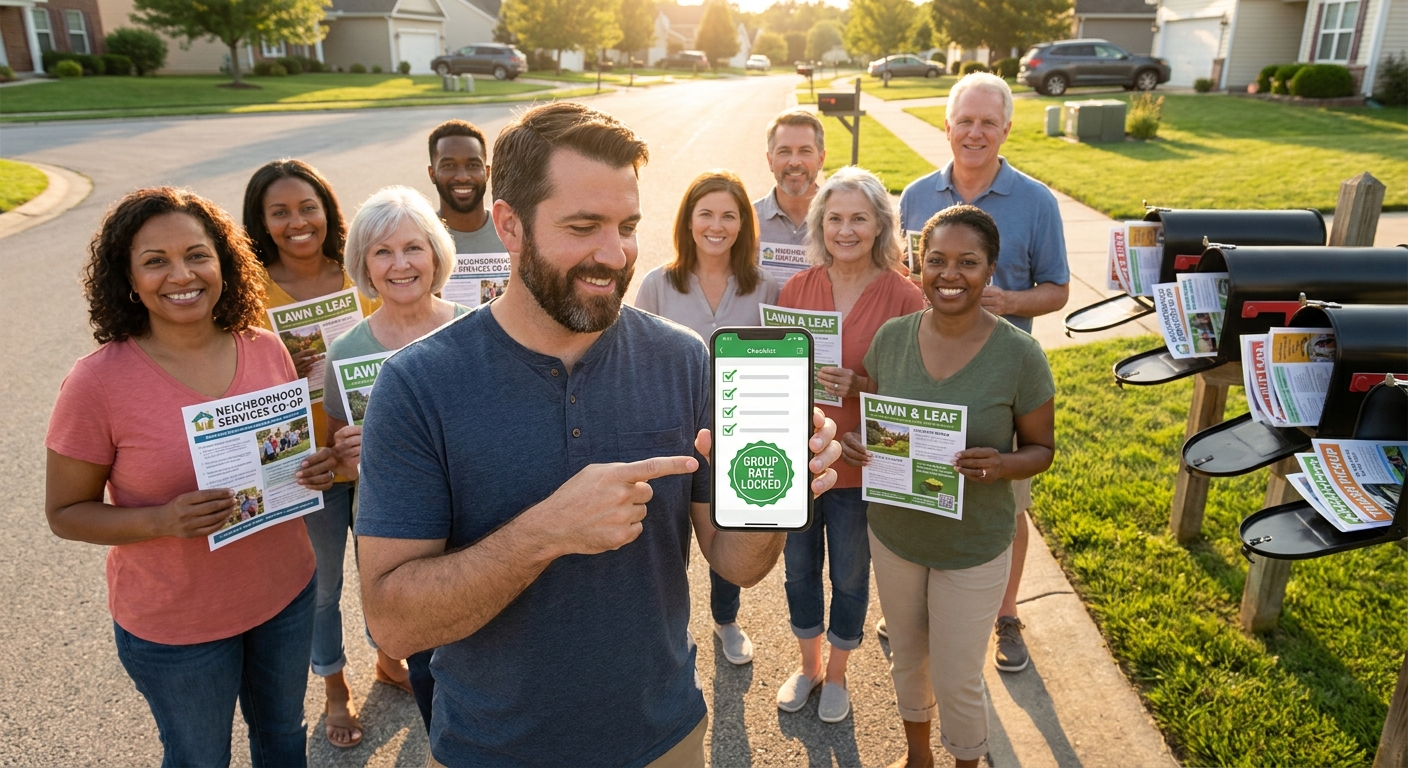
You are not wrong to treat door hangers and mailbox flyers like junk. Most of them look cheap, pushy, and oddly expensive. A lawn service wants $55 a cut. A pest company wants a quarterly plan you never asked for. A trash pickup ad promises “special pricing” that somehow still feels high. So most people toss them. Here’s the part almost nobody tells you. Those same local companies often care less about one customer than they do about three, five, or ten houses on the same street. Fewer sales trips, tighter driving routes, and easier scheduling can turn a so-so offer into a real neighborhood deal.
If you have been wondering how to start a neighborhood group for home service rebates, the shortcut is already sitting in your mailbox. Use the flyer as the starting point. Then ask a few neighbors if they want to request a group rate together. You do not need a fancy app, an HOA board, or a startup platform to begin. You just need one ad, a short message, and a small cluster of interested homes.
⚡ In a Hurry? Key Takeaways
- Yes, you can turn random local service flyers into a small neighborhood buying group and ask for better pricing.
- Start with 3 to 5 interested homes, then contact the company and ask for a street-level or block-level rate.
- Always compare terms, check reviews, and avoid paying upfront for long contracts unless the savings are clear.
Why this works better than most people think
Local home-service businesses live and die by route density. That is the plain-English version of the sales math.
If a lawn crew can cut four lawns on one block in one trip, they make more money with less driving. If a pest control company can book six homes in the same neighborhood on the same afternoon, their costs drop. If a trash hauling or junk pickup service can schedule multiple jobs close together, they save time and fuel.
That is why flyers matter. A flyer is not just an ad. It is proof that the company wants more business in your area right now.
Instead of reading the flyer as “buy this offer,” read it as “this company is trying to fill a route near me.” That gives you room to negotiate.
How to start a neighborhood group for home service rebates
Step 1: Pick the right kind of flyer
The best candidates are services that get cheaper when workers can stay in one area. Good examples include:
- Lawn mowing and yard cleanup
- Pest control
- Trash pickup or valet trash alternatives
- Gutter cleaning
- Pressure washing
- Snow removal
- HVAC tune-ups
- Window cleaning
The weaker candidates are one-time specialty jobs that vary a lot by house, like major tree removal or full kitchen remodeling. You can still ask, but the group discount may be smaller.
Step 2: Find just a few neighbors, not the whole block
This is where people get stuck. They think they need twenty homes. You usually do not.
Three to five serious households is often enough to start the conversation. More is nice. But do not wait for perfection.
Keep your ask simple:
“I got a flyer from this lawn service. If 4 or 5 of us asked together, we might get a better neighborhood rate. Want me to check?”
That is it. No speeches. No spreadsheets yet.
Step 3: Use a low-friction way to gather interest
You can do this with:
- A neighborhood text thread
- A private Facebook or WhatsApp group
- Nextdoor
- A quick paper note on a few doors
- A Google Form if you want to be a little more organized
The goal is not to build a club with bylaws. The goal is to find out who is actually interested and what service they want.
If you already live in a building or rental-heavy area, the same idea works there too. The logic is similar to The ‘Tenant Forum Shortcut’: Turn Renter Chat Groups Into Real Rebate Clubs You Can Actually Join. Start with the group people already use, then turn loose chatter into a real ask with numbers behind it.
Step 4: Contact the company with a group offer, not a question
This is the key move.
Do not call and ask, “Do you have any discounts?” That usually gets you a weak canned answer.
Instead say something like:
“You left flyers on our street. I have 4 neighbors interested in lawn service if we can get a block rate. Can you quote pricing for 4 homes on the same street, with a possible 6 to 8 if the offer makes sense?”
That message works because it gives them:
- Real volume
- A tight route
- A reason to sharpen the pencil
- A chance at more signups
You are not begging for a favor. You are offering efficient business.
Step 5: Ask for the right kind of discount
Sometimes the company will not call it a rebate. Fine. Names do not matter. Savings do.
Ask for one of these:
- A lower monthly rate
- The first service free or half off
- No startup fee
- A seasonal credit
- A referral credit for each added neighbor
- A locked-in rate for 6 or 12 months
This is often how neighborhood rebate clubs work in practice anyway. The money may show up as a credit, waived fee, lower recurring price, or bonus service.
A simple script you can copy
Here is a version you can send by text or email:
“Hi, you recently distributed flyers in our neighborhood for pest control. A few of us on the same street are interested, and we wanted to see whether you offer better pricing for grouped signups. Right now we have 5 homes interested, possibly more if the rate is good. Can you send a group quote, including any waived fees, monthly discount, or referral credits?”
Short. Clear. Hard to ignore.
What kind of savings are realistic?
Do not expect magic. Expect useful savings.
You might see:
- 10 to 20 percent off recurring service
- One free month on a seasonal plan
- Waived setup or equipment fees
- $25 to $100 referral or signup credits
- Price locks that protect you from future increases
On paper, that may not sound huge. But on services you already need, it adds up fast. Especially now, when every home bill seems to climb at once.
Red flags to watch for
Not every flyer turns into a smart deal. A few rules keep this from becoming a neighborhood headache.
Watch out for long contracts
A cheaper rate is not a bargain if canceling costs a fortune.
Check the company before you recruit others
Look at reviews. Check licensing if it matters in your area. Make sure the business is real.
Do not collect money for the company
Let each household sign and pay separately. You do not want to become the billing department for the block.
Get the terms in writing
If they promise a group rate, ask for an email that spells it out.
Do not oversell the deal
Tell neighbors this is a quote request, not a guaranteed win. That keeps expectations sane.
Why this beats waiting for an app to save you
There are more platforms now that try to organize bulk pricing for homeowners and renters. That is useful. But many neighborhoods are still not “supported,” or the service categories are limited, or the deals arrive months too late.
The flyer shortcut works right now because it starts with local demand that already exists. The company has already spent money trying to reach your street. You are simply turning scattered interest into a group ask.
That is often faster than waiting for a polished platform to notice your ZIP code.
Best services to try first
If you want the easiest win, start with services that are routine and easy to compare.
- Lawn mowing
- Pest control
- Gutter cleaning
- Pressure washing
- Window cleaning
These are easier because neighbors can usually say yes or no quickly. There is less customization, and the companies already understand route-based pricing.
How to keep the group from turning into a mess
You do not need to become the mayor of Discount Town.
Use a very small structure:
- One person gathers interest
- One short message goes to the vendor
- The quote gets shared with everyone
- Each home decides on its own
If the first deal works, then maybe you repeat the process for another service later. That is how small rebate clubs often start. Not with a giant launch. Just one useful win.
At a Glance: Comparison
| Feature/Aspect | Details | Verdict |
|---|---|---|
| Getting started | Use an existing flyer, find 3 to 5 interested homes, and ask for a street-level quote. | Easy and fast for most neighborhoods. |
| Potential savings | Often shows up as lower monthly pricing, waived fees, credits, or free first service. | Worth it if the service is something you already need. |
| Risk level | Main risks are weak vendors, confusing contracts, or one neighbor doing too much coordination. | Low risk if each household signs separately and checks the terms. |
Conclusion
The next time a lawn care, trash pickup, or pest control flyer lands at your door, do not just ask whether the offer is good for one house. Ask whether it could be better for five. That small shift is the whole trick. Today, with energy and housing costs climbing, more platforms are popping up to help neighbors band together for better home-service pricing. But most people still wait for those tools to magically appear in their area. This shortcut flips that around. It lets you use the flood of existing flyers and door hangers as instant deal-starters, so you can tap into the same group buying power those newer services are built on, without waiting for your neighborhood to be officially supported.