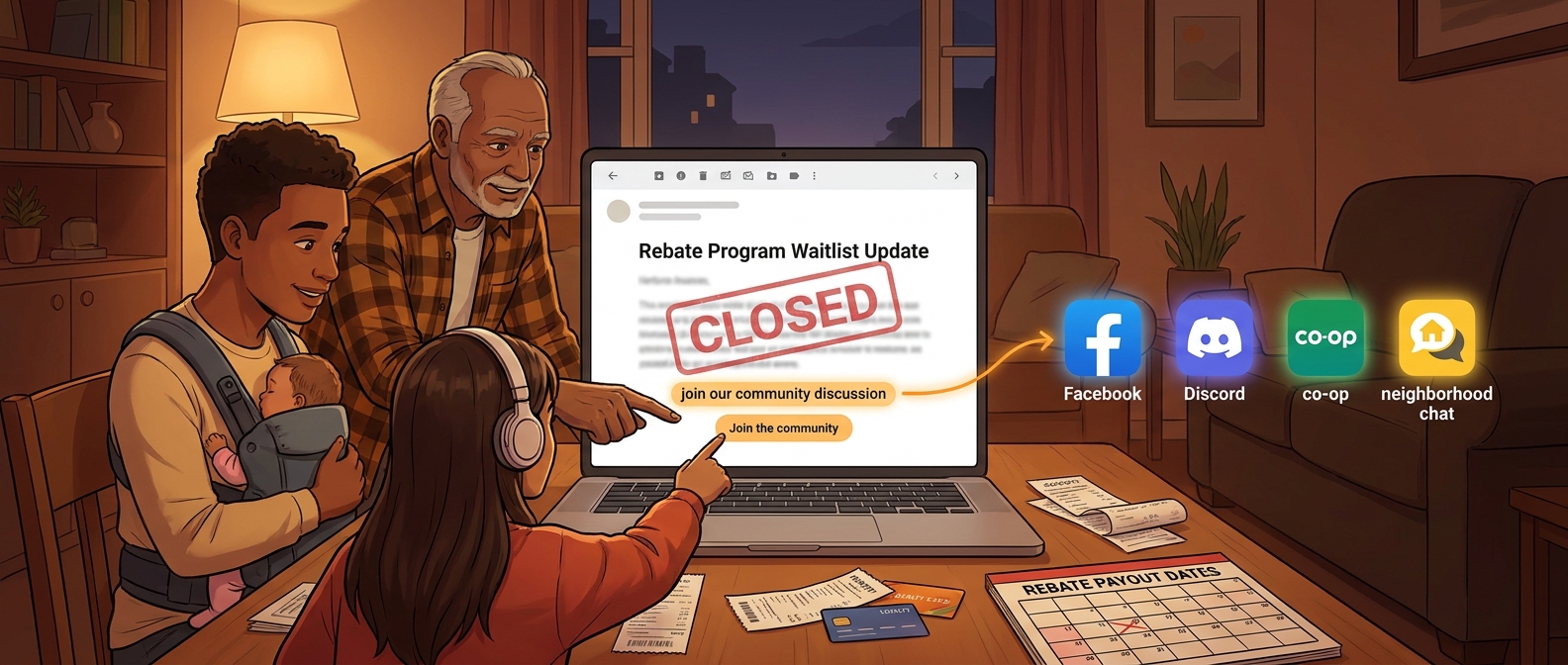
You finally find a rebate program that looks worth your time, click apply, and get hit with the same dead-end message. Waitlist full. Applications paused. Pilot only. That is maddening, especially when you are trying to save real money, not just collect a few random coupon wins. The good news is that a closed public signup page does not always mean the trail is over. Quite often, it means the real action moved somewhere smaller and less obvious. If you want to know how to join invite only rebate groups from closed programs, start with the leftovers most people ignore. Waitlist emails, FAQ pages, help center articles, member comments, and status updates often point to side doors like private Facebook groups, Discord servers, local buying clubs, or partner organizations. The public form may be closed. The community around it often is not. That is the shortcut smart rebate hunters use, and it is a lot more realistic than waiting months for a public spot to reopen.
⚡ In a Hurry? Key Takeaways
- Closed rebate programs often still connect to invite-only groups through waitlist emails, FAQ pages, and community links.
- Search for hidden paths like Discords, Facebook circles, alumni groups, union perks, and local buying alliances tied to the program.
- Stick to legit communities, protect your personal info, and avoid any group asking for upfront fees or account sharing.
Why “Waitlist Full” Is Not Always the End
Most people treat a closed application like a locked door. Fair enough. That is what it looks like.
But companies and buying groups often cap public intake because they are testing supply, managing fraud, or trying to keep a community small enough to moderate. When that happens, they still need places to talk to current members, referrals, and approved partner audiences.
That is where the backdoor comes in. Not a shady trick. Just basic detective work.
The public signup page may be frozen, but the program’s side channels may still be active. Those side channels are often where real invites move around.
Start With the Waitlist Email
If you joined a waitlist, go back and actually read the email. I mean the whole thing.
Look for lines like these:
- “Join our community for updates”
- “Follow program announcements here”
- “Members often hear first in our group”
- “Check our partner communities”
- “Referral access may return before public access”
These phrases are easy to skim past. They matter.
Sometimes the email footer includes a Facebook group, a Discord invite, a brand community, or a support portal where members swap tips. Even if it does not hand you an invite directly, it tells you where the people already inside are hanging out.
What to do next
Search the sender name, the program name, and any odd phrase from the email in Google, Facebook, Reddit, and Discord directories. Put quotation marks around exact phrases if needed. You are trying to find where that wording shows up again.
Mine the FAQ and Help Center Like a Member Would
This is where a lot of hidden paths show up.
FAQ pages often answer questions for current users, not just new applicants. That means they may mention:
- member referral rules
- community guidelines
- partner eligibility
- regional rollout groups
- approved organizations or associations
If you see a sentence like “access may be available through approved partner groups,” stop there. That is your clue.
Now click every linked term. “Partner groups,” “community,” “eligible members,” “local chapter,” and “pilot region” can all lead somewhere useful.
This is also a smart place to dig into cached pages, older support articles, and update logs. Sometimes a page was rewritten, but old versions still mention the names of clubs or communities that were once used for onboarding.
Look for the Semi-Hidden Communities Around the Program
This is the part big deal blogs often miss. They focus on the public signup page because that is easy to link. Real shoppers should care about the surrounding community.
1. Discord servers
Some rebate and testing programs move fast, so members gather in Discord to post openings, product drops, and referral windows. Search the program name plus “Discord,” “server,” “invite,” or “community.”
Also check social bios. A brand or moderator may not put the invite on the main site, but they will stick it in a profile link.
2. Facebook groups
Facebook is still full of regional coupon groups, mom groups, side-hustle groups, and buyer circles that quietly share rebate club openings. Search by program name and related phrases like “insiders,” “beta testers,” “savers,” “deal group,” and your city or state.
Private groups can be especially useful because members often know which programs are quietly taking referrals even when public forms are paused.
3. Union, alumni, and association perks
This one surprises people. Some invite-only buying clubs are offered through teacher groups, employee perk portals, alumni networks, neighborhood associations, and local business groups.
If a help page mentions “partner organizations” or “member communities,” think broader than the rebate brand itself. You may not need to know someone. You may just need to belong to a qualifying group you already forgot you had access to.
4. Local buying alliances
Search your town, county, or metro area with terms like “buying club,” “bulk buy group,” “community deals,” or “discount coalition.” These groups sometimes get first dibs on pilot programs because they are easier to manage than the general public.
Use Status Threads and Comment Sections as Clue Boards
Whenever a program pauses new applications, people talk about it somewhere.
Check:
- Reddit threads
- Facebook comments
- Instagram comments under announcement posts
- X or Threads replies
- blog comment sections
You are not just looking for complaints. You are looking for patterns.
For example:
- “I got in through my local group.”
- “Public signup is closed, but referrals still work.”
- “Check the members server.”
- “Our chapter had invites last week.”
That tells you the route still exists. You just need the right doorway.
How to Join Invite Only Rebate Groups From Closed Programs
Here is the practical version.
Step 1: Save every message
Keep the waitlist email, confirmation page, and any support replies. Tiny details matter.
Step 2: Search the exact wording
Paste unusual phrases into Google inside quotation marks. Add terms like “Discord,” “Facebook,” “community,” “referral,” and “partner.”
Step 3: Check the brand’s side channels
Look at Instagram bios, Linktree pages, Facebook pages, YouTube descriptions, and older posts. Invite links often live there longer than on the main site.
Step 4: Read the FAQ like you are already a member
Ignore the obvious beginner stuff. Hunt for references to referrals, pilots, chapters, organizations, and member communities.
Step 5: Join adjacent groups
If the closed program connects to product testing, ambassador work, or reviewer panels, join those too. They often overlap.
That is why it is worth reading The ‘Brand Insider Gate’ Shortcut: Join Rebate Communities Hiding Inside Ambassador & Reviewer Programs. A lot of the same brands and moderators show up across both worlds.
Step 6: Ask one simple question
Do not send a giant message. Ask, “Is public signup closed only, or are referrals/partner invites still active?”
That gets better answers than “Can someone get me in?”
Step 7: Be patient and useful
Many private groups admit people who follow rules, fill out profiles, and contribute. If you act like a spammer, you will get ignored fast.
What Counts as a Good Sign, and What Should Worry You
Good signs
- The group is linked from an official email, support page, or moderator profile.
- Rules are clear and realistic.
- Members talk about actual purchases, payouts, and timelines.
- There is a visible admin or moderator team.
Red flags
- Someone asks for an upfront fee just to “unlock” rebate access.
- You are told to share store accounts, Amazon logins, or payment details.
- The only proof is screenshots with no context.
- The group pushes rushed buying with no written terms.
If it feels off, walk away. Savings are important. So is keeping your accounts safe.
Why This Works Better Than Chasing Public Links
Public links get crowded first. That is the whole problem.
By the time a giant coupon blog or deal page posts a program, the easiest spots are usually gone. Smaller communities move differently. They share openings by referral, by region, by member status, or by partner access.
That does not mean they are fake or exclusive in some fancy way. It just means they are organized around trust and capacity.
If you are willing to dig a little, you can often find a real path in while everyone else assumes it is over.
At a Glance: Comparison
| Feature/Aspect | Details | Verdict |
|---|---|---|
| Public signup page | Easy to find, but often capped, paused, or flooded with applicants. | Good first stop, poor final answer. |
| Waitlist emails and FAQ pages | Often contain clues about referral routes, partner access, and member communities. | Best place to start digging. |
| Private groups and local alliances | Harder to spot, but more likely to share real openings and invite paths. | Most promising route if you stay careful. |
Conclusion
When rebate programs are capped, paused, or marked pilot only, it is easy to feel shut out at exactly the wrong time. But closed does not always mean gone. If you mine the waitlist emails, FAQ pages, help centers, and status threads for clues, you can often find the semi-hidden communities that still have movement. That might be a Discord server, a private Facebook circle, a union or association perk, or a local buying alliance. Those are the places many big blogs skip because they focus on public links, not the communities behind them. So if you have been stuck wondering how to join invite only rebate groups from closed programs, do not stop at the closed form. Follow the breadcrumbs. That is often where the real savings start.