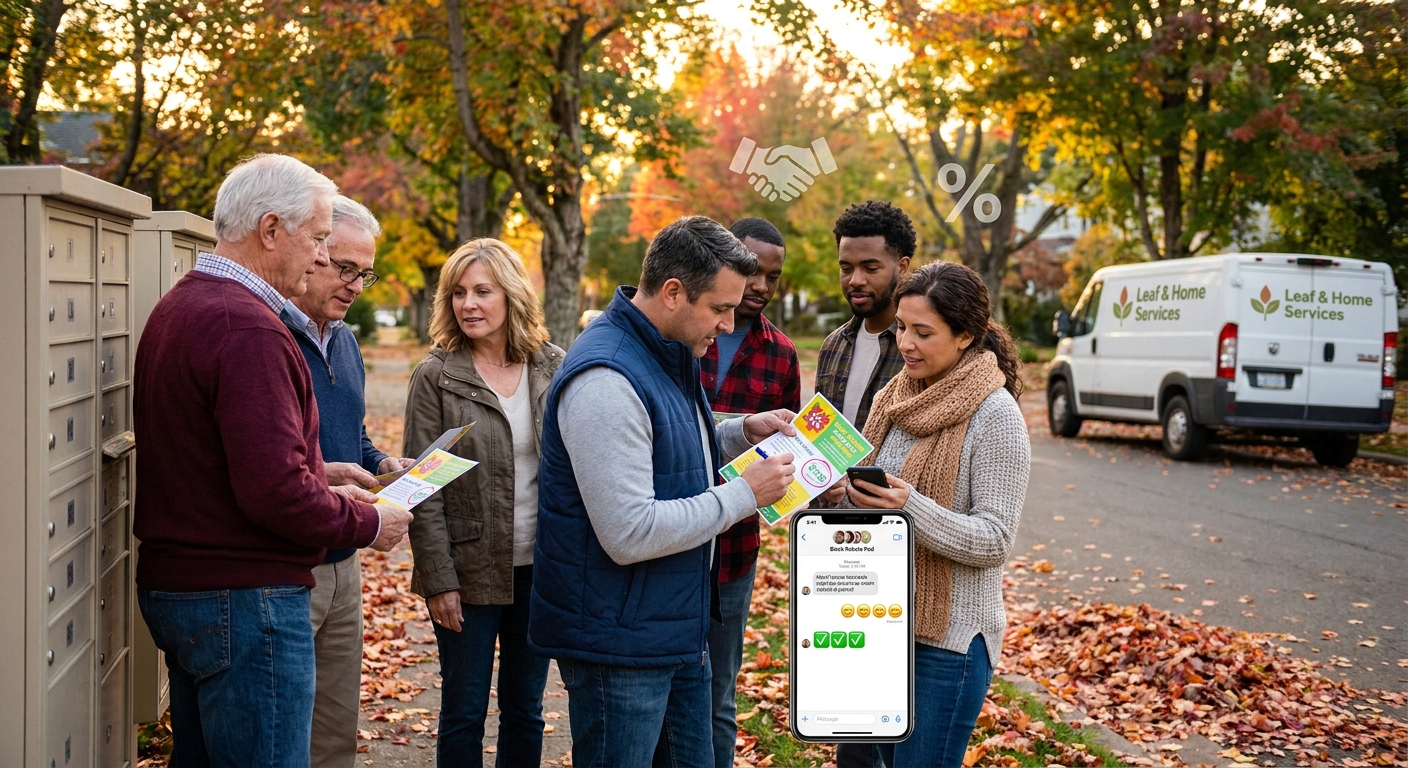
You have probably done it a hundred times. Grab the yard-service flyer off the doorknob, glance at the cartoon mower, and toss it straight into the trash. Fair enough. Most of those ads look cheap, vague, and easy to ignore. But here is the frustrating part. Some of them are basically early warning signs that a local company wants a whole cluster of houses, not just yours. That matters because if three, five, or ten neighbors book together, the provider can save time, fuel, and scheduling hassle. Those savings can turn into lower prices, free add-ons, or recurring credits for everyone in the group. If you have been wondering how to join neighborhood group buying rebate clubs without signing up for another random app, your own block may already be halfway set up. The flyer is not always junk. Sometimes it is the invitation.
⚡ In a Hurry? Key Takeaways
- Those door hangers and mailbox flyers can be the starting point for a small neighborhood rebate pod that gets better pricing than a single-house booking.
- Start by checking whether the company already serves nearby homes, then ask neighbors if they want a shared quote for the same service window.
- Only join pods with clear pricing, written terms, and a simple contact trail so nobody gets surprised by fees or automatic renewals.
Why random flyers can be more useful than they look
Local service companies do not blanket a street by accident. Very often, they are testing demand on one route. If enough homes respond, they can batch the work. That is good for them, and it can be good for you.
Think about lawn care, pest control, gutter cleaning, house cleaning, snow removal, pressure washing, or HVAC tune-ups. These are route-based services. A company makes more money when jobs are close together. That gives you something to work with.
Instead of reading a flyer as, “Do I want this company?” read it as, “Could this become a group quote for the block?” That simple shift is where the savings often start.
What a “local rebate pod” actually means
A rebate pod does not need to be fancy. It can be as small as three neighbors who agree to ask for one shared deal. The rebate can show up in a few different ways:
- Lower per-house pricing if several homes sign up
- A free extra service, like edging, filter replacement, or a seasonal check
- Account credits that apply to future visits
- A referral-style bonus spread across the group
- A locked-in rate for recurring service
This is one reason people searching for how to join neighborhood group buying rebate clubs often miss the easiest answer. You do not always need a formal club first. Sometimes you create the first version of one from a flyer, a group text, and a shared quote request.
How to spot a flyer that is worth acting on
Not every door hanger deserves your time. Some are just one-off promotions. Others are better signs of real neighborhood pricing potential.
Good signs
- The company lists “neighbor discounts,” “route pricing,” or “multiple-home discounts”
- There is a local phone number and a real service area
- The ad mentions nearby streets, a subdivision, or current local customers
- There is a QR code leading to a quote page, not just a generic homepage
- The service is repeatable, seasonal, or route-based
Red flags
- No business address or no online presence at all
- Prices that seem unrealistically low without any details
- Pressure tactics like “today only” with no written terms
- Requests for upfront payment before a quote or visit
- Vague promises of “free service” that depend on referrals you cannot verify
The weekend play: turn one flyer into a rebate group
You do not need a homeowners association meeting or a startup app. You just need a simple process.
Step 1: Check the company in five minutes
Look up reviews. Confirm the business license if that is standard in your area. Visit the website. Make sure the phone number, service list, and location match what is on the flyer.
Step 2: Ask one smart question
Call or message and say, “A few homes on our street may be interested. Do you offer route pricing, multi-home discounts, or account credits for a group booking?”
That wording matters. It gets right to the point and tells the company you understand the value of grouped service.
Step 3: Get the offer in writing
Ask for a short written breakdown. You want to know:
- Minimum number of homes needed
- Exact discount or rebate structure
- Whether the deal is one-time or recurring
- What happens if someone drops out
- Whether each house is billed separately
Step 4: Float it to neighbors privately
Send a short text to trusted neighbors, post in a small street group, or knock on two or three doors. Keep it low pressure. Something like: “We got a flyer from a local lawn company. They will cut the price if 4 homes book together. Want me to send the details?”
That is a lot more effective than posting a giant public thread that turns into side chatter.
Step 5: Pick one organizer, not a committee
One person should collect interest and pass along the quote. That person is not taking payments or playing middleman. They are just helping the group hit the threshold.
Step 6: Keep the pod small at first
Three to six homes is usually enough to test whether this works. If the first round goes well, you can expand later.
Where people get tripped up
The biggest mistake is treating this like a coupon hunt. It is not. It is a routing and scheduling negotiation.
The second mistake is getting too ambitious. If you try to organize 20 households right away, people drift off, ask endless questions, or forget to reply. Small wins beat big plans.
The third mistake is ignoring service fit. A neighborhood pod works best when homes need roughly the same thing at roughly the same time. Lawn mowing is easy. Custom tree removal is not.
Best services for neighborhood rebate pods
- Lawn care and mowing
- Pest control
- HVAC seasonal tune-ups
- House cleaning
- Gutter cleaning
- Leaf removal
- Snow removal
- Pressure washing
- Window cleaning
- Mulch or seasonal yard refreshes
These are predictable, repeatable, and easy for providers to stack on one route. That is exactly where group buying has the best shot of producing rebates or lower prices.
If there is no app in your area, use the offline signal anyway
This is the part many people miss. You do not need to wait for some polished neighborhood savings platform to appear in your ZIP code. The flyer itself is the signal that a provider is fishing for density. Your job is to turn that signal into a small buying group.
And if you like this kind of practical, neighbor-first approach, the same idea works outside home services too. A good example is The ‘Bulk Run RSVP Shortcut’: Turn Local Pickup Posts Into Community Rebate Groups You Can Actually Join, which shows how casual local pickup posts can become shared savings opportunities when people move fast and organize clearly.
How to stay safe and keep it simple
Do not collect money for the group
Each household should pay the company directly. That avoids confusion and keeps the organizer from becoming the complaint department.
Do not overshare neighbor info
Ask people before sending their address or phone number to a provider.
Read renewal terms
Some “discounts” are really auto-renew plans. That is not always bad, but it should be obvious.
Take screenshots
Save the flyer, the quote, and any text about minimum homes or rebates. If the offer changes later, you have a record.
Start with one service cycle
Do one mow, one treatment, one cleaning round, or one tune-up batch before committing to a season-long setup.
How to ask neighbors without sounding pushy
Most people are open to saving money. They just do not want drama. Keep your message short, specific, and easy to ignore if they are not interested.
Try this:
“A local company left flyers on the block for gutter cleaning. I asked if they do group pricing. They said yes if 4 homes join. Each house would book and pay separately. Want the details?”
That works because it answers the big questions fast. What is it, how many homes, how billing works, and whether there is any pressure. There is not.
How this turns into a standing savings engine
Once a few neighbors see one successful group booking, the next one gets easier. You now have a mini network. Maybe the lawn group turns into a spring mulch group. Maybe the HVAC tune-up pod becomes a fall filter and inspection pod.
That is when this stops being a one-time discount trick and starts acting more like a real neighborhood rebate club. Not branded. Not flashy. Just useful.
Providers like it too. If they know your street responds as a cluster, they are more likely to send targeted offers, hold route days, or offer credits to keep the group active.
At a Glance: Comparison
| Feature/Aspect | Details | Verdict |
|---|---|---|
| Door hanger from a local provider | Best when the service is route-based and the company is clearly trying to build density on your street or subdivision. | Strong starting point for a small rebate pod. |
| Neighborhood group booking | Works well with 3 to 6 homes, written pricing, and separate billing for each household. | Usually the easiest way to save without using a new app. |
| Anonymous coupon or deal app | Can offer discounts, but often lacks local route context, neighbor coordination, or recurring credits tied to your block. | Fine for one-off deals, weaker for ongoing neighborhood savings. |
Conclusion
You do not have to wait for a shiny new platform to learn how to join neighborhood group buying rebate clubs. In many cases, the opening move is already hanging on your doorknob. Right now local service aggregators and neighborhood group-buy startups are quietly organizing homeowners into clusters so they can negotiate better pricing and, in many cases, recurring rebates for basics like lawn care, cleaning, HVAC tune-ups, pest control and seasonal yard work. With inflation still squeezing household budgets, providers are often more willing than before to lock in a route of nearby homes in exchange for lower pricing or credits they can spread across the group. If you treat door hangers, mailbox stuffers, and QR-coded postcards as signals instead of junk, you can build a small private rebate pod this weekend. That is the real value here. Less waiting, less app fatigue, and a repeatable community-first way to turn boring flyering into steady neighborhood savings.