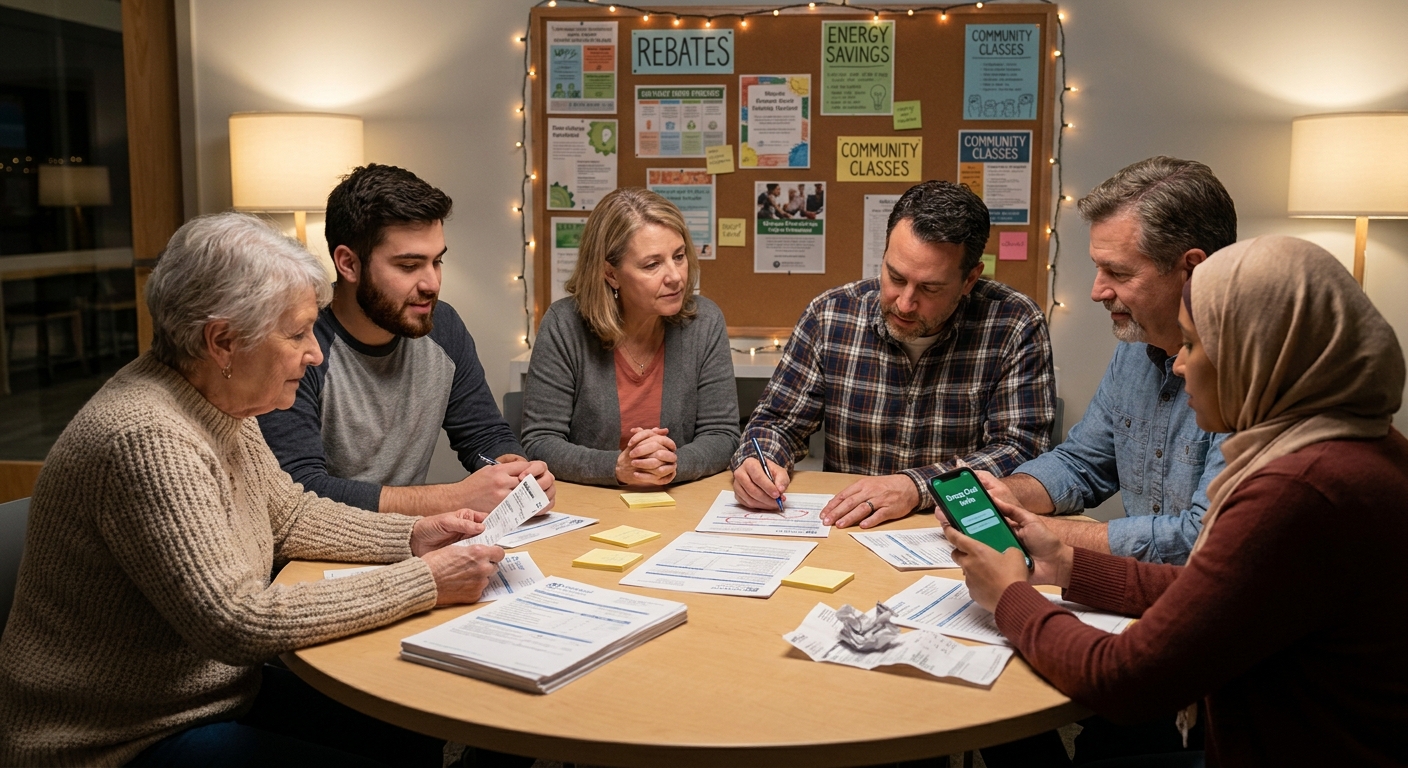
You know the listings I mean. “Energy savings workshop.” “Utility assistance clinic.” “Rebate information night.” They sound like the kind of events you scroll past while looking for something actually useful. That is fair. Most people assume these are one-and-done meetings where you grab a brochure, nod politely, and head home. But that is exactly why they are such a hidden gem. The people in those rooms are not random internet strangers. They are local residents, utility staff, nonprofit helpers, and city workers who are all trying to solve the same money problem at the same time. If you treat these events as the front door to a small rebate club, not just a class, you can build a steady stream of local tips, reminders, and real examples of what forms worked, which programs are active, and where people are actually saving money this month.
⚡ In a Hurry? Key Takeaways
- Yes, you can use library and city rebate workshops to find local rebate groups, and they are often better than online deal groups.
- Stay after the session, swap contact info with 2 to 5 motivated people, and start a simple text thread focused on one rebate category.
- Stick to public programs, verify deadlines and paperwork together, and avoid anyone pushing “secret” deals or upfront fees.
Why boring community calendars are secretly useful
If you are trying to figure out how to find local rebate workshops and turn them into buying clubs, the trick is simple. Stop treating the event itself as the prize.
The event is the filter.
A Facebook group can have 8,000 members and still be useless. Most people are lurking, half the posts are old, and nobody lives near you. A library workshop on weatherization or appliance rebates might only have 12 people. But those 12 people already passed three tests. They live nearby. They care enough to show up. And they are probably dealing with the same utility company, contractor list, and local rules you are.
That is gold.
These rooms also tend to be safer. The host is usually a library, city department, utility partner, nonprofit, or adult education center. That does not make every tip perfect, but it cuts way down on the nonsense.
What a “rebate pod” actually looks like
Do not imagine a formal club with dues, bylaws, and matching tote bags.
A rebate pod can be very small. Three neighbors texting each other about heat pump deadlines. Five parents sharing e-bike voucher updates. A few apartment renters comparing power bill credit programs. One librarian, one city staffer, and four residents on a monthly Zoom.
The point is not socializing for the sake of it. The point is shared progress.
What people in a good rebate pod share
Useful rebate pods trade specific, local information such as:
- Which program is actually open right now
- What documents the portal asked for
- How long approvals are taking
- Which contractors understand the rebate paperwork
- Whether bulk pickup, shared delivery, or ride-sharing makes sense
- What mistakes caused delays
That is a lot more useful than somebody online posting, “I heard there’s free money for appliances,” with no details and no follow-up.
Where to find local rebate workshops this week
You do not need a secret database. Start with the places that already publish public calendars.
Best places to check
- Public library events pages
- City and county sustainability offices
- Utility company community events calendars
- Community action agencies
- Nonprofit housing and energy counseling groups
- Parks and recreation adult classes
- Neighborhood association newsletters
- Community college continuing education calendars
Search terms that work better
Many people search too narrowly. Do not just search for “rebate workshop.” Try terms like:
- home energy workshop
- utility assistance night
- weatherization clinic
- electrification class
- e-bike voucher info session
- water-saving rebate event
- home repair assistance workshop
- income-qualified energy help
Some of the best rebate gatherings are hiding under boring labels.
How to spot the right event before you go
Not every workshop will be worth your time. You want the ones that put real applicants in the same room.
Green flags
- The event includes Q&A time
- It is hosted by a library, utility, local government, or known nonprofit
- The description mentions current programs or application help
- There is registration, which usually means people are serious
- It is tied to a specific topic like insulation, appliances, EV chargers, solar, or water-saving upgrades
Skip or be cautious if
- The event is really a hard sell for one contractor
- No host organization is clearly named
- It promises “exclusive” rebates nobody else knows about
- It asks for payment just to access public rebate information
How to turn one workshop into a real local group
This is the part most people miss. They attend, collect a handout, and leave. Instead, use a simple three-step approach.
Step 1: Arrive with one clear goal
Pick a lane before you go. Maybe you want appliance rebates. Maybe home insulation. Maybe low-income utility bill help. Maybe e-bike vouchers.
When your goal is clear, it is easier to find your people.
Step 2: Listen for the repeat questions
Pay attention to who asks practical questions.
- “Which proof of income did they accept?”
- “Do renters qualify?”
- “Has anyone gotten approved yet?”
- “Can we combine this with a utility rebate?”
Those are your potential pod members. They are not just curious. They are trying to act.
Step 3: Make a tiny, low-pressure ask
Do not say, “Let’s start a club.” That sounds like homework.
Try this instead:
“I’m applying for the same thing. Want to swap numbers and keep each other posted if one of us figures out the paperwork?”
Or:
“A few of us seem to be chasing the same rebate. I can start a text thread if that helps.”
That feels easy. Because it is.
The best format for your rebate pod
Keep it boring. Boring works.
Start with one communication channel
- Group text for fast updates
- WhatsApp if people prefer it
- Email if the group includes older residents or volunteers
- A monthly Zoom if the workshop itself was virtual
Do not set up six apps. That is how small groups die.
Use one simple message to kick things off
Try something like this:
“Great meeting everyone at the library energy workshop. This thread is just for local rebate updates on heat pumps and insulation. If you apply, get approved, hit a snag, or hear a deadline changed, post it here.”
That gives the group a job.
How buying-club behavior saves more than just paperwork time
The phrase “buying club” can sound old-fashioned, but the idea still works.
Once a handful of people in the same area are upgrading the same type of thing, they can compare prices, contractor availability, delivery options, and pickup logistics. Even if you never formally negotiate as a group, you still save time by sharing real quotes and local experiences.
Examples
- Three households ordering approved smart thermostats during the same rebate window
- Neighbors coordinating a shared ride to an appliance pickup event
- A renter group trading notes on portable efficiency upgrades that qualify
- Homeowners comparing which contractors correctly filed rebate documents
One successful claim becomes the template everyone else can copy.
Questions to ask at the event so you find the right people
If you are shy, use the workshop itself to do the heavy lifting. Ask smart, open questions out loud. The people who come talk to you afterward are often the exact people you want in your group.
- “Has anyone here already completed this rebate?”
- “Is there a local contractor list people trust for this program?”
- “Does this stack with the utility rebate?”
- “Would the library ever host a follow-up session for people mid-application?”
- “Are people interested in a shared contact thread for deadline updates?”
That last one is especially useful because it gives the room permission to connect.
How to keep the group helpful instead of messy
Small groups go wrong in predictable ways. They drift off-topic. One person starts forwarding random rumors. Another turns it into a sales pitch.
You can prevent most of that with a few ground rules.
Good rules for a rebate pod
- Stick to one or two rebate topics at a time
- Share links to official sources when possible
- Label personal experience clearly, like “This worked for me in May”
- No pressure to buy from any one contractor
- No posting full personal documents in the group
- Do not pay anyone in the group to “guarantee” approval
Safety matters more than saving 20 extra dollars
Most community workshops are perfectly ordinary, but use common sense.
Keep these boundaries
- Meet in public places for follow-ups
- Use a separate email if you want more privacy
- Redact account numbers and ID details before sharing screenshots
- Verify every rebate at the agency or utility site before spending money
- Be wary of anyone who wants control of your login or application
Real rebate groups save money by sharing information, not by handing a stranger your identity.
How libraries can become your unofficial rebate headquarters
Libraries are especially good for this because they already know how to host low-pressure public gatherings. Staff can point you to bulletin boards, meeting rooms, community partners, and follow-up classes. Some libraries will even let residents reserve space for a small discussion group.
If the first workshop is useful, ask a librarian or host:
“Would there be interest in a monthly drop-in for people applying to local rebate programs?”
You do not need a giant turnout. Six regulars is enough to make this worthwhile.
What to do if there are no workshops near you
Then build from the nearest thing available.
- Attend a virtual utility webinar and connect with people in the chat
- Ask the host if attendee follow-up is possible through an optional email list
- Start with a neighborhood Facebook post, but move good prospects into a smaller private thread fast
- Ask your library if they would host a rebate basics session with a city or nonprofit speaker
Sometimes the shortcut is not finding the perfect event. It is using one decent event to make a better next one.
At a Glance: Comparison
| Feature/Aspect | Details | Verdict |
|---|---|---|
| Library or city workshop | Smaller turnout, local attendees, official speakers, current forms and deadlines | Best starting point for a trustworthy rebate pod |
| Big social media deal group | High volume, mixed quality, broad geography, lots of stale or vague tips | Fine for ideas, weak for verified local action |
| Small local text or email thread | Fast updates, real accountability, easy to compare experiences and timing | Best format once you have 3 to 8 serious people |
Conclusion
The next time you see a sleepy-looking community listing for a rebate class, do not dismiss it. Treat it like a doorway. Local governments, utilities and nonprofits are pumping out new rebate programs right now, and they are funneling real humans who care about saving money into the same physical rooms and Zoom calls. That is an insanely valuable filter you do not get on Facebook or Telegram, where half the deal groups are dead, scammy or filled with lurkers. If you use these workshops to build a small real-world rebate pod, you skip the noise and start getting verified, hyper-local intel from people with skin in the game. That leads to faster approvals, fewer form mistakes, shared rides and pickups, and a nice compounding effect where one person’s win becomes the roadmap for everyone else. In other words, the boring noticeboard might be the smartest money-saving tool in town.