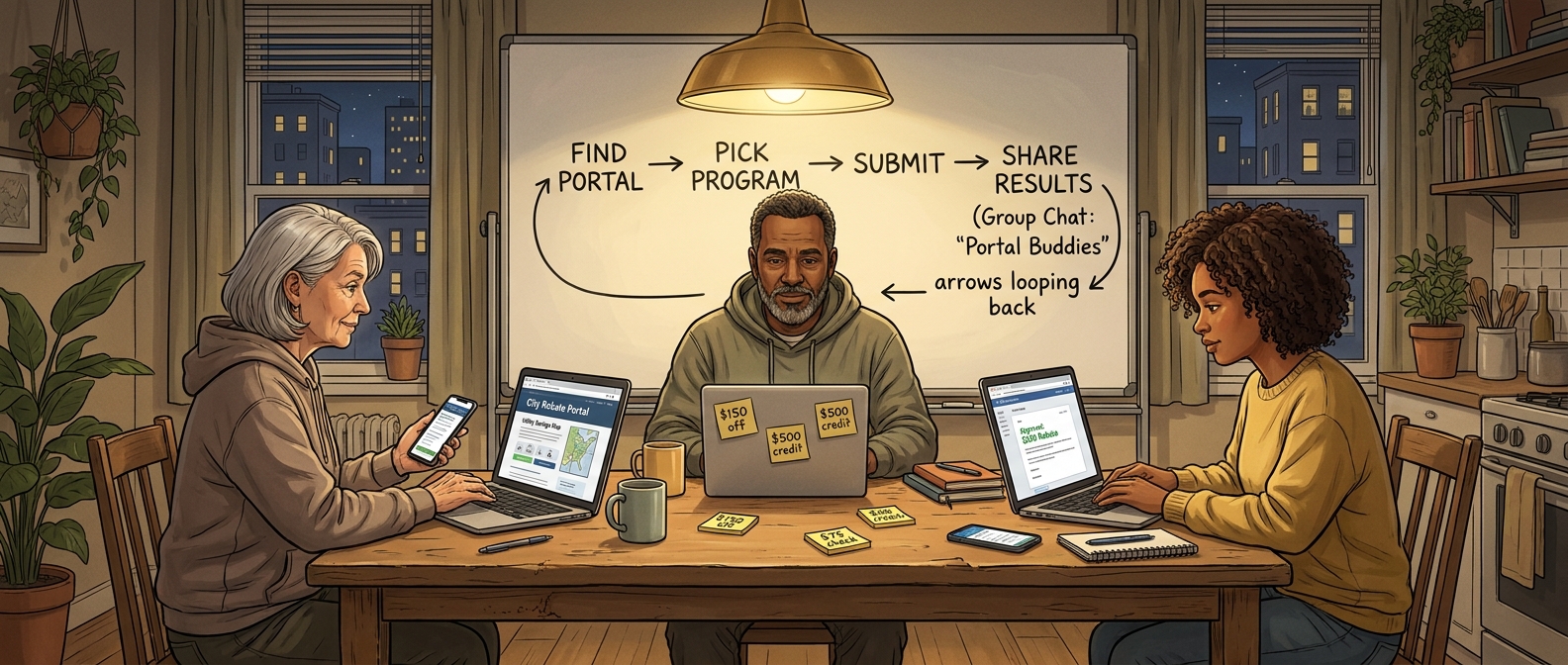
You are not imagining it. Rebate hunting is weirdly harder than it should be. You join a few social groups, see lots of excited posts, maybe one screenshot of a check, then hit a wall when you try to find the real program. The money is often sitting on a city page, a utility portal, or a county PDF that looks like it was built to test your patience. Then come the income limits, approved product lists, contractor rules, and deadlines that seem to change every few weeks.
That is why the smartest move is not joining ten noisy deal chats. It is picking one trusted local portal as your “portal buddy,” then turning that source into a tiny community inside Rebate Clubs. One person finds the page. A few neighbors help decode it. Suddenly you have pre-checked links, notes on what actually worked, and real-world timing from people nearby. That is how to use local rebate portals with community groups without drowning in fine print.
⚡ In a Hurry? Key Takeaways
- Start with one official city, county, or utility rebate portal, not random social posts.
- Use Rebate Clubs to turn that portal into a small local group that shares links, rules, timelines, and approved contractors.
- Always double-check dates and eligibility on the official page, because many energy and climate programs are changing fast in 2026.
Why the boring page usually beats the buzzy group
The best rebates are often controlled by the least exciting websites on the internet.
That sounds unfair, but it is true. Your local utility may have the real application link. Your city sustainability office may have the approved installer list. Your county may host the income chart that decides whether you get a few hundred dollars or a few thousand.
Social posts are still useful. They alert you that something exists. But they are often one step removed from the source. That is where people get tripped up. They hear “free heat pump” or “big EV charger rebate,” but miss the part where the offer is only for certain ZIP codes, panel sizes, or household income levels.
So the shortcut is simple. Use the social chatter to spot a lead. Then anchor yourself on one official portal.
What a “Local Portal Buddy” actually is
Think of it as your home base.
Your portal buddy is the single official page you trust most for your area. Usually that is one of these:
- Your city energy or sustainability rebate page
- Your electric or gas utility rebate portal
- Your county climate incentive page
- Your state clean energy portal, if local pages point there
Once you pick that one page, you stop bouncing between rumors and screenshots. You use it as the main reference. Then you build a small Rebate Clubs group around it so everyone can help make sense of the details.
How to use local rebate portals with community groups
Step 1: Pick one official portal, not five
Start narrow.
Search for your city name plus “rebates,” your utility name plus “energy efficiency rebates,” or your county name plus “home electrification incentives.” You want the page that links out to forms, program guides, and contact details.
If two official pages seem to overlap, choose the one that appears to be updated most often. Look for “last updated” notes, current application windows, or 2026 program references.
Step 2: Save the core links people always ask for
Most local rebate confusion comes from the same repeat questions. Save the pages that answer them.
- Main program page
- Eligibility or income chart
- Approved contractor list
- Application form
- Required documents checklist
- FAQ page
- Contact email or phone number
Put those links into one post inside your Rebate Clubs group. That alone saves people hours.
Step 3: Turn the portal into a micro community
This is the part most people skip, and it is the part that makes the whole thing work.
Inside Rebate Clubs, create a local thread or mini group for that exact portal. Keep it tight and practical. No hype. No vague “any updates?” posting. Organize it around what neighbors actually need to know.
Good categories include:
- Who applied and when
- What documents were accepted
- Which contractors were responsive
- How long approvals took
- Whether funds were still available
- Which links were changed or moved
Now the portal is no longer a lonely government webpage. It becomes a live local map.
Step 4: Let one person verify, then let the group confirm
You do not need everyone to become a rebate expert.
One person can check the official page. Two or three others can confirm details from their own applications or calls. That is enough to catch mistakes fast. If a PDF was replaced, somebody notices. If an installer is no longer on the approved list, somebody flags it. If a rebate is technically open but funding is basically gone, real applicants usually know before the webpage spells it out clearly.
What makes this better than a normal deal group
Typical deal groups are broad. They are built for speed, not accuracy. That can be fun when you are chasing a coupon code. It is not so great when a missed checkbox could cost you a $2,000 rebate.
A local portal group works better because it is:
- Location-specific
- Program-specific
- Based on official sources
- Updated by people who are actually applying nearby
That last point matters. A rebate in one town can have different contractor rules, permit steps, or utility tie-ins than the same rebate one county over.
How to avoid the common traps
Do not trust screenshots without a source link
Screenshots travel faster than facts. If someone posts a rebate amount, ask for the official page it came from.
Do not assume “available” means easy to get
Some programs are technically open but bottlenecked by contractor shortages, inspections, or income verification delays.
Do not mix old and new program rules
Mid-2026 is messy. A lot of energy and climate rebate portals are being revised, merged, or rewritten. Make sure your group labels updates clearly. “Old rules” and “current rules” can save people from expensive mistakes.
Do not rely on one hero
If only one person understands the portal, the group stalls when they get busy. Better to have a few people each track one piece, like timelines, income docs, or installer experiences.
A simple setup that works well in Rebate Clubs
If you want this to stay useful, keep the structure boring and clear. That is a compliment.
- Pinned post: Official portal links and last checked date
- Thread 1: Eligibility and income rules
- Thread 2: Approved contractors and reviews
- Thread 3: Application timelines and payout reports
- Thread 4: Common mistakes and document tips
This makes your local group searchable and calm, which is exactly what rebate hunting usually is not.
Where local PSA posts still fit in
Public notices are often the first clue that a rebate workshop, utility update, or sign-up event is happening. If you have ever ignored one of those sleepy-looking posts, you are not alone.
They are worth another look, especially if they point back to an official program page. If you want a good companion strategy, read The ‘Neighborhood Noticeboard’ Hack: Turn Local PSA Posts Into Invite-Only Rebate Communities. It pairs nicely with this approach. Noticeboard posts help you spot the opportunity. Your portal buddy group helps you make sense of it.
What to post in the group so people actually benefit
You do not need long essays. You need useful field notes.
Good posts look like this:
- “Applied for City Heat Pump Rebate on June 4. Approval email came June 21.”
- “Utility page changed the contractor list today. Here is the new PDF.”
- “Income verification accepted last year’s tax return plus latest utility bill.”
- “Program says open, but call center said funds may pause next month.”
That is the gold. Real timing. Real paperwork. Real outcomes.
Why this matters more right now
Because 2026 is a moving target.
Energy and climate rebates are being revised constantly. New funding rounds open. Old forms expire. Cities sync their pages with utilities. Utilities point back to state tools. A single person trying to track all of that alone will miss things.
A small community can keep up much better than one stressed homeowner with twelve tabs open at midnight.
At a Glance: Comparison
| Feature/Aspect | Details | Verdict |
|---|---|---|
| Official local portal | Has the real rules, forms, dates, and contact details, but can be confusing and slow to read | Best source of truth |
| General social deal group | Fast alerts and lots of chatter, but details are often incomplete, outdated, or not local | Good for spotting leads, weak for final decisions |
| Rebate Clubs micro community | Turns one trusted portal into a shared local reference with timelines, link checks, and real payout reports | Best practical system for staying current |
Conclusion
The trick is not becoming a rebate detective on your own. It is choosing one trusted local portal, then letting a small community help translate it into plain English and real next steps. That matters right now because energy and climate rebate portals are changing constantly in mid 2026, and most of them are painful for one person to cross-check alone. When you anchor on an official city or utility page and turn it into a micro group inside Rebate Clubs, you get pre-checked links, real timelines, and honest reports on which programs actually paid out. That is how confusing government pages become a live local rebate map, and how your community stops leaving free money on the table.