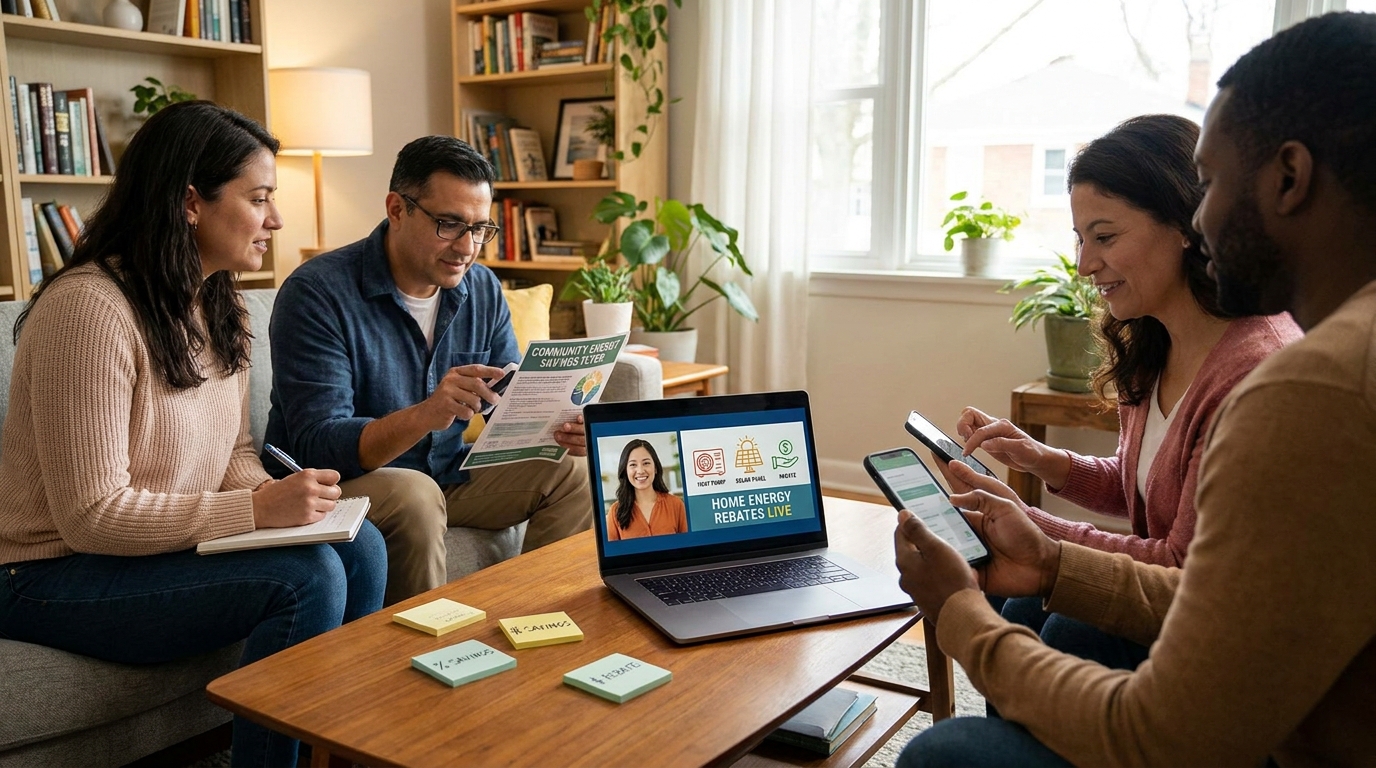
You are not imagining it. Home-energy rebates can feel weirdly hard for something that is supposed to save you money. One page says your heat pump qualifies. Another says your income has to fit a certain band. Then a contractor mentions “load calculations” and “cold-climate specs,” and suddenly you are 20 minutes deep into a webinar thinking, “Forget it.” That is exactly where most people drop off. The twist is that the people who stick around for the “boring” utility webinar or nonprofit info session often find each other, compare notes, and end up in small rebate groups that get better guidance, faster answers, and sometimes even group-buy pricing. If you want to know how to join community rebate groups through energy webinars, the trick is not just watching the slides. It is using the event like a meetup. The savings often start after the official presentation ends.
⚡ In a Hurry? Key Takeaways
- Yes, you can turn free energy webinars into real community rebate groups by connecting with attendees in chat, Q&A, and follow-up emails.
- Stay to the end, ask one practical question, and suggest a small WhatsApp or Facebook group for people in the same area or utility territory.
- Only share basic contact info at first, and confirm rebate rules with the program organizer before trusting any contractor pitch or “limited-time” offer.
Why the webinar matters more than the rebate website
Most rebate websites are built like tax forms with nicer colors. They are full of rules, exceptions, and links that send you somewhere else. Webinars are different. They put a real human in front of you, and that human usually has a target to hit.
States, utilities, and clean-energy nonprofits are trying to get more households into heat pump and efficiency programs right now. That means they are not just teaching. They are recruiting. They want attendance. They want applications. Often, they want clusters of people from the same neighborhood, building type, or utility area because that makes outreach easier and contractor scheduling simpler.
That is your opening.
The “Heat Pump Huddle” shortcut in plain English
The shortcut is simple. You attend a free webinar, energy-coach call, or info night. Then, instead of leaving the second the slides end, you use the event to find a few people with the same goal you have.
Maybe you all want heat pumps. Maybe you are trying to figure out insulation rebates first. Maybe everyone is stuck on approved-contractor lists.
You gather those people into a small side group. Nothing fancy. A WhatsApp thread, a Facebook group, a group text, even an email chain works. Now you are no longer one confused homeowner trying to decode rebate fine print alone. You are a tiny crew comparing notes, sharing deadlines, and spotting deals faster.
How to join community rebate groups through energy webinars
1. Pick the right events
Not every webinar is useful. The best ones are hosted by utilities, city sustainability offices, state energy programs, community action agencies, and local clean-energy nonprofits.
Look for phrases like:
- Heat pump rebate overview
- Home electrification workshop
- Weatherization info session
- Energy coach office hours
- Neighborhood home-energy event
The sweet spot is a local or regional event, not a giant national webinar. Local events are more likely to have people with the same utility, the same climate, and the same list of approved contractors.
2. Stay for the Q&A
This is where the good stuff starts. During the slide deck, everyone is quiet. During Q&A, the real problems come out.
You will hear people ask things like:
- “Do condos qualify?”
- “Does this stack with the state rebate?”
- “Do I need an energy audit first?”
- “Which installers are actually responsive?”
Those are your people.
3. Use the chat box without sounding spammy
You do not need to announce, “Hello strangers, let us form a buying club.” Keep it calm and useful.
Try something like:
- “I’m in the same utility area and trying to sort out heat pump rebates too. If anyone wants to compare notes after this, I’m happy to join a small group.”
- “Would love to connect with others in town who are looking at approved contractors.”
- “If there’s interest, maybe a few of us can start a local chat so we don’t all repeat the same research.”
That reads as practical, not pushy.
4. Watch for organizer clues
Sometimes staff will practically tell you what to do without saying it directly. Listen for phrases like:
- “We can work with neighborhood groups.”
- “Contractors may offer better scheduling for multiple homes in one area.”
- “We have community campaigns launching soon.”
- “If several residents are interested, contact us.”
That usually means there is a group path available, even if it is not on the first slide.
5. Use the follow-up email as your second chance
If the webinar platform hides attendee details, no problem. The follow-up email often includes a contact person, a replay link, or a survey.
Reply with something short:
“Thanks for the session. A few of us in the webinar seemed interested in heat pump rebates for the same service area. Is there an existing community group, neighborhood pilot, or group-purchase option we should know about?”
That one email can uncover a lot. Sometimes there already is a waiting list, a bulk contractor rate, or a coach who can batch people together.
How to start a small rebate crew without turning it into a part-time job
Keep the group small at first. Three to eight households is plenty. Bigger than that, and someone has to become an unpaid project manager.
Your first message should cover four things:
- Your town or utility area
- Your goal, like heat pump quotes or insulation plus rebates
- Your timeline
- One rule, which is “share info, no hard selling”
A simple opener works:
“Hi all. Starting this group for people from the webinar who are trying to figure out heat pump rebates in our area. Goal is to share contractor experiences, rebate deadlines, and program updates. No pressure, no selling, just notes.”
What these groups can actually help you get
Clearer rebate guidance
One person may learn that a home energy audit is required first. Another may find out that moderate-income households get extra help. Another may get the exact wording a utility needs on an invoice.
That saves everyone time.
Better contractor filtering
This is a big one. Rebate programs often have approved contractor lists, but that does not tell you who answers the phone, who knows the paperwork, or who is booking six months out.
A small group can quickly sort out who is organized and who is a mess.
Possible group discounts
Not guaranteed. But real. If several nearby homes want quotes around the same time, some installers will cut travel costs, do same-day site visits, or sharpen pricing a bit to win multiple jobs.
Even when there is no formal discount, shared timing can make the process smoother.
Access to side programs
This is the part casual attendees miss. Group chats often uncover related deals like weatherization help, panel-upgrade support, low-interest financing, or community campaigns tied to the same utility.
If you liked this idea, you may also want to read The ‘Community Solar Shortcut’: Turn Local Energy Programs Into Real Rebate Teams You Can Join, which shows how the same group approach can work beyond heat pumps.
Questions to ask before you trust a “great deal”
Friendly warning. The moment a rebate program gets popular, confusion follows. So do aggressive sales pitches.
Before your group gets excited about a contractor offer, ask:
- Is this contractor on the approved list for the rebate?
- Does the quoted equipment meet the exact efficiency requirements?
- Who submits the paperwork, the homeowner or the installer?
- Are there income rules or home-type limits?
- Is the discount real, or is it just bundled into a high quote?
Think of the group as a fact-checking tool, not a replacement for the official program rules.
Red flags to avoid
“This expires tonight” pressure
Real rebate deadlines exist, but high-pressure sales talk is a separate thing. Verify everything with the program organizer.
Groups that get too personal too fast
You do not need to share tax returns, utility account logins, or full household income details in a neighborhood chat. Keep personal documents private.
One loud person taking over
Every group has one. The person who “already knows” which system everyone should buy. Listen politely, then verify independently.
No written quote
If a contractor is serious, they can put the equipment model, labor, permit details, and rebate assumptions in writing.
A practical script for your next webinar
If you want something easy, here is a simple plan.
Before the webinar
- Write down your ZIP code, utility name, and your main question.
- Check whether the event has chat and Q&A enabled.
During the webinar
- Ask one specific question.
- Note other attendees asking similar questions.
- Post a short “happy to compare notes locally” message in chat.
After the webinar
- Message interested attendees if possible.
- Reply to the organizer’s follow-up email.
- Start a small group with a clear purpose.
- Share only verified links, approved contractor lists, and deadline updates.
At a Glance: Comparison
| Feature/Aspect | Details | Verdict |
|---|---|---|
| Watching webinar only | You get the official overview, but little help with local contractors, real timelines, or shared problem-solving. | Useful start, weak finish |
| Joining a small attendee group | You can compare notes, spot hidden steps, find responsive installers, and hear about group options faster. | Best path for real-world savings |
| Safety and privacy | Share basic contact info first. Confirm rebate details with the utility or nonprofit before signing anything. | Smart and low-risk if you stay careful |
Conclusion
You do not have to become a rebate expert to get rebate-club results. Right now, states, utilities, and clean-energy nonprofits are under pressure to get more people into heat pump and home-efficiency programs. That means more free webinars, more info nights, and more energy-coach calls where staff are trying to guide people into community programs and rate plans. Most attendees hear the slides, close the tab, and move on. The better move is to treat that one-hour session like the start of a neighborhood savings circle. Use the attendee list if it is visible. Use the chat box. Use the follow-up email. Start small. A few households can turn a confusing lecture into shared guidance, vetted contractor leads, and sometimes even group-purchase bonuses that never make it onto the main website. In other words, do not just attend the webinar. Find your huddle.