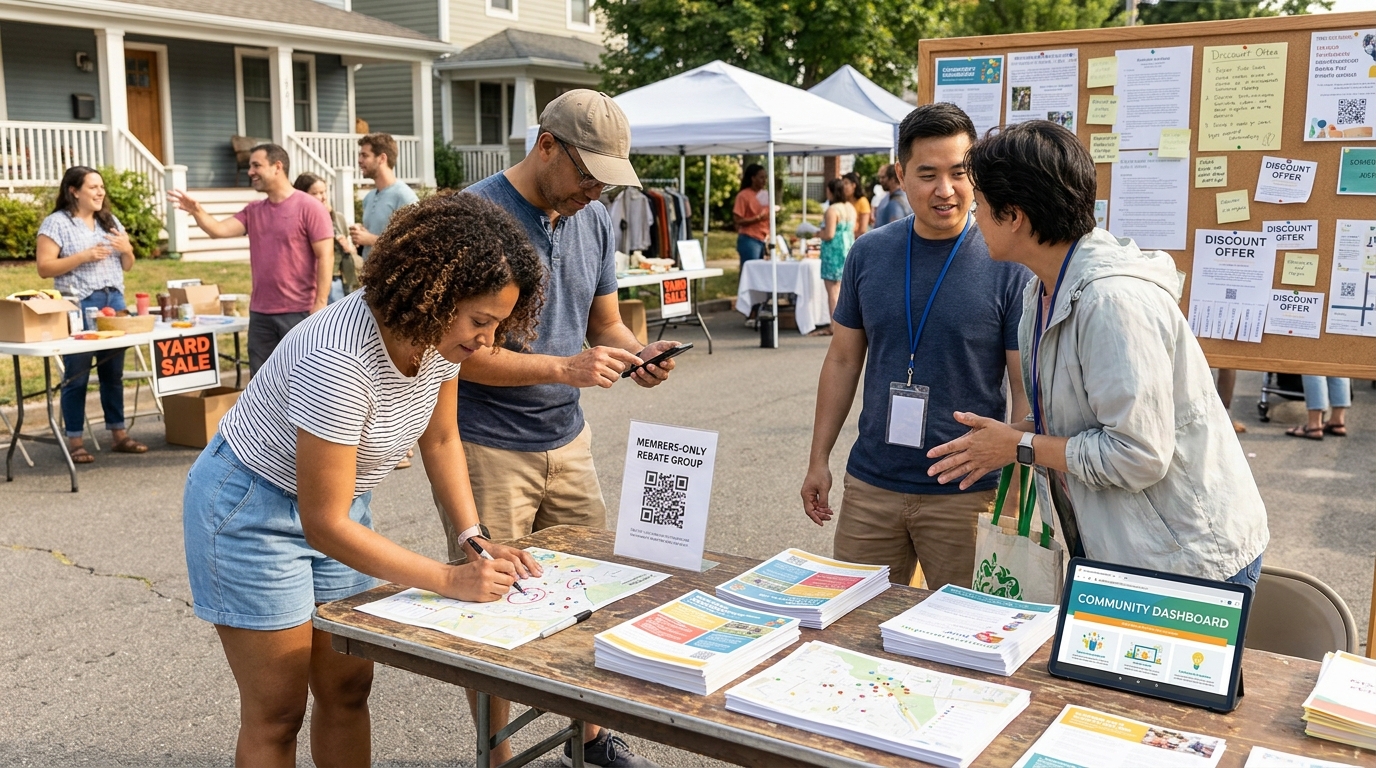
You are not imagining it. Finding real rebate groups online can feel like walking through a hallway full of unlabeled doors. One link leads nowhere. Another wants your payment info too fast. A third looks active until you realize the last real post was months ago. That is why a surprisingly simple move works so well. Stop hunting only inside social feeds and start showing up where rebate-minded people already gather in public. If you want to know how to find local rebate groups at community events, the trick is not just attending an event. It is spotting the people behind the tables, sign-in sheets, sponsor lists and breakout sessions who already organize buying circles, discount pools and rebate programs. Cities, HOAs, churches, chambers of commerce and trade events often put these people in one room. Most attendees focus on the freebies. The smarter play is to meet the humans who know where the real savings live.
⚡ In a Hurry? Key Takeaways
- Public community events are often the easiest place to find real local rebate groups without relying on sketchy invite links.
- Read event pages, organizer notes, sponsor lists and attendee details before you go, then ask direct questions on-site about group discounts and rebate programs.
- Face-to-face meetings are usually safer than blind online joins because you can verify who runs the group and how the savings actually work.
Why this shortcut works
Most rebate groups do not advertise themselves loudly. That sounds backward, but it makes sense.
The best ones are often built around trust. A church budget committee. A neighborhood energy-upgrade group. A local contractor network. A small business association. A parent group sharing bulk-buy deals. These communities usually grow through people who already know one another, or at least share a real local connection.
That is why public events matter. They act like a safe front door.
An energy fair, small business expo, HOA vendor night or church resource event may look ordinary from the outside. But inside, it often gathers exactly the kind of people who know which rebate programs pay, which group discounts are real and which online groups should be avoided.
How to find local rebate groups at community events
You are not going to every event in town. You are choosing the right ones.
Look for events with practical money themes
Start with events tied to saving money, upgrading property or buying in groups. Good examples include:
- Home and garden shows
- Energy-efficiency workshops
- HOA annual meetings with vendors
- City sustainability fairs
- Church community resource days
- Small business networking breakfasts
- Trade association expos
- Local contractor and supplier showcases
If an event mentions incentives, approved vendors, neighborhood improvement, member pricing, business resources or community purchasing, pay attention. Those are clues.
Read the event page like a treasure map
This is the part most people skip.
Before you attend, study the event page. Not casually. Properly. Check:
- The organizer name
- Co-hosts and sponsors
- Vendor or exhibitor lists
- Panel topics
- Registration notes
- Attendee comments
- PDF flyers or linked agendas
You are looking for signs that real rebate communities may be nearby. Phrases like “member savings,” “preferred supplier network,” “bulk purchase initiative,” “community upgrade program,” or “local partner incentives” are often gold.
If this kind of clue-hunting sounds familiar, it pairs nicely with The ‘Neighborhood Noticeboard’ Hack: Turn Local PSA Posts Into Invite-Only Rebate Communities. The same idea applies here. Public posts that look boring often lead to the real local insiders.
Check who is in the room before you get there
The participant list can tell you more than the event headline.
Say a city workshop is about home weatherization. Fine. But if the sponsor list includes a credit union, two local installers, a neighborhood coalition and a church outreach office, that event is no longer just a workshop. It is a meeting point.
That is where you may find:
- People who pool purchases to hit discount thresholds
- Organizers who know active rebate clubs
- Business owners who quietly share referral-based savings groups
- Residents already using local incentive programs
What to do at the event
Do not open with “Can you add me to your group?”
That comes too fast. You want a real conversation first.
Instead, ask simple questions:
- “Are people here coordinating purchases as a group?”
- “Is there a local discount network people use for this?”
- “Do you know who helps residents or members combine rebate deals?”
- “Are there any local groups you trust for this kind of savings?”
Those questions are friendly, specific and not pushy. They also help you spot who actually knows the local scene and who is just staffing a table.
Talk to the non-obvious people
Everyone goes straight to the flashy vendor booth. Sometimes that works. Often, the better lead is the quieter person checking people in, moderating a panel or introducing sponsors.
Why? Because organizers and community partners usually know who keeps showing up and who runs reliable programs.
A church admin may know the family network that coordinates appliance rebates. An HOA board member may know the resident who runs a neighborhood contractor discount list. A chamber staffer may know the business buying group that saves members real money every quarter.
Listen for the trust signals
You are trying to avoid scammy groups. So listen carefully.
Good signs include:
- They explain clearly how the rebate works
- They can name real local partners
- They do not rush you to pay or join on the spot
- They mention past events, members or community references
- They are comfortable answering boring questions about process
Bad signs include:
- They avoid specifics
- They promise huge savings with no paperwork or rules
- They want upfront money before explanation
- They push you to use a random app or private link immediately
- They cannot tell you who else is involved locally
The best event categories for rebate-club piggybacking
City and county events
These are often the safest starting point. Public agencies may host workshops on energy upgrades, water saving, storm prep, business grants or neighborhood improvement. Even if the city itself is not running a rebate group, the partner organizations at the event may be.
HOA and condo association meetings
These are underrated. When a whole building or neighborhood wants roofing, solar, landscaping, pest control, windows or security upgrades, group pricing becomes very attractive. Rebate-minded residents often organize quietly through committees or resident circles.
Churches and faith-based community fairs
These events often bring together trusted local families, support ministries and business owners. That trust matters. Savings groups formed in these spaces may be smaller and less visible online, but often more stable.
Small business and trade events
If you run a small business, this is a big one. Trade shows, chamber mixers and supplier expos can connect you to group purchase programs, merchant rebate pools and member-only vendor discounts that are much harder to find through random searching.
A simple plan for your first event
If this feels like a lot, keep it basic.
- Pick one event with a money-saving angle.
- Read the event page and note three names. Organizer, sponsor, vendor.
- Prepare two questions about local group discounts or rebates.
- Attend for 30 to 60 minutes.
- Talk to at least three people.
- Only follow up with groups that explain things clearly and feel grounded in the local community.
That is it. You do not need to work the whole room like a salesperson. You just need one good lead.
Why face-to-face beats blind clicking
Online groups can be useful. But they are also easy to fake.
At a real-world event, you can do something the internet often blocks. You can connect a person to a place, a role and a reputation. If someone says they run a local rebate network, you can ask who else is involved. You can see whether others know them. You can tell whether their explanation makes sense.
That lowers the chance of joining a dead group, a sloppy operation or an outright scam.
And if you are a Rebate Clubs member, this matters even more. Better communities usually mean better offers, faster trust and fewer wasted hours chasing junk links.
At a Glance: Comparison
| Feature/Aspect | Details | Verdict |
|---|---|---|
| Finding groups online only | Fast, but often full of stale links, fake invites and little proof of who is behind the group. | High convenience, higher risk. |
| Piggybacking on community events | Takes a bit more effort, but gives you real conversations, local references and safer entry points. | Best balance of trust and payoff. |
| Reading organizer and participant clues | Helps you spot where group discounts and rebate leaders are likely to appear before you even leave home. | Smartest first step. |
Conclusion
The big opportunity is hiding in plain sight. Cities, HOAs, churches and business networks are already putting deal seekers, organizers and trusted local partners in the same room. Most people walk past the best part and focus only on the event itself. If you learn how to read event pages, organizer notes and participant lists like a treasure map, you can find safer, higher-payout rebate communities through real conversations instead of blind clicks. For Rebate Clubs members, that can mean better rebates, faster trust and far less risk. And right now, with scam groups multiplying and household budgets under pressure, that is not just helpful. It is important.