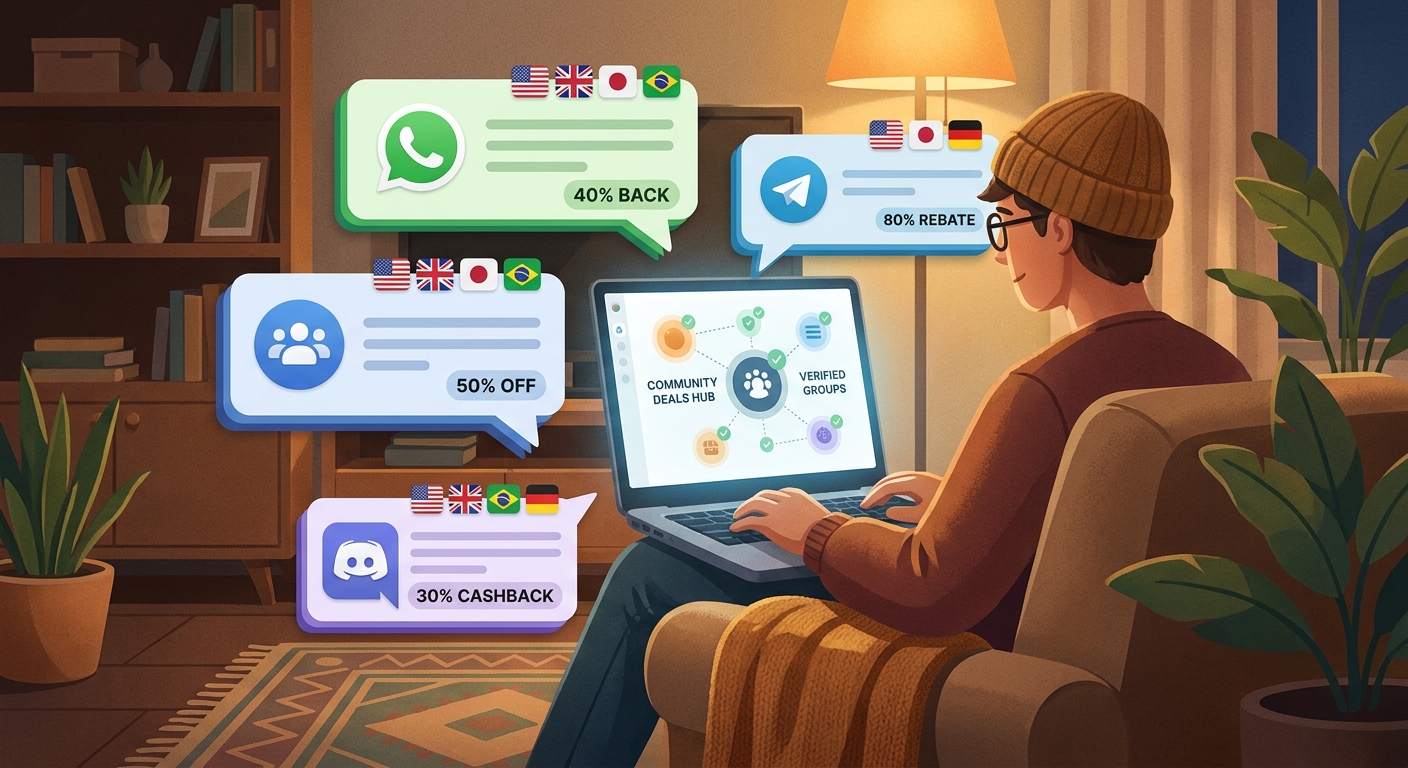
You are not imagining it. A lot of “secret” WhatsApp and Telegram rebate groups really do feel sketchy. One minute you see people bragging about 70% back on everyday items. The next minute you are staring at an invite link from a random comment account, wondering if you are about to join a smart shopping community or walk straight into a mess involving fake offers, stolen cards, or dead channels. That frustration is real, especially if you just want better deals without turning bargain hunting into a part-time investigation. The safer shortcut is not chasing every fresh invite link. It is following established global deal hubs that already run public communities across regions and platforms. Think of it as using the front door instead of climbing through a window. If a deal network already has a visible brand, active public pages, and multiple linked groups, you have a much better shot at finding legit rebate communities without wasting time or taking unnecessary risks.
⚡ In a Hurry? Key Takeaways
- To learn how to safely join legit rebate and deal groups on WhatsApp and Telegram, start with known public deal hubs, not random invite links from comments or DMs.
- Check for signs of a real ecosystem first. Public website, active social accounts, linked channels, clear rules, and a history of posted deals.
- This cuts down the odds of landing in scam groups, fake rebate schemes, or channels tied to stolen-payment abuse.
The Country Hop shortcut explained
The basic idea is simple. Instead of joining one mystery group at a time, you start with a larger public deal community that already has members in different countries and on different apps.
These hubs often run Telegram channels, WhatsApp groups, websites, newsletters, or social pages all at once. That matters because it gives you a trail to follow. You can see who is behind the group, how long they have been posting, and whether people are actually discussing deals instead of just dropping suspicious payment requests.
This is why I call it the “Country Hop” shortcut. You are not trusting a single invite link. You are moving through connected, visible deal communities that already have some structure and reputation.
Why random invite links are such a gamble
A random invite link can lead to a perfectly harmless group. It can also lead to spam, affiliate bait, fake screenshots, or worse. The biggest problem is that you have no context.
No track record
If the link came from a comment section, a DM, or a forwarded message, you often do not know who runs the group, how old it is, or whether previous members had a good experience.
Fake urgency is common
Scammy groups love pressure. “Join now.” “Only five slots left.” “Admin verifies payouts manually.” That kind of language is meant to make you stop checking and start clicking.
Some schemes are not just fake. They are illegal
This is the ugly part. Some “rebate” groups are really fronts for carding, refund fraud, account takeovers, or stolen-payment reselling. Even if you think you are just getting a cheap deal, you do not want your name, number, or shipping address mixed up in that world.
What a safer deal hub looks like
If you want to know how to safely join legit rebate and deal groups on WhatsApp and Telegram, look for a hub that behaves like a real community, not a pop-up trap.
Public-facing presence
A safer hub usually has a website, public Telegram channel, social profile, or landing page you can inspect before joining anything private.
Connected communities
Good signs include one main channel linked to region-specific groups, separate chat and announcement channels, or clear labels like “UK deals,” “US rebates,” or “EU alerts.” That structure shows organization.
Clear rules and moderation
If every post is chaos, be careful. Legit communities tend to pin rules, explain how offers work, warn about expired deals, and remove obvious spam.
Normal deal behavior
Real groups talk about coupon stacking, cashback apps, store policies, shipping limits, and timing. Sketchy groups push private payments, ask for account logins, or promise “guaranteed” returns that make no retail sense.
How to check a group before you join
You do not need to be a security expert. A few basic checks go a long way.
1. Search the hub name outside the app
Look it up on Google, Reddit, Facebook, or X. If it is real, there is often some footprint beyond one invite link.
2. Inspect the public channel first
On Telegram especially, many communities have a public broadcast channel before the chat group. Read a week or two of posts. Do deals look consistent? Do they name stores, prices, and rebate methods clearly?
3. Watch for payment weirdness
If admins ask members to send money directly, buy “access,” share banking details, or hand over retailer account credentials, stop there.
4. Check for expired-link churn
Scammy ecosystems burn through links and names quickly. Legit hubs sometimes rotate links too, but they usually announce changes through their main public pages.
5. Use a burner approach at first
Join with minimal exposure. Do not post your phone number publicly, do not share your home address in chat, and do not connect primary payment accounts until the group proves itself over time.
What “country hopping” actually helps you do
Done right, following global deal hubs can be genuinely useful.
Find live communities faster
Instead of testing ten dead links, you can start from one active hub and branch into regional groups that are already being maintained.
Spot patterns across markets
A rebate trend in one country often shows up elsewhere later. A public global hub can help you see which promotions are real, recurring, and worth your attention.
Stack savings more safely
Better communities often discuss the normal building blocks of legit bargain hunting. Store sales, manufacturer coupons, cashback apps, loyalty points, and official rebates. That is very different from groups built around suspicious payment tricks.
Red flags that should make you leave immediately
Here is the short list. If you see these, get out.
- Admins promise “unlimited” refunds or guaranteed 90% cashback with no explanation.
- Members are told to use someone else’s card, account, or invoice details.
- The group requires crypto or person-to-person payment to unlock deals.
- There is heavy pressure to act before you can verify anything.
- All testimonials look copied, vague, or strangely identical.
- You are asked for retailer logins, banking info, or identity documents.
A simple safe-start routine
If you are curious but cautious, use this routine.
Start with observation
Spend a few days reading before buying anything. Quietly watch the posts, comments, and admin behavior.
Test with a low-stakes deal
If you decide to try one, make it a small, ordinary purchase from a well-known retailer using your own payment method.
Keep records
Screenshot the offer, rebate terms, and any deadlines. Legit deals can still get messy, and having a record helps.
Separate your bargain hunting
Use a dedicated email address for deal communities. If possible, keep your main inbox and main messaging circles separate from promo groups.
Why public ecosystems beat “secret” groups
People hear “secret group” and assume that means better savings. Sometimes it just means less accountability.
Public-facing ecosystems are not perfect, but they are easier to check. They have more eyes on them. They are more likely to correct bad links, flag fake offers, and point members toward verified rebate methods instead of shady shortcuts.
That is the real advantage here. You are not just looking for a discount. You are looking for a setup that lowers risk while still giving you access to collective deal-finding.
At a Glance: Comparison
| Feature/Aspect | Details | Verdict |
|---|---|---|
| Random invite link | Little context, weak history, often shared in comments or DMs | High risk. Avoid unless you can verify it through a trusted public source. |
| Established public deal hub | Visible brand, linked communities, active moderation, clearer deal patterns | Best starting point for safer joining and less wasted time. |
| “Too good to explain” rebate group | Big promises, vague methods, pressure tactics, private payment demands | Walk away. This is where scams and stolen-payment schemes often show up. |
Conclusion
The smart move right now is not hunting harder. It is filtering better. There is a flood of discount and rebate groups popping up around the world, and plenty of the fresh links passed around in comments and DMs are tied to scams, fake offers, or stolen-payment schemes. If you focus on established, public-facing deal hubs that already run multiple channels and communities, you give yourself a safer path into active, curated ecosystems instead of gambling on one-off invites. That means less time wasted, fewer bad surprises, and a better chance to tap real group buying power and stack verified rebates with confidence. You do not need a secret backdoor. You need a community that can be checked before it can be trusted.