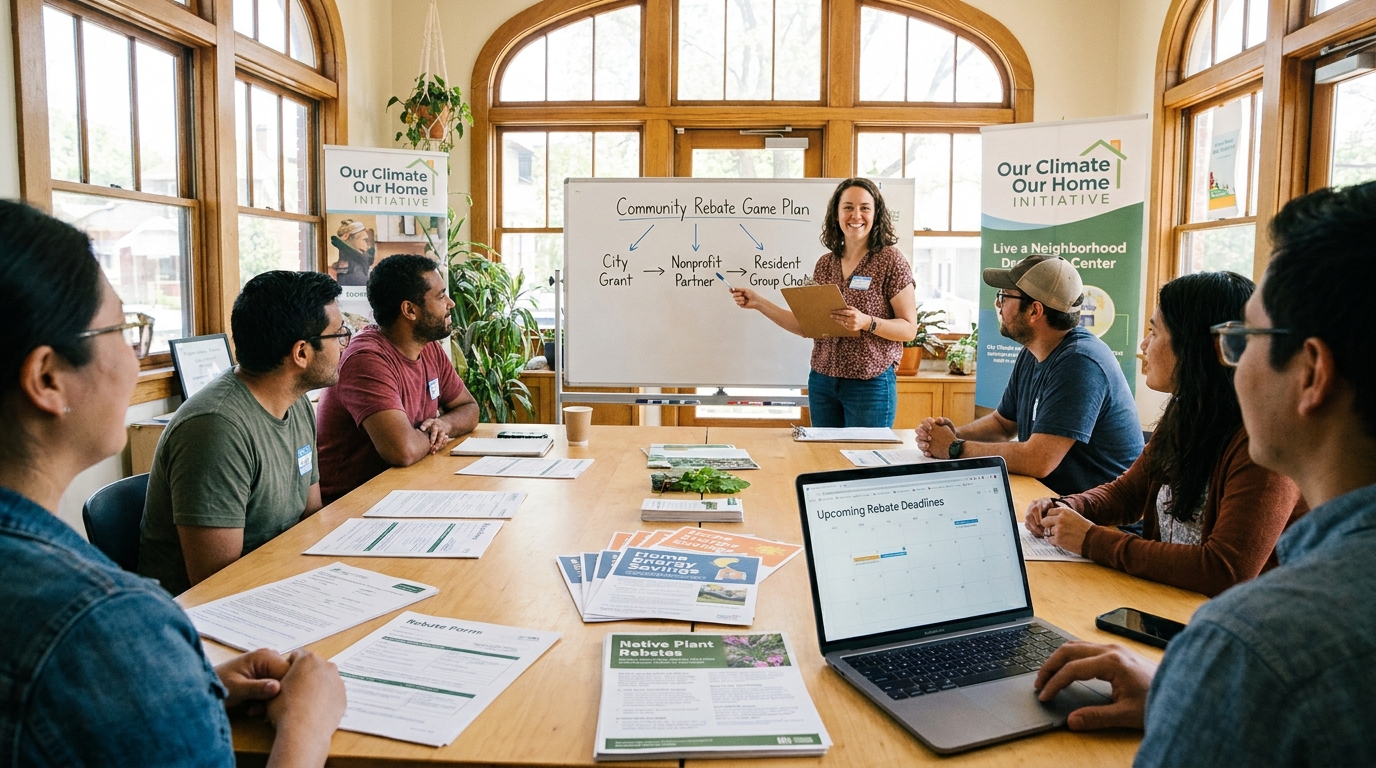
You are not crazy if rebate hunting feels weirdly harder than it should be. You hear about people getting money back for insulation, heat pumps, EV chargers, lawn removal, rain barrels, even native plants. Then you search online and fall into a swamp of city PDFs, utility pages, expired grant notices, and forms that look like they were last updated three mayors ago. Meanwhile somebody down the street somehow got a free home energy visit and a much bigger rebate than the one you found. What gives? Usually, the money is not hiding in some secret app. It is moving through local nonprofits, city partners, utilities, watershed groups, and neighborhood programs that need real households to join in batches. If you know how to find those groups, attend one workshop, and get on the right mailing list, you can often move from public info to insider-level opportunities pretty fast.
⚡ In a Hurry? Key Takeaways
- Local community rebate programs are often the easiest path to bigger 2026 savings because nonprofits, councils, and utilities are paid to enroll groups of residents.
- Start with workshops, webinars, and neighborhood sign-up pages, then follow the trail to small cohorts, installer lists, and staff contacts who help with paperwork.
- Stick with real grant-backed groups tied to your city, county, utility, or established nonprofit. That cuts down the risk of scams and expired offers.
The real shortcut is not a coupon. It is a community program.
When people search how to join local community rebate programs, they usually expect a single portal with a clean list of offers. That is not how many of the best deals work right now.
A lot of 2026 funding is being pushed out through local partners. Think nonprofit climate groups, watershed councils, neighborhood associations, county sustainability offices, utility conservation teams, and native plant organizations. These groups get funding goals. They need a certain number of homes, blocks, or households to participate.
That changes everything.
Instead of waiting for random consumers to stumble in, these programs often create small rebate communities. Join the info session. Get into the email list. Fill out the interest form. Suddenly you are in a group that gets better instructions, preferred contractors, reminder emails, and sometimes extra bonus money for joining as part of a cohort.
Why neighbors seem to get better rebates than the public pages show
It is usually not because they are richer, better connected, or gaming the system. Often they just found the local organizer before you did.
Public pages are the top layer
The public website is often basic because it has to cover everyone. It may only show the standard utility rebate or the broad city offer.
The real action happens one step deeper
Once you attend a webinar or join a neighborhood challenge, you may hear about:
- extra stackable utility incentives
- free site visits or energy coaching
- group purchasing discounts
- paperwork help
- special funding for income-qualified households
- pilot programs that are not heavily advertised yet
This is also why buying clubs and community cohorts overlap so often. If you want to see how group deals can quietly beat public offers, read The ‘Quiet Co‑op’ Shortcut: Slip Into Serious Rebate Power By Piggybacking On Existing Buying Clubs. The same “you had to be in the room” feeling shows up here too.
Who is running these programs in your city?
Look for organizations that already manage public-interest projects. They are the most likely to have grant money and participation targets.
Good places to look
- Your electric, gas, or water utility
- City sustainability or environmental departments
- County energy offices
- Watershed councils and water conservation nonprofits
- Native plant societies and garden nonprofits
- Air quality districts
- Community action agencies
- Local climate alliances
- Housing nonprofits
- Neighborhood associations with “green homes” or resilience programs
Search phrases that actually work
Skip broad searches like “best home rebates near me.” Try these instead:
- your city + home energy workshop rebate
- your county + electrification program
- your utility + community rebate program
- your city + rain garden native plant rebate
- your county + lawn conversion grant
- your utility + neighborhood pilot EV charger
- your city + climate action webinar homeowner
Also search the words program partner, community outreach, cohort, pilot, technical assistance, and implementation support. Those terms often lead to the real operator, not just the official funding source.
How to join local community rebate programs without getting lost
Here is the simple path.
1. Find the public front door
Look for an event page, webinar registration, interest form, newsletter sign-up, or community challenge page. If a program is active, there is usually some low-pressure entry point.
2. Join even if you are “just curious”
Do not wait until you are 100 percent sure you want a heat pump, charger, or landscape project. Many of the best offers go first to people already on the list.
3. Watch for the handoff
This is the part most people miss. After the public webinar, there is often a next-step email inviting you to:
- a smaller orientation call
- a neighborhood cohort
- a contractor matchmaking event
- a rebate pre-screening form
- a private group Q&A
- a site assessment waitlist
4. Reply to the human being
If a program manager or outreach coordinator signs the email, answer it. Ask, “Are there upcoming funding rounds, group discounts, or partner rebates I should know about?” That one message can save you weeks of random searching.
5. Ask the stacking question
Always ask what can be combined. For example:
- utility rebate + city incentive
- water district rebate + native plant grant
- state charger program + utility make-ready support
- home energy audit + installer discount + tax credit
Program staff usually know what stacks cleanly and what order to file things in.
What these micro-communities often offer that public shoppers miss
The money matters, of course. But the hidden value is often the hand-holding.
Paperwork help
Many residents give up because forms are annoying. Local programs know this. Some will pre-screen your eligibility, review invoices, or walk you through application steps.
Preferred installers
You may get a short list of contractors who already know the program rules. That means fewer mistakes and fewer rejected rebates.
Participation bonuses
Some grants reward neighborhoods or groups for hitting enrollment targets. If ten homes sign up, the support level may improve. If fifty do, the program may add workshops, coaching, or extra funds.
Earlier notice
This is a big one. Once you are in the orbit of a local nonprofit or utility partner, you are more likely to hear about new pilots before they are widely promoted.
Red flags to watch for
Not every “community program” is worth your time. A few checks can keep you safe.
- No clear tie to a utility, city, county, school, or established nonprofit
- Pressure to pay a large fee upfront just to access basic rebate information
- Vague promises of “guaranteed” savings without written program details
- No physical address, no staff names, no public partners
- Expired dates or broken application links all over the site
A legitimate group should be able to explain who funds the program, what zip codes qualify, what deadlines matter, and what the application process looks like.
Best categories to target in 2026
If you want the best odds of finding active local funding windows, start with areas where public agencies have clear participation goals.
Home energy upgrades
Heat pumps, insulation, sealing, induction, panel work, and home energy coaching are still strong categories in many places.
Water conservation
Think turf replacement, drip irrigation, rain barrels, smart controllers, and stormwater-friendly yard projects.
Native plants and habitat
This is one of the quieter rebate spaces. Local districts and nonprofits often fund demonstration gardens, pollinator yards, and low-water conversions.
EV charging
Some of the best opportunities are tied to utilities, multifamily housing, or neighborhood charging pilots rather than broad consumer ads.
A simple script you can use today
If you find a local program and are not sure what to ask, send this:
Hello, I live in your service area and I’m interested in current home or yard rebate programs. Are there any upcoming workshops, group sign-ups, pilot programs, or partner incentives for residents in 2026? I’d also like to know whether your team helps with paperwork or approved contractor lists. Thank you.
That is it. Short, clear, and easy for staff to answer.
At a Glance: Comparison
| Feature/Aspect | Details | Verdict |
|---|---|---|
| Public rebate search | Broad results, old pages, lots of self-service research, easy to miss local add-ons | Useful for a first pass, but rarely the best final path |
| Community nonprofit or utility program | Workshops, staff help, group enrollment, better awareness of stackable incentives | Often the smartest route for active 2026 funding |
| Private cohort or buying group | May include negotiated pricing, vetted installers, and smoother paperwork after you join | Great if tied to a real local partner and clear program rules |
Conclusion
The main thing to remember is this. The best rebate opportunities are often not sitting on flashy consumer websites waiting to be claimed. Right now, a lot of the new money is flowing through community-based programs run by nonprofits, councils, and utilities. These groups are quietly building small communities of residents so they can hit participation goals for home energy, water conservation, EV charging, and native plant projects. When you join their workshops, get on their lists, and follow the trail from public webinar to smaller cohort to private rebate group, you stop chasing dead links and start getting in front of current 2026 funding windows. That is how people end up with bigger, easier, more stacked savings, sometimes with paperwork help included. Keep using Rebate Clubs as your guide. The real win is not one lucky rebate. It is learning how to plug into the local grant machinery again and again as new programs roll out.