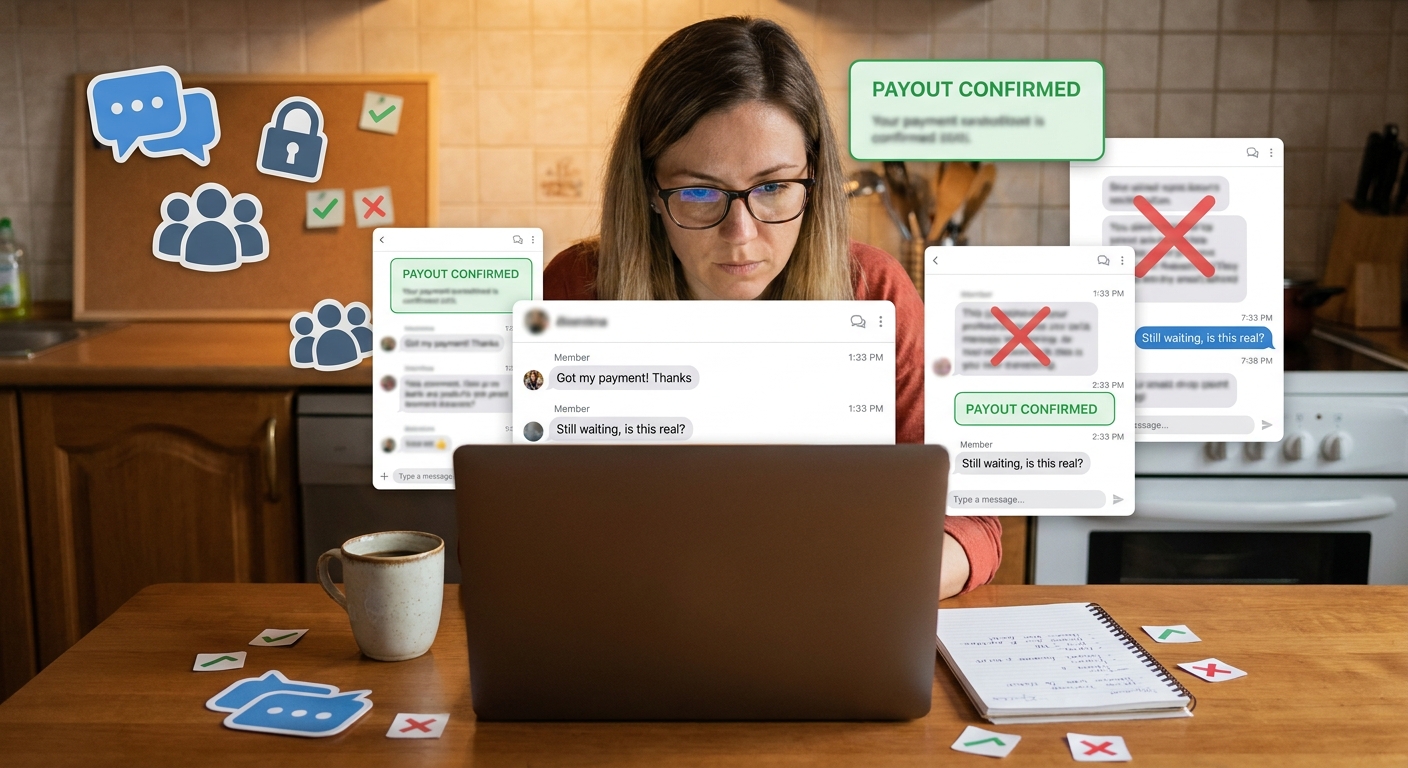
You should not have to play detective every time a rebate group promises easy money back. Yet that is where a lot of shoppers are right now. They join a Telegram channel, a Facebook group, or a Discord server, see people hyping “fast payouts,” buy the product, submit the form, and then the group goes quiet. No reply. No rebate. Just a lesson that came after money was already spent. If you want to know how to verify rebate groups before joining, start with one simple rule. Do not trust screenshots of deals. Trust proof of payout. A real group can show a pattern of members actually getting paid, not just admins making promises. That shortcut alone will save you from most bad groups. It is quick, practical, and a lot more useful than trying to guess who sounds trustworthy in a busy chat full of urgency and FOMO.
⚡ In a Hurry? Key Takeaways
- Only join rebate groups that can show recent, consistent proof that real members were paid.
- Ask for payout evidence from multiple members, across different dates, before you buy anything.
- If a group uses pressure, hides admin identity, or avoids payout questions, walk away.
The Proof of Payout Shortcut
Most scammy rebate groups have one thing in common. They are great at selling the deal and terrible at proving the payout.
That gives you a very useful shortcut.
Before joining, or at least before spending a dollar, ask one question: Can this group prove that ordinary members have actually been paid, recently and more than once?
Not “the admin says yes.” Not “someone posted a cropped Cash App screenshot three months ago.” Real proof. Repeated proof. From real people.
This matters because fake groups often copy the look of legit rebate communities. They post polished graphics, limited-time offers, and cheerful comments. But when payout day comes, they stall, change rules, or disappear.
If you remember only one thing, remember this. Deals are easy to fake. Payout history is harder to fake at scale.
How to Verify Rebate Groups Before Joining
1. Look for a payout trail, not a one-off screenshot
A real community should have a visible pattern of successful payouts. You want to see multiple examples over time.
Good signs include:
- Members posting received payments on different dates
- Comments that mention the rebate amount, timing, and process
- Payout confirmations from more than one platform, like PayPal, Venmo, or bank transfer
- Older payout posts that are still visible, not deleted after a week
One screenshot proves almost nothing. Ten payout reports from different members over two months tells a much better story.
2. Check whether the proof comes from members, not just admins
This is where many people get tripped up. Admin-posted “success” screenshots are easy to stage.
What you really want is independent member confirmation. Scroll through the group. See if regular people are saying things like “Got mine today,” “Paid in 48 hours,” or “Mine took 5 days but it came through.”
Natural conversation is hard to fake well. Especially over time.
If every positive message sounds the same, comes from brand-new accounts, or appears only right after someone asks “Is this legit?”, be careful.
3. Ask a simple question in the group
You do not need to be dramatic. Just ask plainly: “Has anyone here been paid in the last two weeks?”
Then watch what happens.
In a legit group, members usually answer. In a bad one, you may get silence, vague reassurance, or an admin who suddenly becomes defensive.
That reaction tells you a lot.
4. Watch for rule changes after you buy
One classic trick is moving the goalposts. The group says the rebate is easy, then adds new steps later.
Examples:
- “You forgot to submit in the right format”
- “Now you need to invite three friends first”
- “Payouts are delayed until next cycle”
- “This offer only counted for premium members”
Read the group rules before joining. Take screenshots. If the terms are fuzzy, that is not a small issue. That is the issue.
5. Search outside the group
Never rely only on information inside a rebate group. Search the group name, admin name, and payment method on Google, Reddit, Facebook, and scam-report forums.
If several people say the same thing, pay attention. Especially if they mention missed payouts, deleted chats, or banned members after asking questions.
This is also why it helps to start in better places. If you are still looking for communities worth checking, 5 Quiet Places Smart Shoppers Use To Find Legit Rebate Communities (Before The Masses Show Up) is a useful guide for finding groups before they get flooded with copycats and noise.
Red Flags That Usually Mean “Leave Now”
Some warning signs are subtle. Others are basically a flashing red light.
Pressure to act immediately
If the whole pitch is “buy now or miss out forever,” slow down. Scammers love urgency because urgency shuts off common sense.
No clear payout schedule
A legit group should be able to explain when and how rebates are paid. “Soon” is not a schedule.
Admin identity is completely hidden
Privacy is one thing. Total anonymity plus money collection is another. If nobody knows who runs the group and there is no reputation attached to the account, your risk goes up.
Questions get deleted
If members asking about late payments are muted, mocked, or removed, that is all the answer you need.
Upfront fees for access to “secret” rebates
Be very careful here. Some paid communities are real, but scam groups often charge a small entry fee because it adds up fast. If there is a fee, proof of payout needs to be even stronger.
A Simple 5-Minute Vetting Checklist
If you want the fast version, use this before joining any group:
- Can I find recent payout proof from multiple members?
- Are the rules clear and saved in writing?
- Do members answer payout questions openly?
- Can I find outside mentions of the group that are not from the admin?
- Is there any pressure to spend before I have time to check?
If you answer “no” to two or more of those, skip the group.
What Legit Rebate Communities Usually Look Like
Real communities are not always flashy. In fact, the better ones are often a little boring.
That is a good thing.
They tend to have:
- Clear posting rules
- Visible admin communication
- Repeat members, not random new accounts every day
- Past payout history people can scroll back and review
- Reasonable deal language instead of nonstop hype
Legit groups know trust is their whole business. They do not act offended when you verify them. They expect it.
At a Glance: Comparison
| Feature/Aspect | Details | Verdict |
|---|---|---|
| Proof of payout | Multiple recent member confirmations, visible history, clear payment timing | Strong sign of a legit group |
| Group behavior | Open answers to questions, stable rules, no panic-driven pressure to buy fast | Safer and more trustworthy |
| Scam indicators | Deleted questions, vague promises, hidden admins, one-off screenshots, sudden rule changes | Avoid immediately |
Conclusion
Right now there is a wave of shady discount and rebate groups riding the collective buying trend, especially on encrypted chats and invite-only communities. That makes it easy to feel rushed, especially when a deal window looks like it is about to close. But you do not need to guess. The cleanest shortcut is proof of payout. If a group cannot show that real members actually got paid, recently and consistently, do not join. This simple habit helps you avoid losing cash, makes it easier to separate real rebate communities from hype, and strengthens the wider Rebate Clubs community because smart shoppers start sharing proof instead of promises. Slow down, check the payout trail, and trust evidence over excitement.