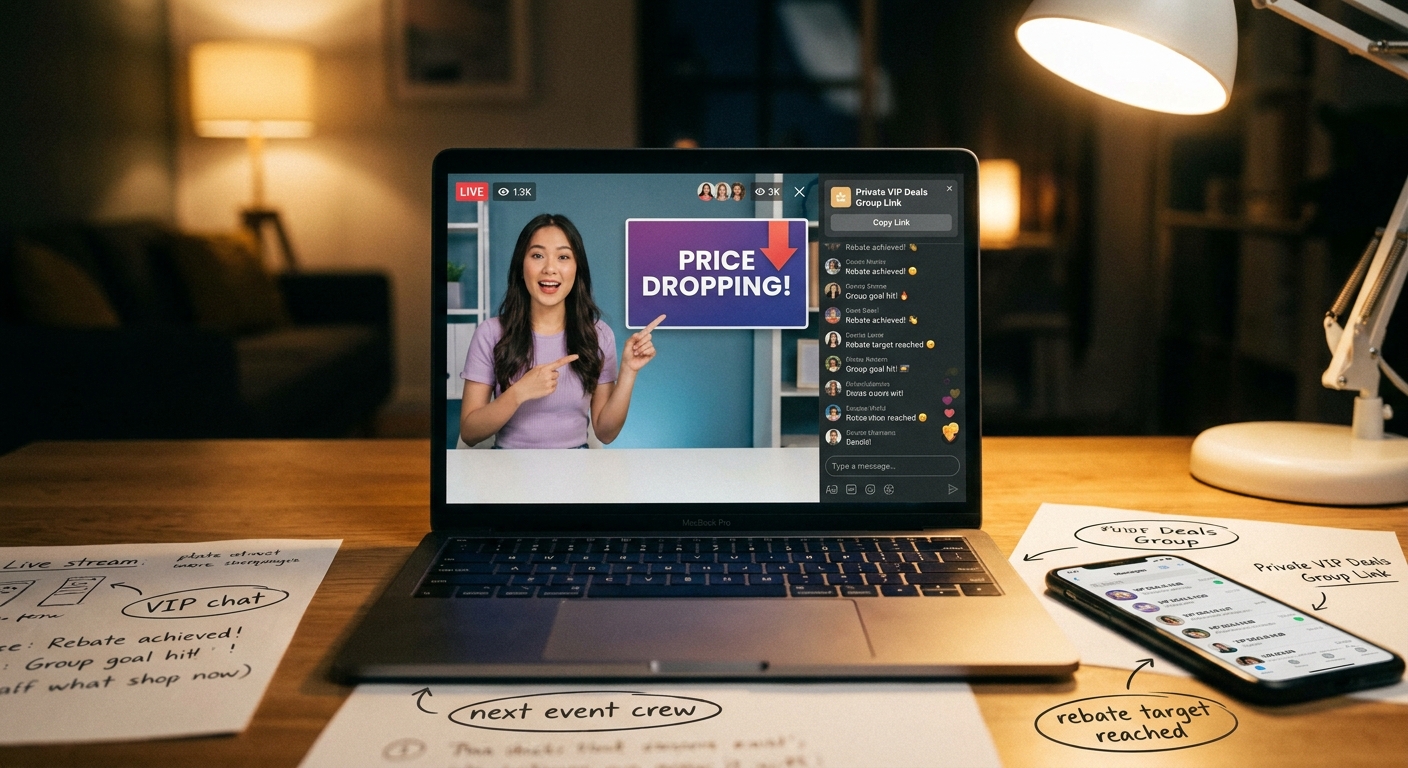
You are not imagining it. A lot of “exclusive” rebate groups really do look shady. One invite link sends you to a silent Telegram channel. Another drops you into a Facebook group full of recycled coupon posts and zero proof that anyone got paid. That is why many shoppers miss the safer shortcut sitting right in front of them. Live shopping events. The public livestream is often just the front porch. The real value shows up when the host, brand rep, or repeat buyers start pulling regulars into a smaller group to coordinate future drops, bonus links, stacked rebates, and group-buy thresholds. If you want to know how to join live shopping rebate groups without wandering into scam territory, start with events that already have a visible host, active comments, order screenshots, and repeat buyers who come back every week. You are not chasing a secret club. You are watching for a real shopping crowd that keeps meeting after the stream ends.
⚡ In a Hurry? Key Takeaways
- The safest way to join live shopping rebate groups is to start inside a public livestream with a real host, real buyers, and visible deal history.
- Watch for clues like repeat commenters, post-stream group invites, buyer screenshots, and hosts who explain exactly how rebates and group pricing work.
- Avoid random invite links with no event context, no payment proof, and pressure to act off-platform right away.
Why livestreams are the new front door
Most people still treat live shopping like background noise. A host talks fast, a timer counts down, and a coupon flashes on screen. Fine if you just want one deal.
But that is not where the best savings usually stop.
Many live events quietly create a repeat-buyer crowd. Once enough people show up every week, the host or a power buyer often starts a Telegram, WhatsApp, or Facebook group to keep everyone together between events. That is where people share restock alerts, rebate deadlines, bundle ideas, and “we need five more buyers to unlock the lower price” messages.
That is the real trick behind how to join live shopping rebate groups. You do not begin by hunting secret links. You begin by finding a live event that already behaves like a community.
What a legit rebate group looks like during a live event
You can usually spot the difference in ten minutes.
Signs you are looking at a real group forming
A good event has a host with a consistent schedule, not a one-time account that appeared yesterday. The comments are full of actual questions and actual answers. People mention past orders. Some will say things like “last week’s pack arrived” or “the cashback hit this morning.”
You may also see buyers helping each other. That matters. Scam-heavy channels tend to be one-way broadcasts. Real communities have back-and-forth.
Look for these specific clues
- Repeat names in the chat from one event to the next
- Hosts referring to a buyer group for reminders or bonus links
- Screenshots of shipped orders, rebate confirmations, or redeemed cashback
- Clear rules on how to qualify for the discount or rebate
- Comments that mention prior group buys actually closing successfully
If you see those patterns, you are probably watching a live sale that has a real “after party” group behind it.
How to join live shopping rebate groups without getting burned
Here is the safe, boring method. It works better than chasing mystery links.
1. Start with the livestream, not the invite link
If someone posts “join our rebate crew” with no event attached, skip it. Instead, join a live shopping event on a platform where you can see the host, the product, the comments, and the timeline of posts. That public trail gives you context.
2. Stay for the comment section
The chat tells you almost everything. Are people asking where to submit receipts? Are others answering from experience? Is the host patient and specific? Good signs.
If the comments are just “DM me” over and over, bad sign.
3. Wait for the group invite to come from the host or pinned post
The safest invites usually come one of three ways. A pinned comment during the event. A follow-up post on the brand or host page. Or a direct mention from a moderator you can already see working in the live chat.
That is much safer than a random stranger in comments saying “message me for secret rebates.”
4. Check whether the group has a memory
When you land in the Telegram, WhatsApp, or Facebook group, scroll up. A real group has history. Older deal posts. Questions from buyers. Shipping updates. Maybe a few expired offers. That is good. It means the group existed before you got there and will likely exist next week too.
5. Verify the math
Before you buy anything, make sure the host explains:
- The sale price
- The coupon or code
- The rebate amount
- Any minimum group size needed
- How and when payout happens
If nobody can explain how the savings stack, do not spend your money.
The best kinds of events to watch
Not every livestream turns into a useful rebate crew. Some are pure entertainment. Some are just hard sells.
The most promising ones usually fit into a few buckets.
Host-led repeat sales
These are weekly or near-weekly streams where the same host sells similar categories. Beauty, household basics, snacks, supplements, gadgets. Buyers get comfortable. The community starts to remember each other. That is where repeat groups are born.
Threshold-based group buying events
These are especially useful. The price drops when enough people join. That structure naturally pushes buyers to coordinate outside the event, because everyone benefits when the group fills fast.
Niche enthusiast events
Think specialty foods, hobby supplies, kids’ items, pet products, or regional brands. Smaller audiences can actually be better because the comments are easier to read and the buyer history is easier to verify.
Red flags that should make you leave immediately
This part matters more than the coupon.
No public trail
If the “deal group” seems disconnected from any real event, seller, or host, walk away.
Pressure to pay a person directly
If someone wants Venmo, Cash App, crypto, gift cards, or bank transfer instead of using a normal checkout, that is a huge warning sign.
No proof of past payouts or deliveries
A real group should be able to show buyer history. Not perfect proof, but enough to show that orders ship and rebates land.
Too many platforms too fast
If you are pushed from TikTok to Telegram to a private website to a weird payment page in three minutes, stop. The more they try to move you away from public view, the less protection you have.
Fake urgency with no specifics
“Only 30 seconds left” means nothing if there is no clear item, no posted terms, and no visible checkout flow.
How to tell whether a group is worth rejoining every week
Joining once is easy. Rejoining is only worth it if the group saves you time, not just money.
A useful group does three things well:
- It posts deals clearly
- It has enough active members to fill group thresholds
- It keeps enough history that you can learn from past buyers
You want the kind of group where regulars say, “Last week this stacked with a cashback app,” or “Wait until Friday, the host usually adds a second code.” That kind of memory is valuable.
It is similar to what happens in small real-world rebate teams. If you like the idea of turning regular shopping into a repeat savings habit, The ‘Grocery Cart Circle’ Shortcut: Turn Weekly Store Runs Into Real-Life Rebate Crews shows how the same logic works offline too.
A simple starter plan for this week
If this all sounds useful but a little messy, try this:
Step 1
Pick one platform where live shopping already happens a lot. Stay with mainstream spaces first.
Step 2
Watch two or three events in the same product category. Do not buy yet. Just observe.
Step 3
Write down the names of hosts who have repeat buyers and clean, specific explanations.
Step 4
Join only the group linked by the host or official moderator.
Step 5
Lurk for a week. See if the same people return, whether deals close, and whether buyers report results.
Step 6
Test with one small purchase, not a cart full of “can’t miss” items.
That is the easiest way to learn how to join live shopping rebate groups without making an expensive mistake.
At a Glance: Comparison
| Feature/Aspect | Details | Verdict |
|---|---|---|
| Public livestream with active chat | You can see the host, buyer questions, product details, and deal history before joining any private group. | Best starting point |
| Random Telegram or Facebook invite | No context, unclear ownership, and often little proof that rebates or shipments are real. | High risk, usually skip |
| Persistent weekly buyer group | Repeat members, archived posts, stackable savings tips, and faster group-buy coordination. | Most useful long-term option |
Conclusion
Live shopping is not just noisy modern QVC. It is turning into a very practical way to find real buyer communities in plain sight. Once you know how to spot the signs, you can turn a one-off stream into a weekly rebate crew with active hosts, visible engagement, and a track record you can actually check. That means better stackable savings now, and less risk later. The goal is not to chase every “exclusive” invite. It is to find the groups that already act like real communities, then rejoin the ones that keep proving themselves.