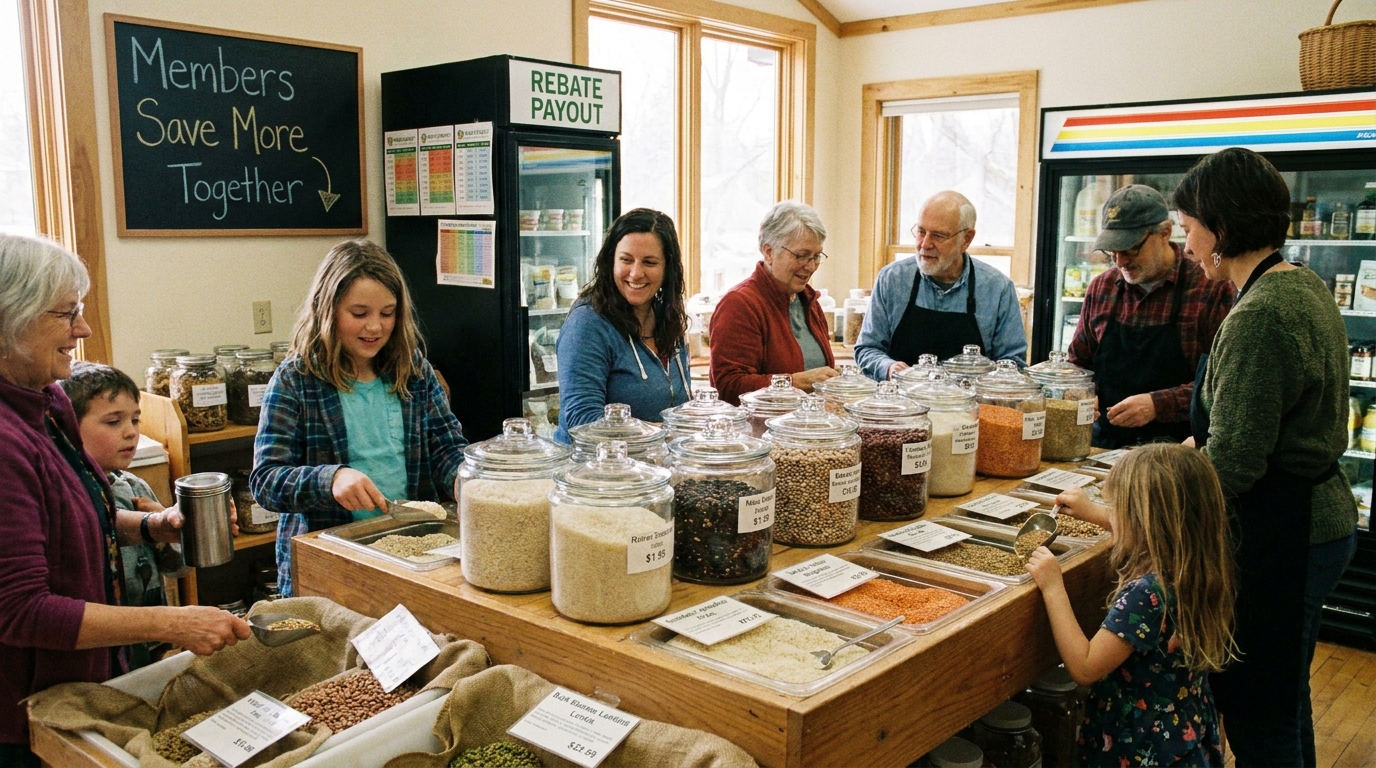
You are not imagining it. The internet is full of screenshots of cheap flour, canned goods, paper towels, and detergent that seem almost too good to be real. Then you click through and hit a wall of weird membership terms, wholesale forms, or people pitching it like you need to become a reseller by Friday. That is exhausting. If all you want is a normal, neighborly way to save on basics, the good news is this. Real local bulk-buy groups do exist, and many of the best ones look a lot more like food co-ops, buying clubs, church pantry groups, farm-share pickups, and community associations than flashy “opportunities.” If you are wondering how to join local bulk buying club for rebates, start close to home. The safest options are the ones with real pickup points, clear pricing, simple member rules, and actual people you can talk to before you hand over a dime.
⚡ In a Hurry? Key Takeaways
- Yes, you can join a real local bulk buying club for rebates without starting a business. Look for food co-ops, community buying clubs, and member-based neighborhood groups.
- Ask three things before joining: how orders work, where rebates or savings show up, and whether there are membership fees or minimum buys.
- If the math is fuzzy, the products are random, or the pitch feels pushy, walk away. The best clubs are transparent and easy to explain.
What a real neighborhood bulk-buy club actually looks like
Let’s clear up the biggest confusion first. A local bulk-buy club is not always a formal “club” with a shiny website and branded tote bags.
Sometimes it is a food co-op with monthly ordering. Sometimes it is a school or church group that combines household orders. Sometimes it is a farm market network that also buys pantry staples in volume. The common thread is simple. A bunch of people buy together so everyone gets better pricing.
In some groups, the savings happen upfront as lower prices. In others, members get year-end patronage refunds, store credits, or rebate-style payouts based on how much the group bought. Either way, the point is the same. Group buying makes the math work better than solo shopping.
How to join local bulk buying club for rebates
If you want the short version, here it is. Find a local co-op or buying group, ask how membership works, confirm how savings are returned, and start with one small order.
That is the basic path. Here is how to do it without wasting your time.
1. Search locally, not nationally
Use plain search terms like:
- food co-op near me
- community buying club [your town]
- bulk food cooperative [your county]
- member grocery co-op [your city]
- church pantry buying group [your area]
Also check Facebook community groups, library bulletin boards, local farm directories, and extension office websites. Old-school places often know about the good stuff before Google does.
2. Look for signs that it is a real community group
A trustworthy club usually has at least a few of these:
- A local pickup location
- Named organizers or a board
- Posted member rules
- Regular order cycles
- Product lists with clear pricing
- Some explanation of fees, credits, or rebates
If all you see is hype, vague promises, or “message me for the secret,” keep moving.
3. Ask the three questions that matter most
You do not need to sound like an auditor. Just ask:
- How do orders get placed and picked up?
- How do members actually save money or receive rebates?
- Are there fees, work requirements, or minimum orders?
Those three questions cut through most of the nonsense fast.
4. Start small
Do not open with a giant order of shelf-stable everything. Buy a few things you already use. Rice. Oats. Beans. Flour. Dish soap. Toilet paper. Stuff you know your household will actually go through.
This lets you test product quality, pickup logistics, and whether the promised savings are real.
Where rebates show up in the real world
This is where many people get tripped up. “Rebate” does not always mean a check magically landing in your mailbox every month.
In local co-ops and buying clubs, savings can show up in a few different ways:
Lower member pricing
This is the easiest to understand. Members pay less than non-members because the group is buying in volume.
Patronage refunds
Some co-ops return extra revenue to members at the end of the year based on how much they spent.
Bulk-order credits
Some groups negotiate discounts, then pass part of that back as order credits after the buy closes.
Vendor promos stacked through the group
This is where the club gets more interesting. A group may qualify for supplier specials, local grant-backed food access programs, or rotating discounts that a single household would never see on its own.
The main thing is transparency. If nobody can clearly explain where the savings come from, be careful.
What makes a food co-op better than a random “bulk-buy opportunity”
The biggest difference is that co-ops are usually built around service, not recruitment.
You are joining to buy food and household goods at a better price. Not to recruit your cousin. Not to stock a garage full of product. Not to become a part-time motivational speaker on social media.
That is why local co-ops often feel refreshingly boring. And in this case, boring is good.
They also tend to be values-driven. That can mean local sourcing, lower packaging waste, shared governance, fair pricing, or support for nearby producers. Even if your main goal is saving money, it is nice when the setup does not feel greasy.
Red flags that should make you back away
Not every buying group is worth your money or your trust. Watch for these warning signs:
- You cannot see sample prices before paying
- The savings are described in vague, exciting language instead of numbers
- There is pressure to recruit others
- The products seem random and constantly changing
- The fee structure is confusing
- No physical pickup point or local contact exists
- People spend more time talking about “the opportunity” than the groceries
If it feels like a side hustle in disguise, it probably is.
Good places to find these clubs without getting lost
Start with organizations that already exist in your town. Co-ops are not the only path.
You may also find useful leads through neighborhood business groups and local associations. If you want another low-drama route into community-based savings, The ‘Chamber Shortcut’: Turn Boring Business Memberships Into Real Rebate Clubs You Can Join Locally is worth a look. It is a good reminder that some of the best rebate networks hide in plain sight.
Other places to check:
- Independent grocery stores with member days
- Farm co-ops and CSA pickup sites
- School parent groups
- Faith communities
- Community centers
- Local Facebook groups and Buy Nothing spinoffs
How to tell if the savings are actually worth it
Cheap is nice. Useful cheap is better.
Before joining, compare the group’s prices on 10 things you buy often. Not fancy one-time items. Real staples. Then add any membership fee and divide it across a month or a year.
For example, if membership costs $40 a year and you save $8 a month on basics, the math starts working pretty quickly. If the pricing only beats your regular store on obscure items in giant quantities, maybe not.
Do not forget the “sanity savings”
There is also value in having one trusted place to buy a bunch of basics at once, especially if your current routine involves chasing five separate store deals and clipping digital coupons that expire in 14 minutes.
Convenience matters. Trust matters. Not having to guess whether a website is sketchy matters too.
If you are shy about joining, here is the easy first move
Email the organizer and ask if you can observe one order cycle or attend one pickup. Plenty of groups are happy to explain how they work before asking you to commit.
You are not being difficult. You are being sensible.
A real community buying club should be able to explain itself in plain English. If they can’t, that tells you something.
At a Glance: Comparison
| Feature/Aspect | Details | Verdict |
|---|---|---|
| Membership structure | Local co-ops and real buying clubs usually explain fees, pickup rules, and member benefits clearly. | Good sign if the rules are simple and visible upfront. |
| How savings work | Savings may come as lower member prices, order credits, or year-end patronage refunds. | Best when the math is easy to follow. |
| Risk level | Community groups with local contacts and real pickup points are usually much safer than vague online “opportunities.” | Stick with groups that feel local, transparent, and low-pressure. |
Conclusion
You do not need to become a reseller, decode wholesale jargon, or join a sketchy internet club to save on basics. Right now, prices on groceries and household staples are still squeezing everyone, and people want ways to save that feel human, not spammy or scammy. Local co-ops and bulk-buy clubs can offer exactly that. The math is usually clearer, the people are real neighbors, and the savings can build over time instead of vanishing after one flashy promo code. Start small, ask plain questions, and trust the groups that make it easy to understand how the savings work. That is usually where the real deals live.