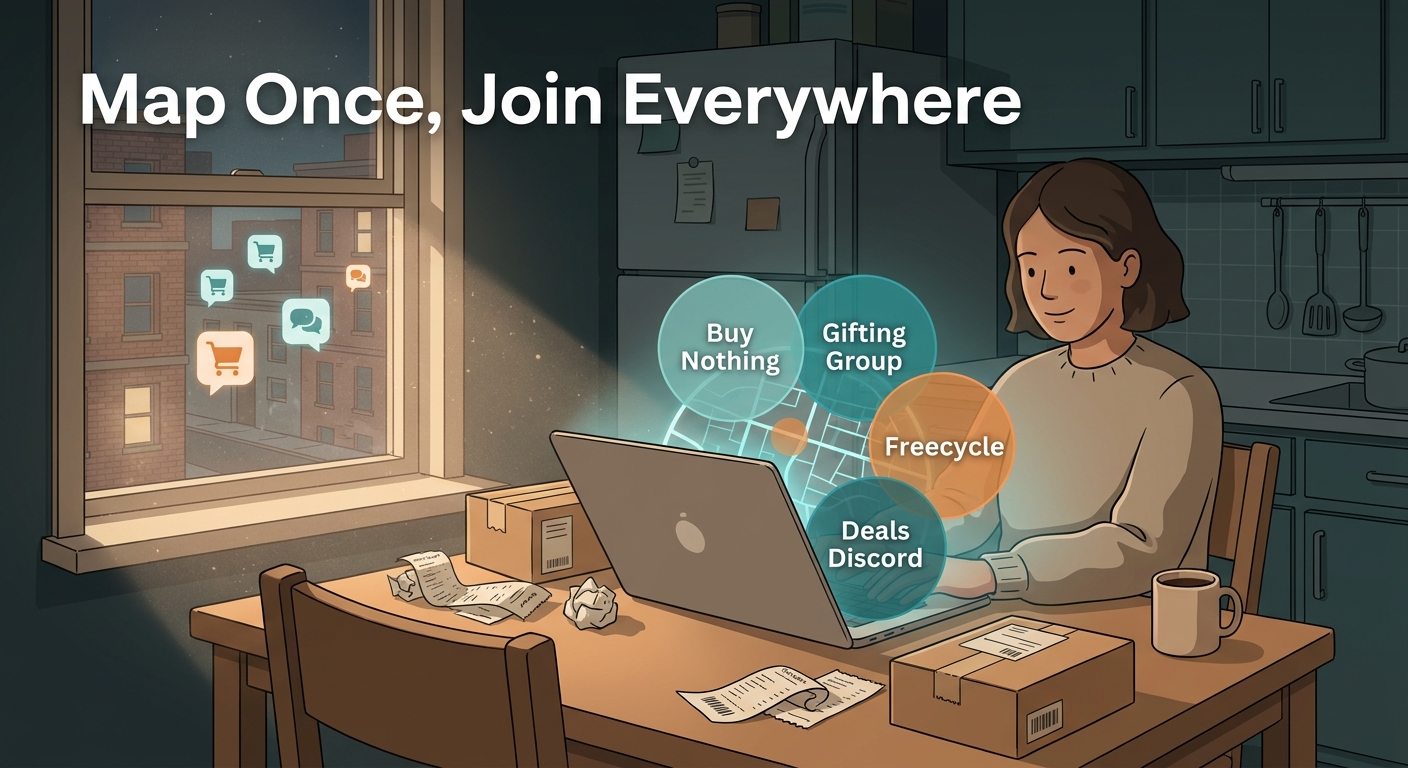
You are not doing anything wrong if Buy Nothing feels weirdly hard to join. A lot of people search for it, find three abandoned Facebook groups, one app with unclear boundaries, and a pending request that never moves. Meanwhile, someone two streets over is getting a free air fryer, extra diapers, and a heads-up about a grocery gift card promo before it hits the big deal sites. That gap is real. The trick is that “Buy Nothing” is no longer the only name people use. Some groups split off, some moved platforms, and some quietly rebranded as community gifting, neighborhood sharing, or mutual aid swaps. If you want to know how to find and join buy nothing and local gifting groups, stop searching one exact phrase and start building a local map. Once you do that, these groups can act less like random free-stuff pages and more like hidden rebate clubs with real weekly savings.
⚡ In a Hurry? Key Takeaways
- The fastest way to find active groups is to search by your neighborhood plus related names like “Buy Nothing,” “gifting,” “freecycle,” “mutual aid,” and “community sharing,” across Facebook, the Buy Nothing app, Nextdoor, Discord, and Reddit.
- Join a few small local groups first, then watch for posts about store promos, surplus food, curb alerts, loyalty freebies, and neighborhood referrals that turn free sharing into real savings.
- Skip any group pushing prepaid card “flips,” Telegram-only deals, or up-front payments. Good local gifting groups do not ask you to buy your way in.
Why this feels harder than it should
Ten years ago, you could search one phrase, join one Facebook group, and call it a day. Not anymore.
Now there is the official Buy Nothing brand, unofficial spin-offs, neighborhood gift circles, school-parent swap groups, church pantry boards, apartment resident chats, and “community help” pages that function like gifting groups even if they never say so.
That is why basic search results feel incomplete. You are looking for one label, but the real action is spread across five different labels and three platforms.
It is similar to what happens in mutual aid spaces. If you want another angle on that overlap, The ‘Mutual Aid Shortcut’: Turn Quiet Help Groups Into Real Rebate Circles You Can Join Today explains how community help groups often become practical money-saving circles once you know what to watch for.
How to find and join buy nothing and local gifting groups
Step 1: Search your exact area, not just your city
Start smaller than you think. Search your:
- Neighborhood name
- ZIP code
- Apartment complex name
- School district
- Nearby town names
Use combinations like:
- “Buy Nothing [neighborhood]”
- “gifting group [ZIP code]”
- “community gifting [town name]”
- “freecycle [city]”
- “mutual aid [neighborhood]”
- “free stuff [neighborhood] Facebook”
- “pay it forward [town]”
- “curb alert group [city]”
This matters because many groups are hyper-local. If you search only your big city name, you may miss the active group that uses your subdivision or district instead.
Step 2: Check more than Facebook
Facebook still matters, but it is no longer the whole picture. Look in five places:
- Facebook. Search Groups, not just regular posts.
- Buy Nothing app. Useful in some areas, dead in others. Worth checking anyway.
- Nextdoor. Good for curb alerts, food giveaways, and quick local referrals.
- Reddit. Search your city subreddit for “Buy Nothing,” “free,” “mutual aid,” and “gifting.”
- Discord. Local deal servers, parent swap servers, and college community servers often share freebies and loyalty promos.
Do not ignore community bulletin sources either. Library calendars, church newsletters, school PTA pages, and apartment resident portals often point to private groups that search engines never show.
Step 3: Look for alternate names
This is the part most people miss.
A group may do the exact same thing as Buy Nothing and never use those words. Search for:
- Gifting with Integrity
- Community Gifting
- Neighborhood Share
- Pay Nothing
- Pay It Forward
- Everything Free
- Freecycle
- Mutual Aid
- Blessings Group
- Curb Alert
- No Sell Group
- Local Swap
If a group bans selling but encourages giving, borrowing, sharing leftovers, or posting needs, it can still be useful even if it does not carry the official Buy Nothing label.
Step 4: Figure out if a group is alive before you apply
Dead groups waste time. Before you request access, check:
- How many posts appeared in the last 7 days
- Whether admins have posted recently
- How many comments active posts receive
- Whether people actually mark items as picked up
- Whether the rules mention a platform move
If the latest post is from six months ago, move on.
If the pinned post says “we moved to the app” or “join our Signal/Discord,” follow that trail. This is often where the real community went.
Step 5: Answer membership questions carefully
A lot of pending requests sit forever because people rush this part.
Use your real neighborhood if asked. Agree to the rules clearly. If there is a prompt like “Why do you want to join?” keep it simple: “I live in the area and would like to give and receive locally.”
Some groups reject profiles that look brand new, fake, or blank. If your Facebook account has no photo, no location, and no friends, that can slow things down.
You do not need to overshare. Just look like a real local person.
How these groups become “hidden rebate clubs”
This is where things get interesting.
Strictly speaking, gifting groups are not rebate sites. But in real life, they often create rebate-like savings because members pass along things that reduce what you would have spent anyway.
Common examples include:
- Unused grocery loyalty rewards
- Restaurant birthday freebies someone cannot use
- Baby formula checks and manufacturer coupons
- Store credit from a return with no receipt
- Buy one get one offers people want to split
- Energy-saving kits from utility programs
- Extra produce from CSA boxes or garden surplus
- Referral bonuses for internet, power, and delivery apps
- Free samples and promo bundles from brand ambassadors
None of that shows up when you keep refreshing Marketplace for cheap furniture. It shows up when you are inside a trusted local group where people know who can use something this week.
How to connect your local map to real savings this week
Start with a simple savings map
Make a note on your phone with five sections:
- Facebook gifting groups
- Buy Nothing app groups
- Nextdoor neighborhoods
- Local Discord or Reddit communities
- Cashback and coupon communities
Add links, membership status, and a quick note like “active,” “slow,” or “dead.”
Within 30 minutes, you will usually spot which places are worth your time.
Watch for three kinds of posts
If your goal is practical savings, do not just look for random free lamps.
Focus on posts that lower recurring costs:
- Groceries. Pantry extras, coupon bundles, expiring meal kits, loyalty point giveaways.
- Energy and home. Fans, blackout curtains, weather strips, free utility kits, spare air filters.
- Family basics. Diapers, kids clothes, school supplies, unopened toiletries, pet food.
Those are the items that make a real difference when bills are high.
Pair local groups with active deal communities
This is the shortcut.
Use gifting groups for local trust and fast pickups. Use deal Discords and cashback groups for timing. If a Discord flags a grocery app promo or a utility referral bonus, your local group may be the best place to split extras, pass along bonus items, or find someone with matching loyalty perks.
For example, if a store is running a “spend $50, get $10 back” promotion, local groups often help people bundle purchases, share category-specific coupons, or move the free extras quickly instead of letting them go to waste.
What a good group looks like
You do not need a perfect group. You need one that is active, local, and normal.
Good signs include:
- Clear rules about gifting and pickups
- Regular posts with comments from real people
- Admins who approve members and remove spam
- Members posting both offers and requests
- Specific pickup areas, not vague “DM me” chaos
Bonus points if the group also shares local tips like which grocery store marks down produce at night, which pharmacy has monthly rewards, or where utility rebates are easiest to claim.
What to avoid
There are a few red flags that should send you in the other direction.
- Anyone asking for money to access “exclusive” freebie channels
- Telegram groups promising gift card multiplication
- Posts that ask you to send a verification code
- Admins who push crypto, prepaid card schemes, or fake mystery shopper offers
- Groups with endless affiliate links and no real local exchanges
A healthy gifting group is boring in the best possible way. It is neighbors giving away a toaster, extra tomatoes, and a coupon they cannot use. That is what you want.
Best first message if you are new
If you finally get in, do not overthink your first post.
Try something like:
“Hi neighbors, I’m new here and nearby. Happy to learn the group rules. I can offer a few unopened pantry items this week, and I’m also keeping an eye out for kids winter gear and any grocery savings tips.”
That works because it shows you understand the give-and-take of the group. Even if you need more than you can offer right now, starting politely helps people trust you.
If your area has no active Buy Nothing group
That does happen.
If so, build your own mix instead:
- One local free group
- One mutual aid group
- One school or parent swap group
- One apartment or neighborhood chat
- One deal or cashback Discord
Together, that often works better than waiting for one perfect Buy Nothing group to appear.
At a Glance: Comparison
| Feature/Aspect | Details | Verdict |
|---|---|---|
| Where to search first | Facebook Groups, Buy Nothing app, Nextdoor, local Reddit, and neighborhood Discords searched by exact area name | Best approach. Do not rely on one platform. |
| Best savings potential | Groups that share groceries, household basics, referral bonuses, store promos, and loyalty rewards | Highest real-world value for weekly budgets |
| Safety and scam risk | Low in moderated local groups, much higher in Telegram-only “rebate” channels or pay-to-enter clubs | Stick with verified local communities |
Conclusion
If you have been frustrated trying to figure out how to find and join buy nothing and local gifting groups, the fix is not more searching of the same old phrase. It is a better map. Search by neighborhood, try alternate group names, check multiple platforms, and skip anything that looks dead or sketchy. Energy and grocery prices are still beating people up, and the fastest savings often come from small trusted communities sharing free goods, free upgrades, loyalty points, and local tips under names you would never think to search. Once you connect those groups to active deal Discords and cashback communities, you stop wasting time on dead pages and scammy channels and start finding practical savings you can use this week.