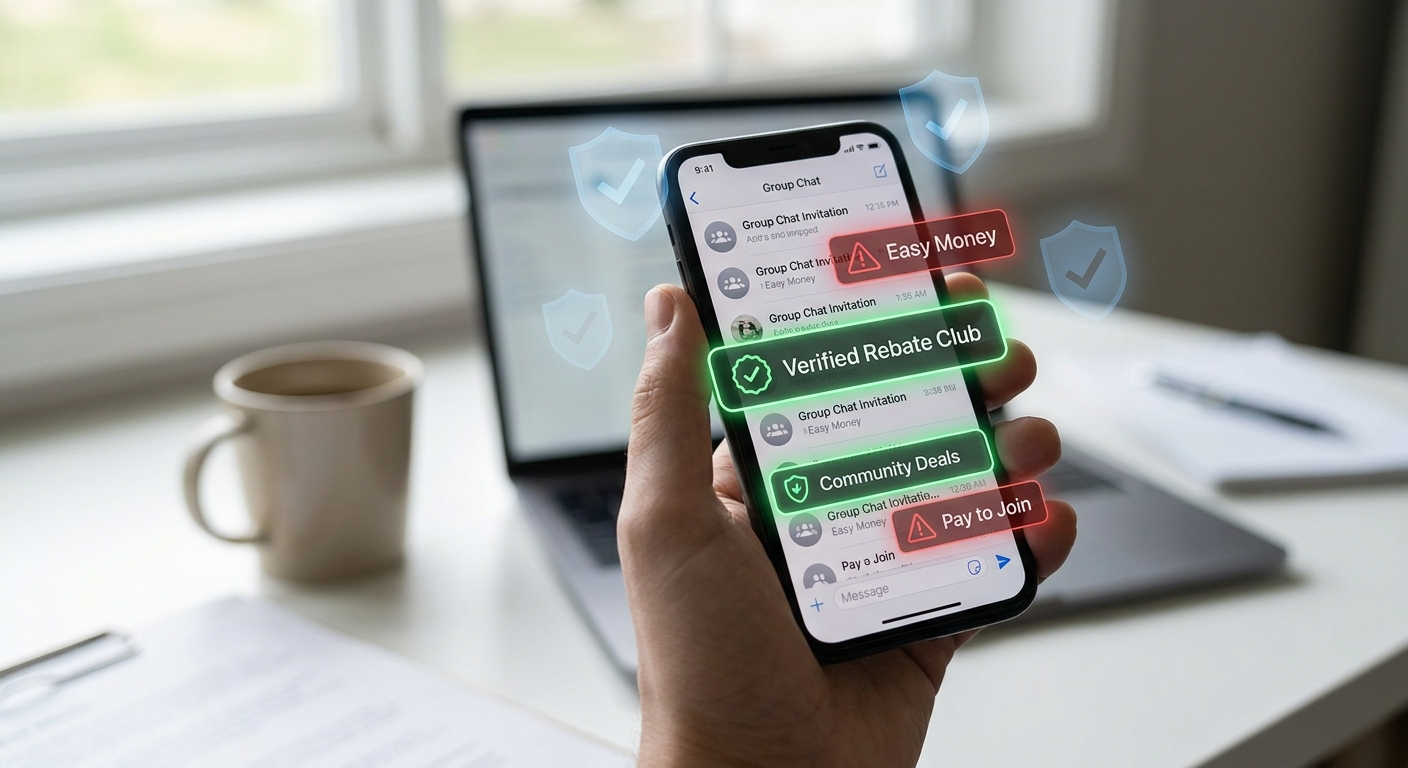
You are not wrong to feel uneasy. A lot of rebate groups on WhatsApp, Telegram, Discord, and Facebook really do save people serious money. But plenty of them also look one tiny step away from a phishing trap, a fake job scam, or a “send $20 first” hustle. That mix is what makes this so frustrating. You want the group discount, not the risk of losing your account, your card details, or your phone number to strangers. The good news is you do not need to become a cybercrime expert to spot the difference. A quick check I call the Safe Signal Test can tell you a lot before you ever click Join. It is basically a fast scan of the group name, description, recent posts, link behavior, and how members act. If a group passes those signals, it may be worth a closer look. If it fails two or three, walk away. Cheap deals are never worth expensive problems.
⚡ In a Hurry? Key Takeaways
- The safest way to join WhatsApp and Telegram rebate groups is to check for clear rules, normal member chatter, verifiable deal history, and no upfront payment demands.
- Use the Safe Signal Test. Scan the title, description, pinned posts, last 20 messages, and admin behavior before you join or buy anything.
- Real groups may be private, but scammy groups often push urgency, off-platform payments, fake screenshots, and “50% off for everyone” offers that make no sense.
The Safe Signal Test, a 2-minute filter before you join
If you are trying to figure out how to safely join WhatsApp and Telegram rebate groups, start here. Before you join, or at least before you act on anything inside the group, check five things.
1. Read the group title like a warning label
A legit rebate group title usually sounds boring. That is a good sign. It might mention product categories, regions, store names, or simple terms like “deals,” “rebates,” “price matches,” or “coupon alerts.”
A sketchy title often tries too hard. Watch for phrases like:
- Guaranteed profit
- Daily earning tasks
- 100% approved payouts
- 50% off everything
- VIP payment access
If the title sounds more like a side-hustle pitch than a shopping group, that is your first red flag.
2. Check the description for plain-English rules
Real communities usually explain what the group is for, what members should post, and what is not allowed. You want to see some kind of structure. Even a short description helps.
Good signs:
- Clear purpose, such as Amazon rebates, local store deals, or cashback stacking
- Rules about spam, referral dumping, and private-message scams
- Admin contact info or a linked community page
- A note that members should never send money to unlock deals
Bad signs:
- No description at all
- Lots of hype, no rules
- Payment instructions in the description
- Pressure to contact only one person for “special access”
3. Read the last 20 posts, not just the pinned one
This is where the truth usually shows up.
A real rebate group has normal human messiness. Questions. Thank-yous. A few expired deals. Someone saying, “This worked for me.” Someone else saying, “Code is dead now.” That is healthy.
A fake or risky group often has a weird pattern:
- Only screenshots, no discussion
- Members posting identical praise
- No one asks basic questions
- Every “success story” sounds copied
- Admins delete concerns fast
If every message feels staged, assume it probably is.
4. Look at what the group asks you to do first
This one matters a lot. Legit deal groups typically ask you to read the rules, watch for product links, maybe post your own finds, or use standard shopping apps and store pages.
Walk away if the first step is any of these:
- Pay a fee to enter
- Send money to “activate” your account
- Do a purchase with a promise of later reimbursement from a stranger
- Share your login, one-time code, or banking app screenshot
- Move to a private chat before seeing the deal terms
That is not a rebate club. That is a setup.
5. Check whether the savings make basic sense
A real community can find impressive discounts. Bulk buying, coupon stacking, cashback, price mistakes, invite perks, and seller promos are all real. But there is still math involved.
If a brand-new group promises endless 50 percent discounts on popular products with no conditions, ask yourself the obvious question. Who is eating that cost?
Sometimes the answer is “nobody,” because the whole thing is built on stolen cards, fake reviews, account abuse, or bait-and-switch refunds. If the discount looks too clean and too constant, be careful.
What legit rebate groups usually look like
Not every private group is shady. In fact, some of the best ones are a little hard to find because they stay quieter on purpose. They do not want spam, bots, or copycats flooding the chat.
That is why invite-only access by itself is not a scam sign. It just needs context. If you are trying to figure out whether a private link is normal or suspicious, this guide on The “Invite‑Only Trail” Shortcut: Turn Quiet Referral Links Into Real Rebate Clubs You Can Actually Join is worth a look. It explains the difference between a guarded front door and a locked room with no windows.
Legit groups often share a few common habits:
- Admins explain how deals work
- Members report when deals expire
- Posts link to known stores or standard checkout pages
- There is no pressure to keep secrets from payment platforms
- People talk about product quality, shipping, and real-world results
Red flags that should stop you cold
Some warning signs are strong enough that you should leave immediately.
“Task” language
If the group talks about completing tasks, unlocking levels, boosting commissions, or increasing your earning tier, you may not be looking at a shopping community at all. A lot of fake rebate scams borrow the language of shopping to lure people into fake work schemes.
Off-platform payment pressure
If a deal only works after you send crypto, gift cards, Zelle, Cash App, or direct bank transfer to a person in the group, stop there. Real savings communities do not need you to fund a stranger.
Stolen-card vibes
Be blunt with yourself. “Half off any item, any time, no limits” is not a normal retail model. It can signal card fraud, hacked seller accounts, or reshipping abuse. You do not want your name, shipping address, or payment method anywhere near that.
No independent footprint
A trustworthy community does not need to be famous, but it should have some trace of normal life. Maybe a website. Maybe a Reddit mention. Maybe older social posts. Maybe comments from real members across time. If the group appeared yesterday and already claims thousands in payouts, be skeptical.
A simple join safely checklist
Here is the friendly IT version. Before you join or buy, ask:
- Can I tell what this group actually does in one sentence?
- Are the rules visible and sensible?
- Do recent posts sound like real people talking?
- Are deals linked to known stores or normal checkout paths?
- Is there zero pressure to send money first?
- Would I be comfortable showing this process to my bank if something went wrong?
If the answer to that last one is no, trust that feeling.
How to protect yourself even in good groups
Let us say a group looks fine. Good. You should still keep your guard up a bit.
Use a separate email for deal hunting
This cuts down on spam and keeps your main inbox cleaner if a group gets noisy or turns sloppy later.
Do not share screenshots with personal info
Order numbers, addresses, and partial card details can reveal more than you think.
Use payment methods with buyer protection
Credit cards are usually safer than debit cards for online buying disputes. Avoid direct transfers to people.
Turn on two-factor authentication
Especially for WhatsApp, Telegram, email, and shopping accounts. Account takeovers often start with one leaked code or one reused password.
Start small
Do not make your first test purchase a $300 gadget. Try a low-cost item and see how the group handles instructions, support, and follow-up.
What to do if a group feels wrong after you join
Leave. Report if needed. Change any password you shared nearby. If you clicked a strange link, run a security scan on your device and watch your accounts for unusual logins or charges.
You do not owe a suspicious group one more chance just because you already joined it. A lot of scams depend on that exact hesitation.
At a Glance: Comparison
| Feature/Aspect | Details | Verdict |
|---|---|---|
| Group description | Clear purpose, rules, admin info, no payment demand | Good sign |
| Recent member activity | Natural questions, deal updates, mixed reactions, expired offers noted | Usually trustworthy |
| Upfront fees or secret payment steps | Entry charges, direct transfers, crypto, gift cards, “unlock” payments | High risk, avoid |
Conclusion
There are real savings to be found in rebate groups, and there are also plenty of bad actors borrowing the look and language of those communities. That is why a fast vetting habit matters so much right now. A quick scan of the group title, description, recent posts, and member behavior can save you from fake tasks, stolen-card “50% off” schemes, and pay-to-enter code rings. It can also help you find the communities that are actually worth your time. The goal is not to be paranoid. It is to be steady. When more shoppers use simple checks like the Safe Signal Test, the whole Rebate Clubs world gets cleaner, more useful, and more trustworthy. You still get the upside of group buying power. You just stop paying for it with your money, your account security, or your peace of mind.