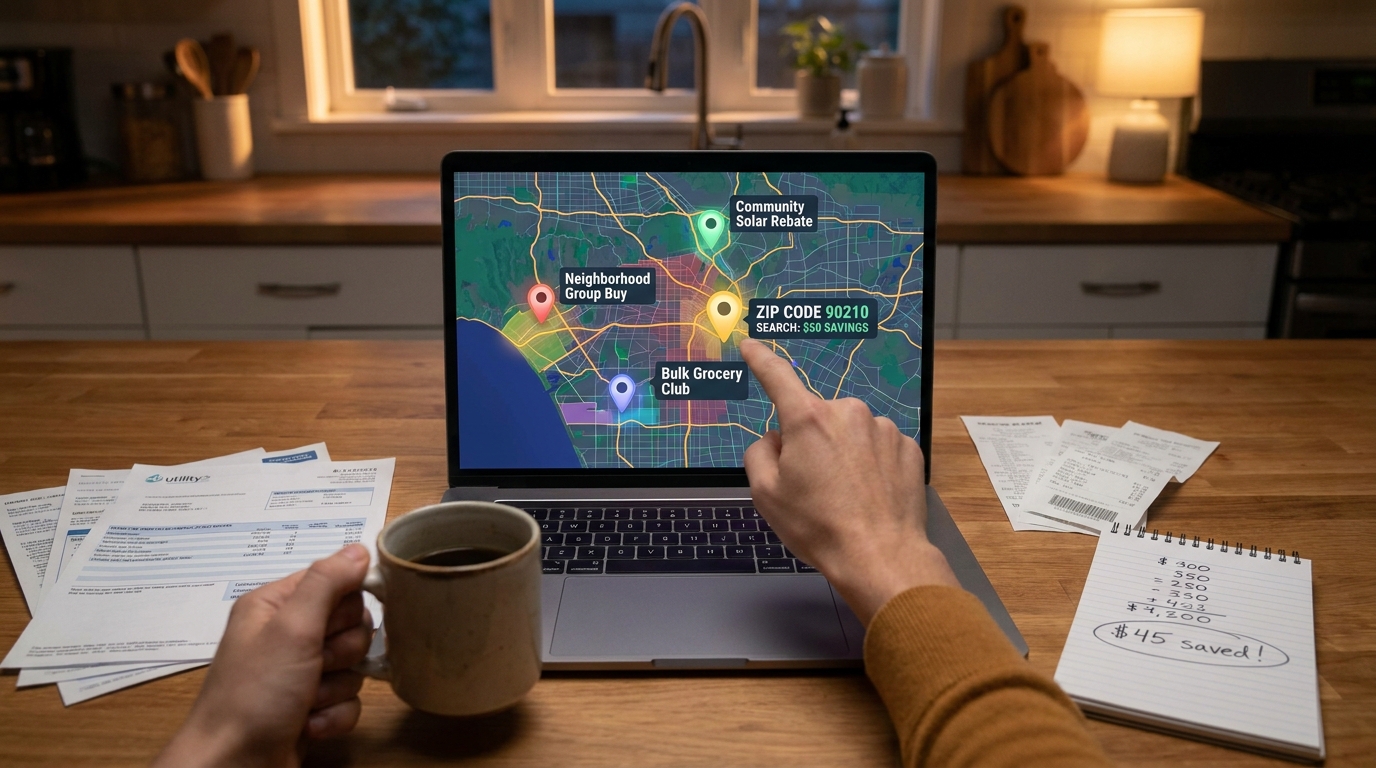
You are not wrong if searching for rebate clubs feels like wandering through a yard sale full of handwritten signs. Most people start with Facebook, Reddit, or random coupon forums. Then they hit the same wall. Half the groups look abandoned. The other half look a little too eager to collect your email, phone number, or Venmo. What you actually need is much simpler. Start with geography, not products. If you search for active rebate and group-buy communities by ZIP code first, you can spot real local programs much faster and skip a lot of the junk. That small shift matters because more neighborhood buying platforms and community rebate programs now quietly offer map tools, directory pages, and ZIP search features. They just do a terrible job of making them obvious. Once you know where those hidden maps live, finding a legit club nearby gets a lot easier, and a lot safer.
⚡ In a Hurry? Key Takeaways
- To find local rebate and group buy clubs by ZIP code, search for location tools, community maps, and member directories first, not product deals.
- Use your ZIP plus terms like “community buying,” “group buy map,” “rebate program,” and “near me” to uncover active local clubs fast.
- Real clubs usually show organizer names, meeting areas, partner stores, or verified signup pages. Scams stay vague and push for payment or personal info too early.
The ZIP code shortcut most shoppers miss
Here is the mistake most people make. They search for a thing.
“TV rebate group.” “Bulk grocery deal club.” “Appliance rebate forum.”
That sounds reasonable, but it often leads you into national deal chatter instead of local buying communities. A much better approach is to search for the community first, then see what kinds of deals that community handles.
If you want to know how to find local rebate and group buy clubs by zip code, think like you are looking for a neighborhood association, not a coupon code.
What to search instead
Use searches built around your location:
- your ZIP code + group buy
- your ZIP code + rebate club
- your ZIP code + community buying program
- your city + neighborhood buying club
- your ZIP code + member map
- your county + rebate program near me
This changes the results you get. Instead of endless deal pages, you are more likely to see local directories, map pages, utility-backed programs, neighborhood co-ops, and platform landing pages with actual coverage areas.
Where the hidden group-buy maps usually live
These tools are often there. They are just tucked away in places most people never click.
1. Community platform “Find a group” pages
Many newer buying platforms have a page that says things like “Find your local organizer,” “See groups near you,” or “Check availability by ZIP.” It may not rank well in Google, but it is often sitting one or two clicks deep on the platform’s site.
Look in website menus for:
- Locations
- Communities
- Coverage map
- Find a chapter
- Join local group
2. Utility and city rebate pages
Some of the best rebate communities grow out of energy, appliance, home upgrade, or recycling programs. The public page may look boring, but the partner network behind it can be very useful.
If you are trying to join something real, utility-backed and city-backed programs are often safer than random social media groups.
3. Store partner locators
A surprising number of rebate clubs are organized around local merchants, warehouses, installers, or co-ops. Their websites may have a dealer locator, approved partner map, or event schedule by ZIP code.
This is also where vendor questions help. If you are already talking to a local seller, this related guide can save time: The ‘Supplier Shortcut’: Use One Hidden Question To Turn Vendors Into Instant Rebate Clubs.
4. Facebook and Nextdoor, but only after the map step
Social platforms should be your second stop, not your first. Once you know a real local platform or partner exists in your ZIP code, then Facebook or Nextdoor becomes a way to confirm activity, not a blind search for it.
How to mine a ZIP code map like a pro
You do not need special tools. Just a method.
Step 1: Find the coverage area
Enter your ZIP code into any locator, map, or “near you” field you can find. If there is no search box, scan the city list or county list.
Your first goal is not to join anything yet. It is simply to answer one question.
Does this club actually exist near me?
Step 2: Check for signs of a real, active community
A legit group usually has at least two or three of these:
- a named organizer or local contact
- recent events, updates, or deal posts
- a partner store, warehouse, supplier, or city program
- clear ZIP code or neighborhood coverage
- rules about membership, pickup, ordering, or claim deadlines
If all you see is hype and no structure, keep moving.
Step 3: Look for the handoff point
Real clubs tend to hand you off somewhere sensible. Maybe a signup page. Maybe a local coordinator email. Maybe a members-only portal after basic screening.
Sketchy ones skip straight to “Pay now,” “DM admin,” or “Send your personal info first.” That is your cue to back out.
Step 4: Cross-check outside the platform
Search the club name plus your city. Look for mentions on local business pages, event calendars, neighborhood boards, or public partner sites. If the club is real, it usually leaves at least a few footprints.
Red flags that save you from rebate-group scams
This matters because scammy “rebate groups” often mimic the language of real community clubs.
Be cautious if you see this
- No address, no service area, no ZIP coverage, just vague promises
- Admin accounts with almost no history
- Pressure to send money before you know how the program works
- Claims of “guaranteed rebates” with no terms
- Broken websites, dead links, or copied reviews
- Requests for sensitive info early, like bank login details or full ID
Good signs instead
- Partnership with a known business, nonprofit, utility, or municipality
- Clear explanations of eligibility and deadlines
- Public FAQ pages
- Specific pickup zones, service areas, or neighborhood chapters
- Moderated groups with posting rules and visible activity
Best search phrases to use with your ZIP code
If standard searches are failing, try these combinations:
- [ZIP code] “group buy”
- [ZIP code] “rebate club”
- [ZIP code] “community purchasing”
- [city] “bulk buying club”
- [ZIP code] “find local organizer”
- [county] “community rebate program”
- [ZIP code] “approved partners” rebate
- [city] “co-op buying group”
Also try searching inside maps, not just standard search engines. A surprising number of programs have location pages that barely rank in Google but show up fine in site search or map search.
Why this works better than searching by product
When you search by product, you get noise. National promos. Expired offers. Old forum threads. Affiliate pages. Coupon clutter.
When you search by ZIP code, you get structure. Coverage. Organizers. Partners. Service boundaries.
That structure tells you whether a club is real before you waste an hour reading comment threads.
What to do if your area has no obvious club yet
Do not assume there is nothing near you. Sometimes the club exists under a supplier, merchant, installer, or local community program instead of calling itself a “rebate club.”
That is why it helps to ask local vendors a simple question: “Do you work with any neighborhood buying groups or rebate communities in this ZIP code?” You may get pointed to a private but legitimate network that never shows up in normal searches.
If you want help with that approach, read The ‘Supplier Shortcut’: Use One Hidden Question To Turn Vendors Into Instant Rebate Clubs.
A simple checklist before you join
Before signing up, ask yourself:
- Can I confirm this group serves my ZIP code?
- Do I understand how rebates or group buys actually work here?
- Is there a real organizer, partner, or local business attached?
- Are recent posts or events visible?
- Am I being asked for too much too soon?
If the answers feel solid, you are probably looking at a real opportunity. If not, you are saving yourself time by walking away early.
At a Glance: Comparison
| Feature/Aspect | Details | Verdict |
|---|---|---|
| Searching by product | Usually pulls up national deals, old threads, and generic coupon pages instead of local communities. | Poor starting point |
| Searching by ZIP code | Helps uncover coverage maps, local organizers, partner directories, and location-based signup tools. | Best first step |
| Joining from random social posts | Fast, but risky. It is hard to verify if the club is active, local, or trustworthy. | Use only after verification |
Conclusion
The trick is simple once you see it. Stop hunting for deals first, and start by hunting for local club footprints by ZIP code. Right now there is a real surge of neighborhood group-buy platforms and community rebate programs quietly building “find by ZIP” tools, but most people still search by product or brand and never see them. Flip that around, and you can find safer, more active, more vetted communities much faster. That keeps you away from sketchy rebate groups, cuts down on wasted scrolling, and makes Rebate Clubs the place you start when you want a clear path instead of a guessing game.