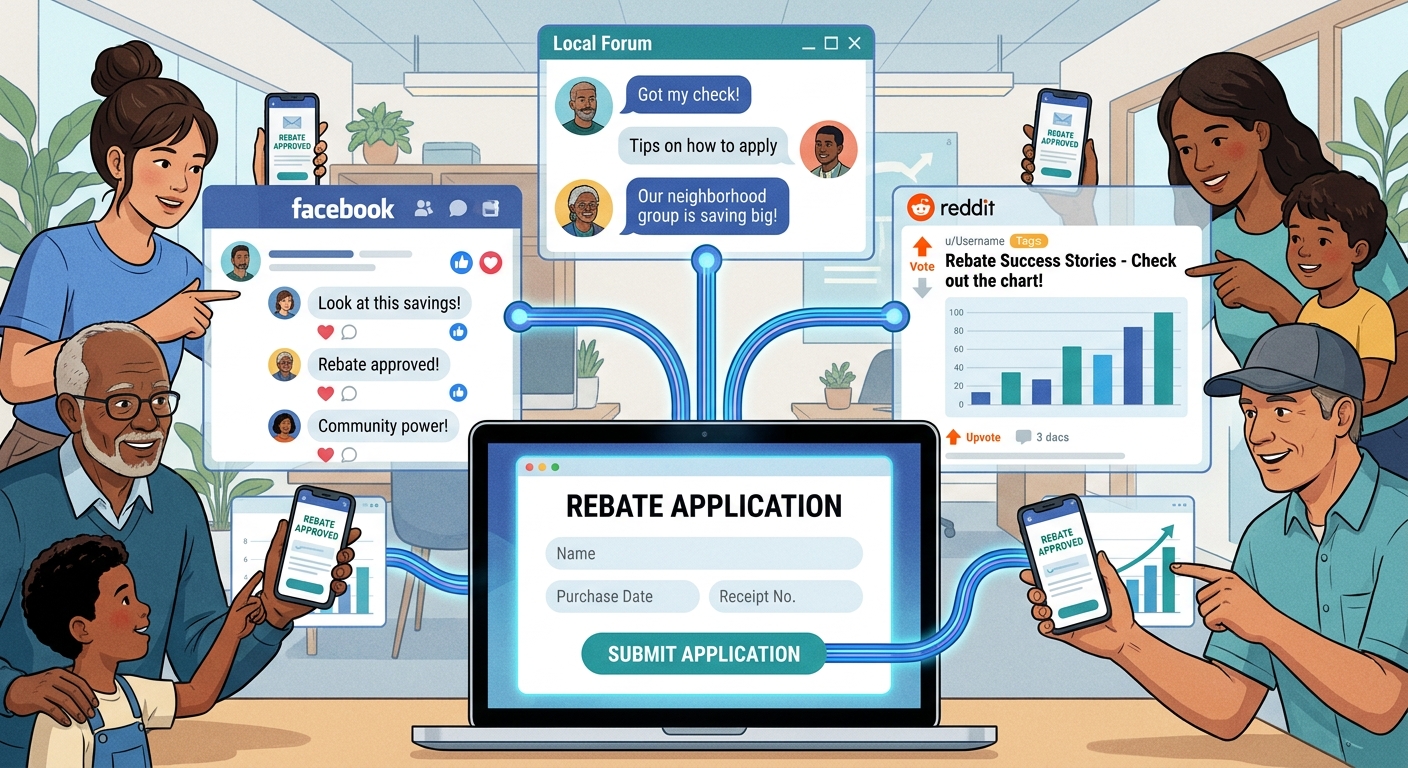
You click a rebate link, fill out the form, cross your fingers, and move on. I get it. Most people are tired by the time they even reach the application page. The last thing they want is more homework. But that is exactly where many of the best savings hide. Not in the form itself, but in the people who keep posting, testing, and discussing that form. If you want to know how to find real community rebate groups, start by following the link back to whoever shared it first. Good rebate hunters often gather in tiny Facebook groups, Reddit threads, neighborhood forums, email lists, and comment sections where they compare approval times, upload screenshots, and warn each other when a portal quietly changes the rules. That “upstream” move can save you hours, help you avoid junk groups, and get you into communities that care about actual payouts, not just flashy links.
⚡ In a Hurry? Key Takeaways
- To find real community rebate groups, do not stop at the form. Trace the link back to the person, page, or post sharing it.
- Check comments, profiles, repeat posts, and linked groups to find small communities that share timing tips, templates, and approval updates.
- Stick with groups built around real applications and verifiable results, not channels that push nonstop referral links or ask for sensitive data.
The shortcut most people miss
A rebate form looks like the finish line. It is not. It is usually the doorway.
When a rebate is worth real money, somebody is talking about it somewhere. Often several somebodies. Maybe it is a utility customer group comparing heat pump approvals. Maybe it is a local Facebook group helping neighbors claim appliance credits. Maybe it is a Reddit thread where three power users have already figured out which upload format gets fewer rejections.
The official page gives you rules. The community gives you reality.
That is the heart of the Smart Form Follower shortcut. Instead of treating the application link like a one-and-done task, you ask a simple question. Who keeps sharing this, and where do they talk when they are not posting the link?
Why this works so well right now
Government programs, utility rebates, and niche shopping incentives are multiplying fast. The problem is that each portal feels like its own little maze. Different deadlines. Different proof requirements. Different definitions of “eligible.” It is easy to feel lost.
But serious rebate programs leave a trail. A useful explainer post attracts comments. A good checklist gets reposted. A successful applicant tells friends what worked. Soon, a small halo forms around the original application link.
That halo is what you want.
It is where people swap:
- screenshots of approved submissions
- timing tricks for when portals reset or reopen
- sample wording for invoices and receipts
- vendor recommendations that qualify
- warnings about common rejection reasons
Official FAQs rarely get that specific. Communities do.
How to find real community rebate groups from a single form
1. Start with the source of the link
If you found the application in a social post, do not click away after opening the form. Inspect the account that posted it. Look at their last ten posts. Are they always sharing the same kind of rebate, grant, or local savings offer? Do people reply with real questions and real outcomes?
A reliable poster usually leaves clues. They may mention a private group, a newsletter, a subreddit, or a neighborhood page where deeper discussion happens.
2. Read the comments before you apply
This sounds basic, but it works. Comments often reveal whether the rebate is active, who got approved, and what paperwork caused trouble.
Look for signs of a living community:
- people reporting dates they applied and dates they were paid
- follow-up answers from the original poster
- other users linking to related threads or local groups
- specific advice instead of vague hype
If every comment says “thanks” or “DM me,” keep walking.
3. Click through to the poster’s profile or site
This is the upstream move. A person who shares one useful rebate link often shares five more. Maybe they run a tiny local deal page. Maybe they moderate a community for solar incentives. Maybe they post monthly updates on utility programs.
You are not looking for influencer energy here. You are looking for pattern and proof.
Ask yourself:
- Do they post updates when rules change?
- Do they mention rejection reasons?
- Do they answer questions in plain language?
- Do they seem focused on outcomes, not clicks?
4. Search the exact rebate name plus community words
Once you have the program name, search combinations like:
- [rebate name] Facebook group
- [rebate name] Reddit
- [rebate name] approval timeline
- [utility name] rebate forum
- [city or state] energy rebate group
This is one of the fastest ways to answer the question of how to find real community rebate groups without wandering into spammy deal channels.
5. Follow repeated names
In active rebate spaces, the same names tend to pop up. One person knows the income verification rules. Another tracks model-number eligibility. Another has a spreadsheet of approval times.
When you see the same helpful names in multiple places, that is a strong sign you have found the real center of gravity.
What a healthy rebate community looks like
Not every group is worth your time. Some are dead. Some are bait for referrals. Some are just noise.
A healthy rebate group usually has three things.
Specificity
People talk about actual programs, actual forms, actual dates, and actual outcomes.
Recency
Posts are current. If the latest update is from eight months ago, the information may already be wrong.
Receipts
Members share screenshots, approval emails, timeline reports, and document examples with sensitive details removed.
That last part matters. Real communities tend to show evidence. Scammy ones tend to offer certainty without proof.
Red flags that should make you back out fast
Here is where a little caution saves a lot of trouble.
- The group pushes one person’s referral link over and over.
- Admins ask for your login, utility account password, or full ID documents in chat.
- Nobody discusses approvals, denials, or paperwork details.
- Every post sounds urgent, vague, or weirdly emotional.
- Comments are full of copy-paste praise from fake-looking accounts.
If you found a real rebate portal but the surrounding group feels sketchy, trust your gut. Use the official form directly and keep searching for a better community.
A simple way to test whether a group is useful
Before joining or spending time there, scan for answers to four practical questions:
- What documents do people say caused the most trouble?
- How long are recent approvals taking?
- Are there model, vendor, or location quirks?
- Has anyone posted a success story in the last 30 days?
If you can find those answers in ten minutes, the group is probably alive and useful.
If all you find is chatter, memes, and link drops, it is probably not where serious applicants spend time.
Why small groups often beat giant deal feeds
Big coupon feeds are fine for awareness. They are bad for nuance.
Small rebate communities tend to be better because the members share the same friction. They have the same utility company. The same state rules. The same appliance list. The same weird portal bug. That shared context makes the advice far more practical.
This is also why local discovery works so well. If you have ever spotted a rebate in the wild and wanted to know who else was paying attention, you may also like The ‘Billboard Honeycomb’ Shortcut: Turn Local Rebate Ads Into Real-Life Buying Circles. It pairs nicely with this approach because both methods start with a signal and then move toward the people around it.
A safe workflow you can use today
Here is the practical version.
Step 1
Open the rebate form, but do not submit yet.
Step 2
Go back to the page, post, ad, or article where you found it.
Step 3
Check who shared it, then read comments and linked resources.
Step 4
Search the exact program name with words like “group,” “forum,” “approval,” or your city name.
Step 5
Join one or two active communities and quietly read recent posts before asking questions.
Step 6
Use community advice to double-check your documents, timing, and eligibility before you submit.
That extra ten or fifteen minutes can prevent an avoidable rejection.
At a Glance: Comparison
| Feature/Aspect | Details | Verdict |
|---|---|---|
| Official rebate portal alone | Gives rules, forms, and eligibility basics, but often lacks real-world approval tips and recent user feedback. | Necessary, but incomplete |
| Small active rebate community | Shares timelines, document examples, portal changes, and practical fixes based on recent submissions. | Best source for real-world guidance |
| Generic deal or coupon channel | High volume, low context. Often packed with expired links, referrals, and little proof of outcomes. | Use only for discovery, not decisions |
Conclusion
Rebate portals can feel like a lonely maze, especially now that governments, utilities, and niche platforms keep rolling out new programs and new application tools. The good news is that the form is rarely the whole story. Around every serious rebate link, there is usually a small circle of people comparing notes, sharing templates, tracking approvals, and spotting rule changes before the official FAQ catches up. If you move upstream from the application to the humans organizing around it, you give yourself a safer, faster way to find real help. That is how to find real community rebate groups without wasting hours in dead coupon feeds or spammy Telegram channels. Follow the form, then follow the people. That second step is where the real savings often begin.