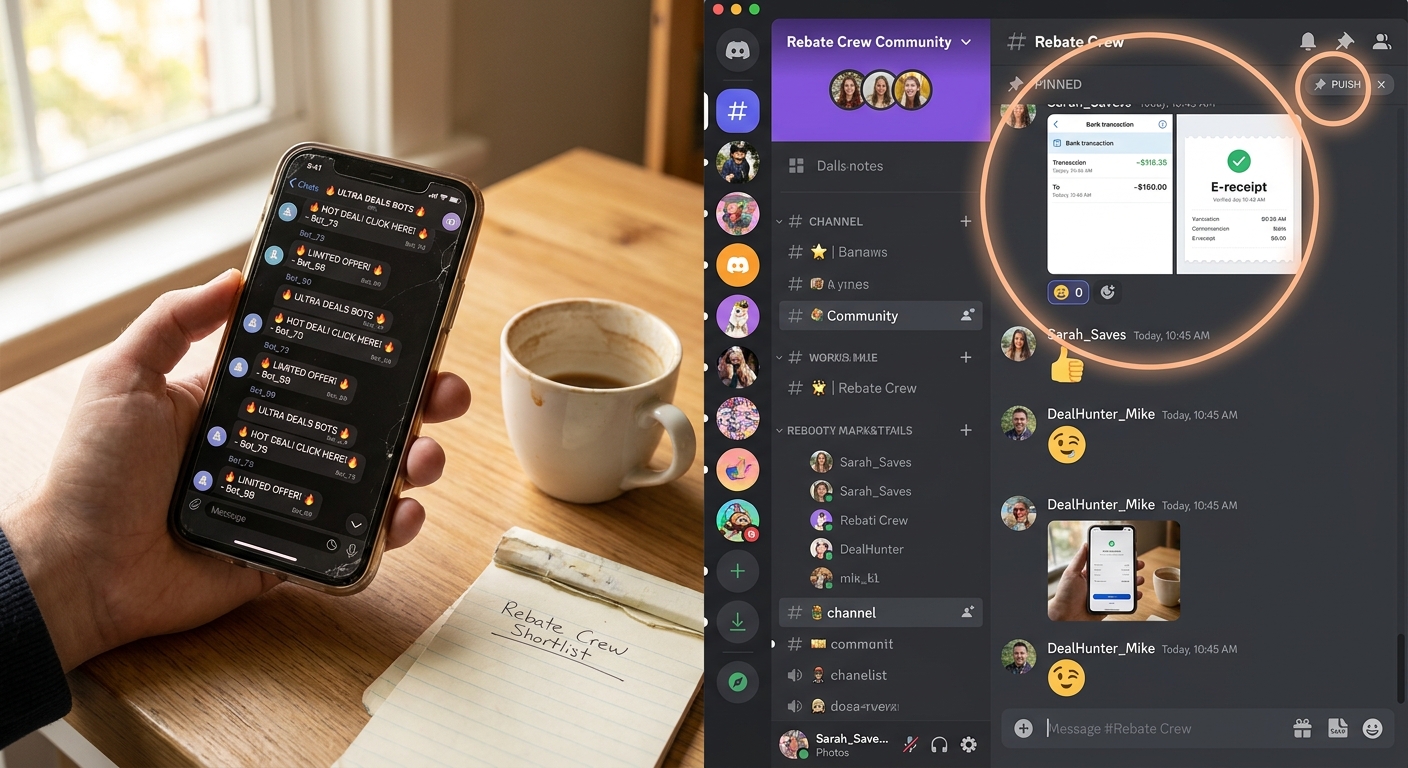
You are not wrong to feel a little buried right now. One minute you are looking for a coupon or rebate tip, and the next you are staring at five Discord invites, three Telegram channels, a “glitch deal” post, and a stranger telling you to hurry before the offer disappears. That is exhausting. It is also how people get pulled into fake deal groups that look busy but never seem to help anyone get paid. If you want to know how to find legit rebate groups on Discord and Telegram, start with one simple idea. Do not trust the hype. Trust the proof that stays visible after the excitement fades. Good groups leave clues. Bad ones leave noise. The fastest way to sort them is what I call the pinned proof shortcut. It is a quick scan of the group’s pinned messages, member behavior, and outside connections to see whether you are joining a real rebate crew or just another promo funnel.
⚡ In a Hurry? Key Takeaways
- Legit rebate groups usually show old, consistent proof of payouts, real member chat, and clear admin history.
- Check pinned posts, joined dates, reactions, and links to sister communities before you follow any deal or hand over personal info.
- If a server is all urgency, no conversation, and no visible payment proof, treat it like promo spam and move on.
The problem with deal servers right now
There has been a fresh wave of Telegram and Discord money-saving communities pushing cash back promos, airdrops, and “loot offers.” At the same time, Facebook has been quietly retiring older community chat features, so more shoppers are drifting into chat-based spaces.
That sounds fine until you see what came with it. Fake members. Paid shoutouts. Copy-paste “success stories.” Bots that make a dead room look alive. Groups that mainly exist to push affiliate links, collect data, or build hype around deals that never really worked for regular people.
The result is simple. People waste time. Sometimes money. And often a lot of patience.
What the pinned proof shortcut actually means
The shortcut is not fancy. You join a group, then resist the urge to chase the newest post. Instead, tap or click the pinned messages first.
Pinned posts are the closest thing a community has to a public record. A legit rebate group tends to pin things that help members: payment proof, rules, how-to guides, retailer limits, screenshots of completed cash back, and updates when deals die.
A bad group often pins hype. “Massive drop now.” “Act fast.” “Limited spots.” “DM admin.” That is marketing, not community building.
What good pinned proof looks like
Look for screenshots that have context. A solid proof post does not just show a random payment image. It usually shows the store name, order timing, rebate platform, expected payout window, and follow-up comments from other members confirming the same result.
Even better, the proof is spread across time. A channel full of payout screenshots from one afternoon is not nearly as useful as a month of normal-looking member wins.
What fake pinned proof looks like
Be careful if every proof image looks cropped the same way, has no timestamps, or shows big earnings with zero explanation. Also be skeptical if all the replies are one-word reactions like “wow,” “paid,” or fire emojis from accounts that never say anything else.
Check joined dates and posting history
This is one of the easiest tells, and people skip it all the time.
On Discord, look at when members joined, especially mods and frequent posters. On Telegram, scan message history and see how far back the chat really goes. A “huge” community that appears to have come alive three days ago is not automatically fake, but it has not earned your trust yet either.
Healthy groups usually have a pattern. Some older members. Some recent arrivals. Conversations that rise and fall during the day. Questions from beginners. Corrections from regulars. Maybe even complaints when a deal fails.
That last part matters. Real communities are not spotless. They have mixed results because shopping deals are messy in real life.
Green flags in the timeline
Look for these signs:
- Members discussing deals from weeks or months ago
- Admins posting updates when a retailer changes terms
- Old pins that still match current advice
- Regular members answering questions, not just admins
Red flags in the timeline
- Long silent gaps, then sudden bursts of deal spam
- Most members joining in a tight cluster
- Only admins posting links
- Deleted message trails or missing context around “proof”
Watch the reactions, not just the member count
Big numbers fool people. A Telegram channel can show thousands of subscribers and still be useless. A Discord server can list a crowd and feel like an empty mall.
Reactions tell a better story than raw size.
In a real rebate group, member response changes depending on the deal. A grocery rebate may get practical questions. A tech item might draw caution about returns, tax, or stock. A dead group, or a botted one, often shows the same flat pattern on everything. The same handful of emoji. The same “thanks” comments. The same instant praise no matter what was posted.
How to spot human behavior
Humans ask annoying but useful questions. “Did this track?” “Which card worked?” “Can I do it twice?” “Is this dead on Android?” “Anyone in Texas try this?”
Those little questions are gold. They show a group is being used by real shoppers with real friction.
If you see only polished promo posts and no messy follow-up, slow down.
Cross-linked communities are a strong trust signal
One of the best clues is whether a group is connected to other real spaces. Good rebate communities often overlap with hobby groups, deal forums, cashback circles, or regional shopping chats. They do not live in total isolation.
If a server mentions a Telegram group, a private Facebook backup, a subreddit, or a second Discord used for receipts and proof, that can be a good sign. It means the community exists beyond one funnel.
This is where a softer entry can help. If you are still getting your bearings, The ‘DM Warm‑Up Shortcut’: Turn Quiet Hobby Groups Into Real Rebate Circles You Can Join Fast is a smart companion read. It is especially useful if the big public groups feel too chaotic and you want a more human way in.
Cross-links that help
- Shared moderators with visible identities across groups
- Members referencing older communities by name
- Backup invite links that have been around a while
- Outside proof, like screenshots reposted and discussed elsewhere
Cross-links that should make you nervous
- A web of clone groups with nearly identical names
- Admins who keep changing channels after complaints
- Invites that lead to “VIP access” upsells
- Communities that exist only to send you into DMs
Your five-minute checklist before trusting any deal group
1. Open the pinned posts first
If the pins are all urgency and no substance, leave.
2. Scroll backward at least a week
A real group can survive being viewed in reverse. A fake one often falls apart fast.
3. Check whether members talk to each other
Not just to the admin. To each other.
4. Look for proof with detail
Payment screenshots, deal explanations, and updates when terms change all matter.
5. Never rush into DMs or forms
If the group quickly pushes you to message someone privately, fill out a mystery form, or connect a wallet before you understand the process, back away.
What to do when a group passes the test
Even if a group looks legit, start small. Follow one low-risk offer first. Watch how the community handles tracking problems. See if anyone reports actual payouts. Ask a question and notice whether the answer is patient, specific, and consistent with the pinned guidance.
That is how trust gets built. Not from one flashy screenshot, but from repeatable results.
At a Glance: Comparison
| Feature/Aspect | Details | Verdict |
|---|---|---|
| Pinned proof quality | Detailed payout screenshots, retailer context, old and new member confirmations, updates when deals die | Strong sign of a legit rebate group |
| Member activity pattern | Mixed questions, normal delays, practical comments, different reactions depending on the offer | Looks human and worth testing carefully |
| Promo pressure and DM pushing | Constant urgency, clone proof posts, little public discussion, quick moves to private chat or outside forms | High risk, best avoided |
Conclusion
The good news is you do not need to become a detective to avoid the worst rebate traps. You just need a simple habit. Check the pins. Check the dates. Check the reactions. Check whether the group has real ties to other communities. In the last day alone, more Telegram and Discord money-saving groups have been pushing cash back promos, airdrops, and loot offers while Facebook keeps stepping back from older community chat tools. That shift is sending more shoppers into chat spaces where scams, fake members, and paid shoutouts are growing fast. A quick human checklist helps you skip the loudest junk and find the smaller number of groups that actually pay. When you use the pinned proof shortcut, your buying power has a much better chance of turning into cash back instead of noise.