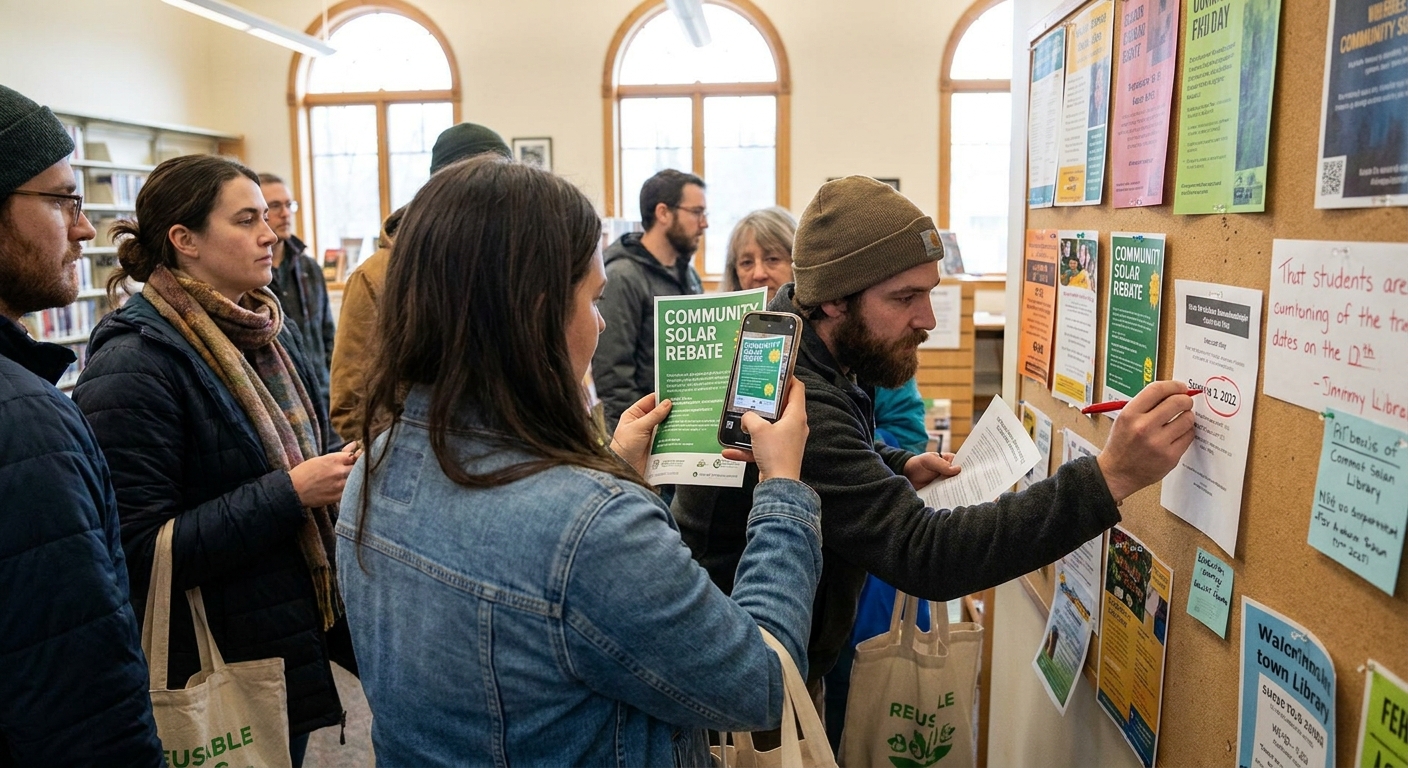
You are not lazy if community flyers make your eyes glaze over. Most of them are packed with tiny print, vague promises, and a web address that looks like it was typed in 2009. Meanwhile, the real value is often hiding in plain sight. A utility rebate, a city energy program, a bulk-buy for rain barrels, a neighborhood solar co-op, or a weatherization group that already knows how to handle the paperwork. If you have been wondering how to find local rebate groups in my community, the trick is not to read every flyer like a school assignment. It is to scan for clues that lead to actual people. A church bulletin board, library hallway, rec center wall, or city hall lobby can be the first breadcrumb. Once you know what to pull from those notices, you can turn one forgotten piece of paper into a live group chat, an info night, or a local buying club that saves you real money.
⚡ In a Hurry? Key Takeaways
- To find local rebate groups in your community, start with physical notice boards and pull out program names, sponsor names, dates, URLs, and contact people.
- One flyer can lead to a real joinable group if you search the exact keywords on Facebook, Nextdoor, Meetup, Eventbrite, and your utility or city website.
- Stick with groups tied to cities, utilities, nonprofits, churches, libraries, and co-ops, and never pay a fee or share personal info until you verify who runs it.
The flyer is not the point
This is the part most people miss. The flyer is rarely the whole program. It is usually just the public crumb.
The real action tends to happen somewhere else. A monthly meetup. A neighborhood email list. A nonprofit intake form. A utility workshop. A co-op waiting list. A volunteer who already knows which forms matter and which ones you can ignore.
So if you are trying to figure out how to find local rebate groups in my community, stop treating the notice board like a reading test. Treat it like a map.
What to grab from a boring flyer in 30 seconds
You do not need a full photo archive of the wall. You just need the pieces that help you track the people behind the program.
Look for these specific clues
When you spot a flyer about rebates, energy savings, appliance upgrades, home repair help, water conservation, solar, insulation, EV charging, composting, or neighborhood buying programs, pull out these details:
- The exact program name
- The sponsoring group, such as the city, utility, nonprofit, or co-op
- A person’s name, if listed
- An email address or phone number
- A website or short URL
- A QR code
- An event date or workshop date
- Any unusual phrases like “bulk buy,” “community partners,” “pilot program,” or “income qualified”
Those odd little phrases matter. They are often better search terms than the big headline.
Take a clean photo, then crop it
Stand close. Get a straight photo. Then crop it down later so the text is readable. This sounds basic, but blurry photos are one reason people never follow through.
The best keywords that turn a paper notice into a real group
Once you get home, start with the exact words from the flyer. Put quotation marks around the program name if it is specific.
Then mix in one of these group-finding words:
- workshop
- co-op
- partners
- community meeting
- waitlist
- interest form
- group buy
- volunteer
- FAQ
- webinar
For example, if the flyer says “Clean Heat Now” from your local utility, try searches like:
- “Clean Heat Now” workshop
- “Clean Heat Now” community partners
- “Clean Heat Now” interest form
- [your town] heat pump group buy
- [your utility name] rebate workshop
This is usually where the hidden stuff appears. Event pages, church-hosted signups, PDF agendas with staff names, Facebook posts from last month, or nonprofit pages that explain the process in plain English.
Where the real people usually are
Most rebate groups do not call themselves “rebate groups.” That is why they are hard to find.
Check these places after you spot a flyer
- Facebook groups for your town, neighborhood, or mutual aid network
- Nextdoor posts tied to the exact program name
- Eventbrite listings for workshops and sign-up events
- Meetup pages for sustainability, home improvement, or community resilience groups
- Your city calendar and utility events page
- Local nonprofit newsletters
- Library event pages and church community pages
If the flyer includes a contact person, search that name with the town and the program. If the person is real and active, you will often find a webinar listing, a partner page, a council meeting document, or a posted presentation.
How to tell if it is a real program or just another dead end
This part matters. Some flyers point to active, well-run programs. Others lead to expired pilot projects or pages that were abandoned two years ago.
Good signs
- The sponsor is a city department, utility, nonprofit, credit union, church, school, or co-op
- There is a recent date on the flyer or webpage
- There is a named contact person
- There is an event, intake form, or office phone number
- Other local groups mention the same program
Warning signs
- The flyer only points to a generic homepage with no mention of the offer
- The program asks for upfront money before explaining the rebate
- No dates, no sponsor, no real names
- Broken links and QR codes that redirect somewhere unrelated
- Pressure to act fast without giving written details
If the program branches into private messaging apps, be cautious and verify first. If that side of the hunt interests you, The ‘Telegram Trailhead’ Shortcut: Turn Deal Alert Channels Into Real Rebate Clubs You Can Join Safely is a smart next step for checking groups without clicking yourself into trouble.
Turn a flyer into a joinable group in four moves
1. Find the organizer
Do not just visit the homepage. Find the human. That could be a program manager, outreach coordinator, volunteer captain, librarian, or church office.
2. Ask the simplest useful question
Send a short note like this:
“Hi, I saw your flyer for the rebate program at the library. Is there a local group, workshop, or email list for people joining this program?”
That question does two things. It tells them you are real, and it pushes them to reveal the part that is not on the flyer.
3. Ask who already helps people with the forms
This is the gold. Many programs have one person or partner group that quietly walks residents through applications. Ask:
“Is there a partner organization or community group that helps people apply?”
That is often how you find the real rebate club, even if it is not called that.
4. Save the chain, not just the deal
If you find one active group, save all the connected names and pages. Utility partner. Nonprofit host. Rec center event page. Volunteer list. This chain helps you find future offers before they spread widely.
The best places to look in person
Not all bulletin boards are equal. Some are full of guitar lessons and lost-cat notices. Others are quietly excellent for rebates and group-buy opportunities.
Best offline spots
- Public libraries
- Parks and rec centers
- Senior centers
- Church foyers and fellowship halls
- City hall and county offices
- Food co-ops and farmers market boards
- Community colleges
- Neighborhood health clinics
These places often host programs for weatherization, water-saving kits, transit passes, appliance recycling, and low-cost home upgrades. They are local, practical, and often tied to funding windows that do not stay open forever.
Why this works better than coupon apps
Big savings apps are fine for mainstream discounts. They are not great at finding local programs that have a human gatekeeper, income rules, neighborhood quotas, or a community sign-up night.
Offline flyers are often early signals. They show up before the offer gets polished, crowded, or advertised to death.
That is why this shortcut works. You are not chasing viral deals. You are finding fresh local ones while there is still room.
If the flyer leads nowhere, do this next
Sometimes the link is dead. Sometimes the event already happened. That does not mean the opportunity is gone.
Try the sponsor, not the flyer
If a notice mentions your water utility, electric company, housing nonprofit, or city sustainability office, go straight to that group’s website and search the topic there.
Use terms like:
- rebate
- assistance
- community partners
- upcoming events
- energy efficiency
- resident programs
Then call or email. Yes, actually call. It is often faster than digging through PDFs.
At a Glance: Comparison
| Feature/Aspect | Details | Verdict |
|---|---|---|
| Offline flyer boards | Great for finding early local programs, real contact names, workshop dates, and niche community offers before they spread online. | Best starting point for fresh, local rebate leads. |
| Searching the flyer keywords online | Turns a vague notice into event pages, sign-up forms, partner organizations, and social posts where the real group activity happens. | Best way to move from paper clue to active community. |
| Big coupon and rebate apps | Useful for broad consumer offers, but usually weak for hyperlocal utility, nonprofit, and co-op programs with human support and local meetings. | Fine as a backup, not the best tool for neighborhood rebate groups. |
Conclusion
If you have been frustrated by vague notices and endless PDFs, you are not doing anything wrong. The problem is that many of the best local rebate opportunities are barely advertised. Cities, utilities, nonprofits, and local co-ops are quietly rolling out new rebate and group-buy programs right now, and sometimes the only public sign is one lonely flyer at a rec center, church, or library. Once you know how to mine those boards for keywords, URLs, dates, and contact names, you can turn a boring paper notice into a live group you can actually join. That means faster access to fresh incentives, less form confusion, and more of the human help that big apps never seem to offer. Start with one bulletin board this week. You may be one photo away from your next useful local savings group.