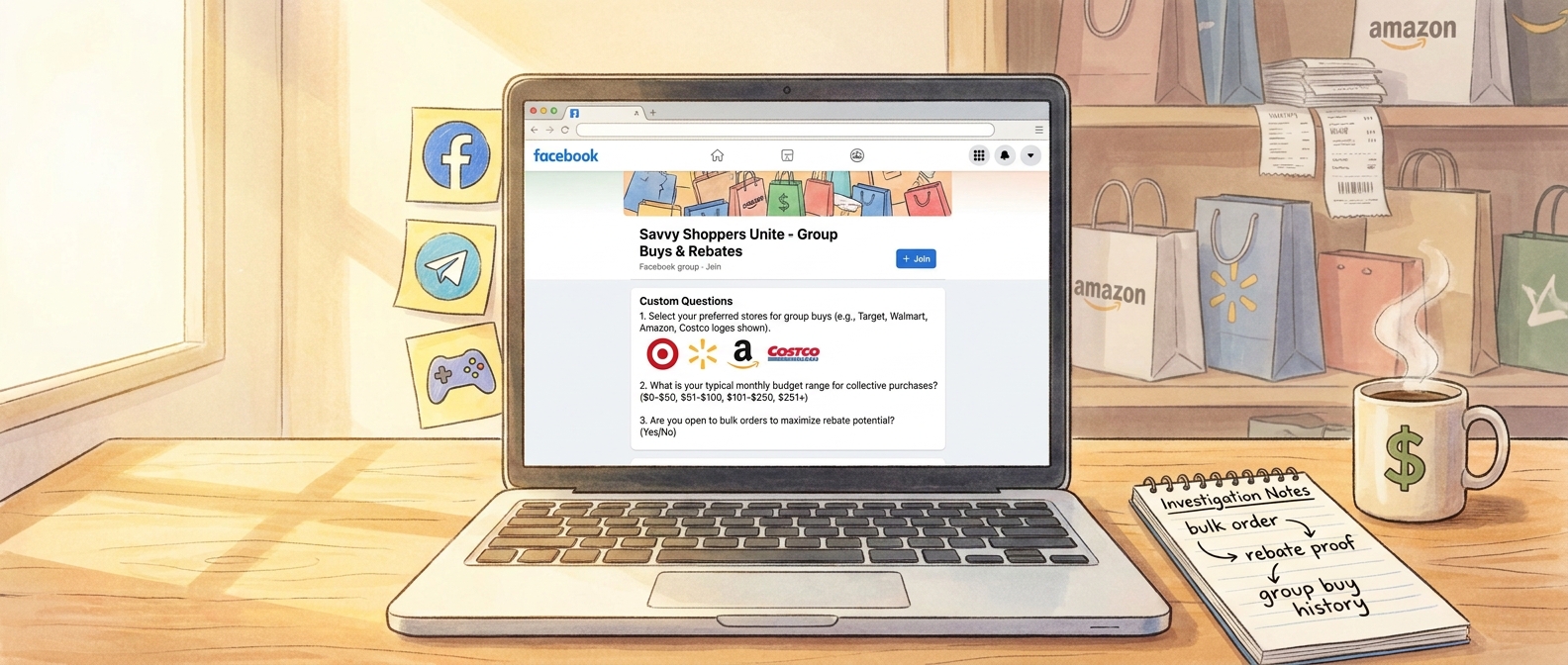
You join a Facebook “deal” group, answer a couple of vague questions, and then walk into the same old mess. Spammy posts. Old links. Admins who vanished months ago. Or worse, a group that acts like a secret club but never actually posts useful rebates. That gets old fast. If you are trying to figure out how to find legit rebate groups on facebook and telegram, search results alone are not enough anymore. The better groups often stay half-hidden on purpose.
One of the easiest ways to spot those better groups is to study what they ask new members before they let them in. Think of it like finding a “signup twin.” If one active, high-paying group asks three very specific questions, there is a good chance its sister groups, backup groups, or admin-run spinoffs ask almost the same thing. That pattern gives you a shortcut. You stop hunting by name and start hunting by behavior, which is usually much more reliable.
⚡ In a Hurry? Key Takeaways
- Legit rebate groups often reveal themselves through smart membership questions, not obvious names or public search listings.
- Copy the wording, tone, and screening style of one good group to find similar “signup twin” communities on Facebook and Telegram.
- If a group asks nothing useful, hides all rules, and shows no proof of recent activity, it is usually not where serious rebate stacking happens.
Why search keeps failing you
Platforms want broad engagement. They push giant coupon pages, generic savings groups, and channels built to scoop up as many members as possible. That is great for the platform. It is not great for you.
The serious rebate groups often do the opposite. They stay private. They rename themselves. They use backup groups. They screen members carefully because too much noise kills the deals. That is why someone searching “rebates,” “Amazon deals,” or “coupon chat” will often miss the groups where the real action is happening.
If this sounds familiar, you may also want to read The ‘Hidden Lobby’ Shortcut: Join High‑Payout Rebate Groups By Starting Where Power Shoppers Already Hang Out. It explains why the best communities rarely sit out in plain view.
What the “signup twin” shortcut actually is
Here is the basic idea. Find one group that feels alive, organized, and clearly run by humans. Then look closely at the questions it asks before approving new members.
Those questions usually tell you three things:
- What kind of members the admin wants
- How serious the group is about rebate rules
- Whether the group is part of a larger admin network
Once you know that pattern, you can use it to spot related groups. Not just by name, but by the admin “fingerprint” hidden in the signup flow.
The questions that usually signal a real rebate group
1. They ask where you heard about the group
This is a big clue. Dead or lazy groups often approve everyone. Better groups want to know whether you came from a friend, another deal group, a Telegram channel, or an outside site.
Why it matters: admins who track referral sources usually care about quality and volume. They are trying to build a working buying crew, not a random crowd.
2. They ask if you understand rebate rules
You might see questions like:
- Do you understand you may need to leave a review or follow claim instructions?
- Have you used PayPal, Venmo, or another payout method before?
- Do you know that rebate timing can vary?
That is a good sign. It means the group has enough deal flow that admins need members who can follow directions without constant hand-holding.
3. They ask for your Telegram handle, email, or messenger preference
This often means the Facebook group is just the front door. The better action may happen in a Telegram thread, a private chat, or a spin-off channel. In other words, Facebook may be the waiting room, not the party.
If several groups ask for the same contact style, that is a clue they may be linked.
4. They ask for a short written answer
Questions like “Why do you want to join?” can seem annoying, but they are useful. Admins use them to filter bots, serial spammers, and people who never read instructions.
More important for you, though, is the wording. If two or three groups ask nearly identical short-answer questions, they may be siblings.
How to use one good group to find its twins
Start with one proven group
You do not need ten. You need one that shows recent posts, real member comments, payout chatter, and clear admin presence.
Take notes on:
- The exact membership questions
- The tone of the rules
- Whether they mention other apps like Telegram
- Whether they ask for region, shopping history, or payment method
Search using the questions, not just the title
This is the part most people skip. Instead of searching only for group names, search for unusual phrases from the signup questions.
For example, if a group asks “Do you agree not to claim without ordering?” or “What is your Telegram username for rebate alerts?” those phrases may appear in other related groups, mirrored landing pages, cached previews, or admin posts.
You are no longer searching for a “deal group.” You are searching for a pattern.
Check for repeated admin habits
Groups run by the same people often share little quirks:
- Same approval questions
- Same welcome message style
- Same payout methods
- Same posting format for deals
- Same rules about screenshots or order numbers
That is your signup twin. Maybe not the exact same group, but close enough to tell you you are in the right neighborhood.
How this works on Facebook
Facebook still has a lot of rebate activity, but much of it is split across feeder groups, backup groups, and niche sub-groups.
What to look for
- Membership questions visible before joining
- Recent member counts or growth spurts
- Admins who mention “sister group,” “backup group,” or “VIP chat”
- Pinned rules that mention rebate timing, claim forms, or off-platform alerts
Good sign
A group that screens members, posts daily, and has comments from real people talking about order issues, payout timing, and product limits.
Bad sign
A group with a huge member count, no meaningful questions, recycled coupon graphics, and no clear proof that members are actually getting paid.
How this works on Telegram
Telegram is trickier because some channels are public, some are private, and some are invite-only with almost no discoverable footprint.
What to look for
- Join requests that ask where you came from
- Linked discussion groups attached to a channel
- Admins who reference another Facebook or Discord screening step
- Consistent deal formatting and payout language
If a Telegram group uses nearly the same intake questions as a Facebook group, that is often a clue that the admin team is moving members across platforms. That is exactly the kind of trail you want.
Red flags that mean “move on”
Not every private group is good. Some are private because they are sloppy, inactive, or shady.
Watch out for these:
- No screening at all, but lots of “exclusive” language
- Admins who demand unusual personal info up front
- No visible discussion of payouts, timing, or deal rules
- Pressure to pay for access before you see any activity
- Constant affiliate pushing with no member success stories
A legit group may be selective. It should not feel like a phishing test.
A simple test you can use in five minutes
When you find a new group, ask yourself:
- Are the signup questions specific enough to filter real members?
- Do those questions suggest an actual rebate process?
- Can I find similar wording in related groups or channels?
- Does the group show recent human activity, not just links?
- Are there signs of payout structure, admin presence, and clear rules?
If the answer is yes to most of those, keep going. If not, do not waste your week waiting for a dead channel to magically get better.
Why this shortcut matters more in 2026
The gap is getting wider. Search results show what is broad, safe, and easy to rank. Serious rebate communities are moving in the other direction. Smaller circles. Tighter screening. More cross-platform movement.
That means the old method of typing a few keywords into Facebook or Telegram and joining the first five results is getting worse, not better.
The smarter move is to reverse-engineer how good groups identify good members. Once you see that pattern, you can spot live communities from the outside, even when their names are forgettable or their listings are half-hidden.
At a Glance: Comparison
| Feature/Aspect | Details | Verdict |
|---|---|---|
| Generic search result group | Broad name, weak screening, lots of old coupon-style posts, little proof of active rebates | Low priority |
| Group with strong membership questions | Asks about referral source, rebate experience, payout methods, or linked chat apps | Promising |
| “Signup twin” match | Similar intake questions, admin style, rules, and posting format across Facebook and Telegram | Best lead for finding legit, active rebate groups |
Conclusion
The best rebate groups are not always the ones you can easily search. Right now there is a real gap between what Facebook and Telegram show you and where serious rebate stacking actually happens. Admins are locking things down. Algorithms are pushing broad savings content, not the tighter buying crews where volume and payouts are better. That is why the signup twin shortcut matters. When you focus on member-question patterns, you get a repeatable way to spot live, human-run communities without wasting time on dead pages or fake exclusivity. Rebate Clubs should not just hand you a list. It should teach you how to think like a power shopper and reverse-engineer the good groups from the outside. In a crowded 2026 deals world, that practical edge is what saves you time, money, and a lot of frustration.