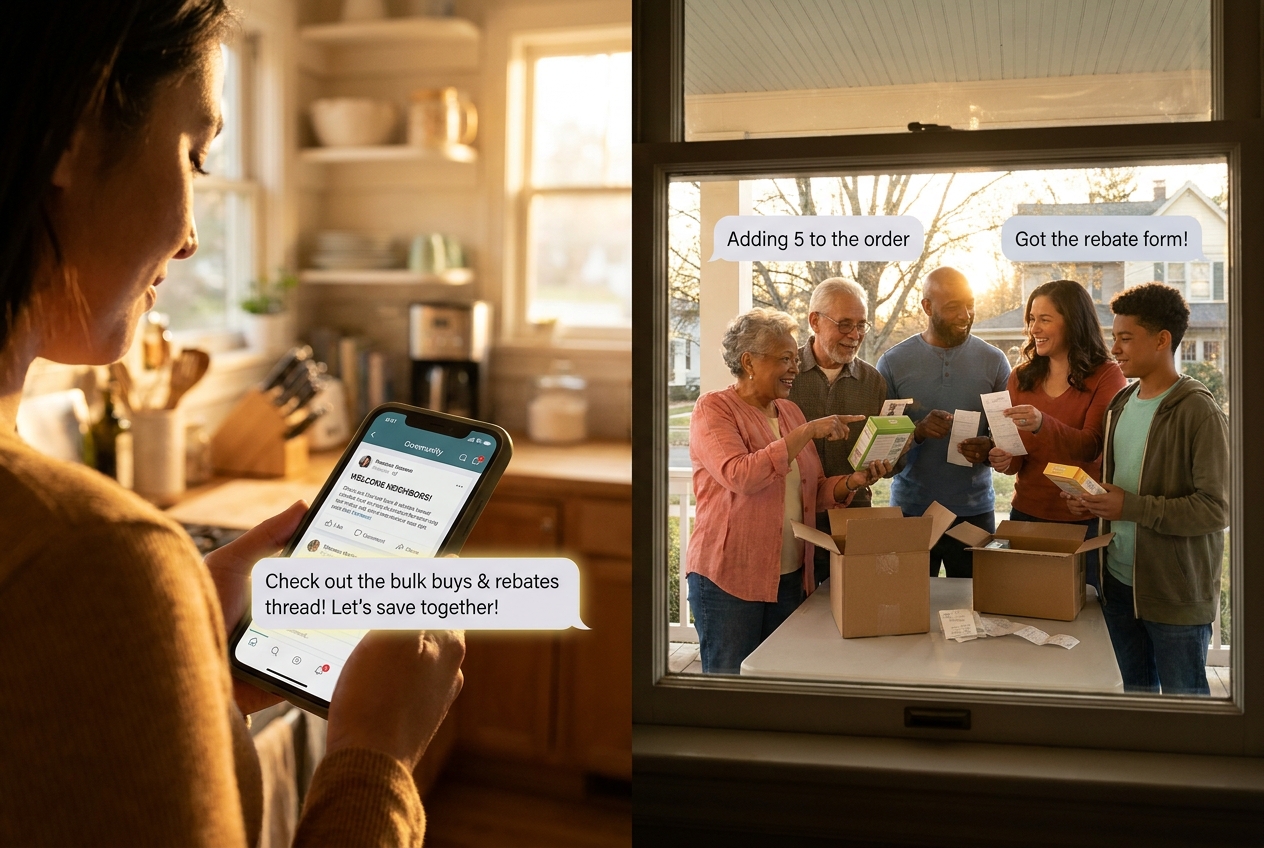
You are not imagining it. You can sign up for every coupon app on your phone and still miss the best local savings. That is because the really useful stuff often lives in tiny neighborhood chat groups that do not show up in Google, app search, or public social feeds. If you are trying to learn how to find local rebate groups on Nextdoor, the trick is not hunting harder. It is using the one moment when people are most likely to notice you. Your welcome post. Most new members write a polite hello and move on. Big mistake. A short, targeted intro can act like a filter and bring the right neighbors to you. Ask if anyone runs local bulk buys, rebate swaps, kids’ gear circles, or deal chats. That one sentence can open the door to invite-only groups that were basically invisible five minutes earlier.
⚡ In a Hurry? Key Takeaways
- The fastest way to find local rebate groups on Nextdoor is to use your intro or welcome post to ask directly about bulk buys, rebate chats, and neighborhood deal groups.
- Keep your message short and specific so the right people reply or message you privately with invites.
- Stick to trusted neighbors, verify any group rules first, and never share payment info until you are comfortable with the people involved.
Why the obvious search usually fails
Here is the annoying part. The groups you want are often real, active, and nearby, but they are not labeled in a neat, searchable way.
They may live inside a private Nextdoor thread, a WhatsApp group started by three parents, a text chain for warehouse-store runs, or a hyper-local Facebook chat with a name that makes no sense unless you already know the people in it.
So when people ask how to find local rebate groups on Nextdoor, the answer is often not “search better.” It is “make the right people identify themselves.”
The welcome-post shortcut
Many neighborhood platforms highlight new members. That is your opening.
Instead of posting something generic like “Hi everyone, just moved here,” use a version that does two jobs at once. It introduces you and quietly asks for the exact kind of local money-saving network you want.
A simple post you can copy
Try something like this:
“Hi everyone, I’m new to the neighborhood and always looking for smart local savings. Does anyone here coordinate bulk buys, rebate deals, kids’ gear swaps, or neighborhood deal chats? I’d love to join if there’s a group.”
That is friendly. It is clear. And it gives helpful neighbors an easy reason to reply.
Why this works better than browsing
People who run these side groups are usually not advertising them all day. They are busy. They may also want to keep the group small, local, and useful.
Your post does something important. It signals that you are not just bargain curious. You are willing to participate.
That matters. Organizers often want members who actually show up for group buys, share real deals, and do not waste everybody’s time.
What kinds of groups you might uncover
Once people start replying, you may find more than “rebates” in the strict sense.
- Bulk-buy groups for paper goods, cleaning supplies, or pantry items
- Appliance or utility rebate tip circles
- Kids’ clothing and gear swap chats
- Moving box and household-item pass-along groups
- Local contractor discount and referral threads
- Seasonal buying groups for mulch, firewood, school supplies, or holiday items
That is the real point. Local savings groups are often a mix of rebates, resale, swaps, and shared buying power.
How to ask without sounding weird
You do not need to write like a salesperson. In fact, please do not.
Keep it warm and normal. One or two lines is enough. If your neighborhood is chatty, you can add a little context.
For example:
“Hi neighbors, I’m new here and trying to get smarter about local deals. If anyone knows of a neighborhood rebate group, bulk-buy chat, or swap group, I’d be grateful for a pointer.”
That sounds human. Because it is.
What to do after people reply
This part matters just as much as the first post.
Reply quickly
If someone tags a group admin or says “message me,” do it within a day if you can. These little groups often run on momentum.
Ask one smart follow-up question
Try:
- “What kinds of deals does the group usually share?”
- “Is it mostly coupons, rebates, swaps, or group orders?”
- “Are there any rules before I join?”
Be useful early
If you get invited, do not lurk forever and do not flood the chat. Share one genuinely helpful tip, confirm interest in a group buy, or thank the organizer.
That is how you stay in the good circles.
A good safety rule for private deal groups
Most neighborhood groups are fine. Still, use common sense.
- Do not prepay strangers without understanding the setup.
- Check whether a rebate is from a real utility, retailer, or manufacturer.
- Meet in public places if items are changing hands.
- Start small before joining bigger pooled purchases.
You want local savings, not local drama.
If nobody answers your post
That does not mean the groups do not exist.
It may just mean your first post was seen at a bad time, or the people who know are cautious.
Try these backup moves
Comment on nearby threads about school supplies, moving, yard sales, appliance replacements, or utility bills. Those are natural places where bargain-minded neighbors tend to show up.
You can also search for older posts using words like “bulk,” “swap,” “group order,” “coupon,” “rebate,” “Costco,” “kids clothes,” or “utility rebate.”
And yes, old-school offline clues still matter. If you want another simple local trick, read The ‘Neighborhood Mailbox Shortcut’: Turn Boring Flyers Into Real Rebate Groups You Can Actually Join. Sometimes the flyer everyone ignores is exactly what points you to the active local deal people.
Why this matters more now
Neighborhood buying has gotten more private, not less.
People are still sharing deals. They are just doing it in smaller circles where trust is higher and noise is lower. That means the best opportunities are often hidden from search and invisible to outsiders.
Your intro post is a low-effort way to get past that wall.
At a Glance: Comparison
| Feature/Aspect | Details | Verdict |
|---|---|---|
| Generic welcome post | Friendly, but gives neighbors no reason to connect you with private deal or rebate circles. | Low value for finding savings groups |
| Targeted intro question | Asks directly about bulk buys, rebate chats, swaps, and local deal groups, which prompts the right people to reply. | Best starting move |
| Private invite-only chats | Usually where the most useful local buying, swapping, and rebate coordination actually happens. | High value, but join carefully |
Conclusion
If you have been wondering how to find local rebate groups on Nextdoor, stop thinking like a search engine and start thinking like a neighbor. The best circles are often hidden in small private spaces like neighborhood apps, WhatsApp chats, and hyper-local Facebook groups. They are real, but they are rarely discoverable. That is why your welcome post matters so much. Most people waste it with a plain hello. A better move is one direct line like, “Does anyone here coordinate bulk buys or rebate deals for the neighborhood?” That simple question helps the right three or four people find you, and those are usually the people already running useful side chats for group buys, moving supplies, or kids’ gear. It is low effort, low risk, and much more practical than endlessly chasing random promo codes. Join once, post once, and let the replies lead you to an actual local rebate community.