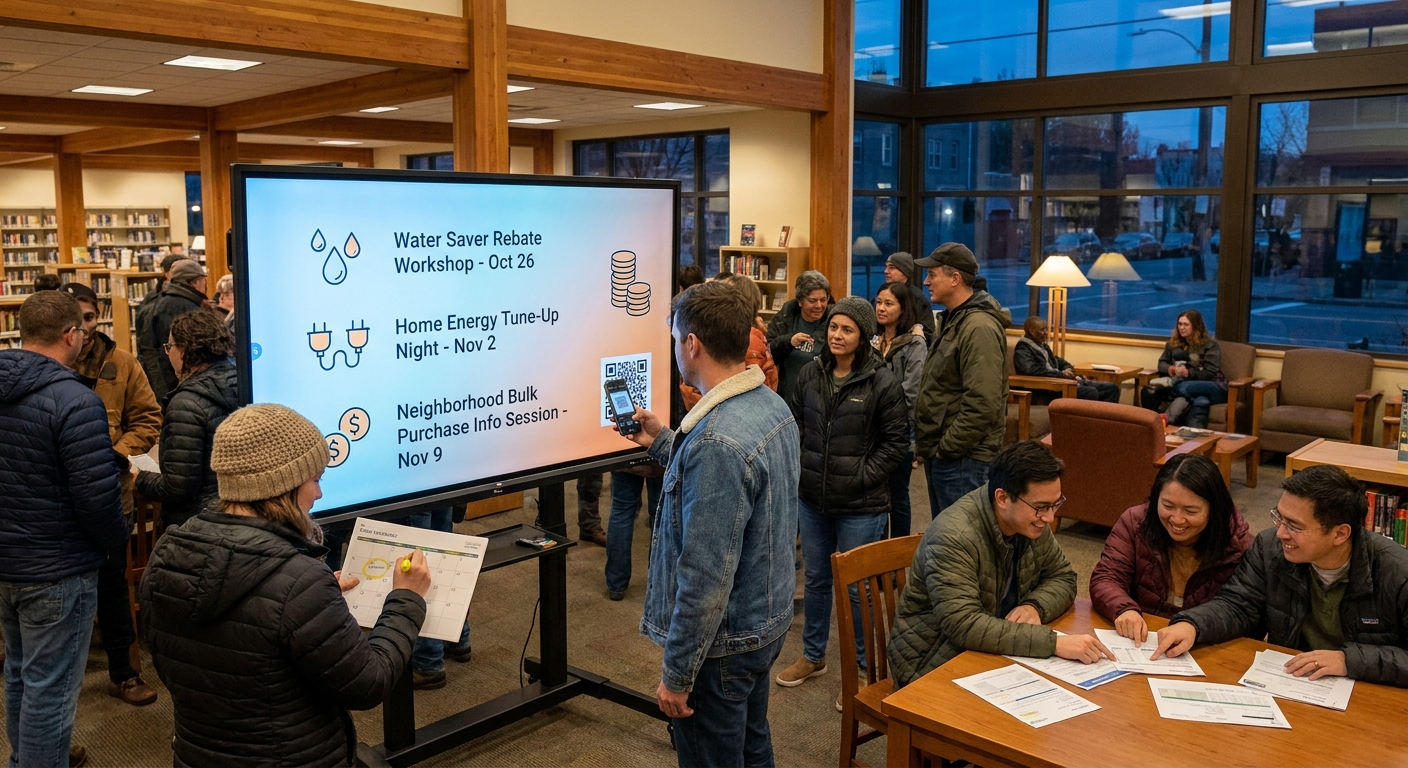
You know the feeling. You search for ways to save money locally, hoping to find real people swapping real tips, and instead you land in a swamp of Facebook groups, Telegram links, and “deal experts” who somehow always want your email, your phone number, or your trust a little too fast. It is frustrating because you are not looking for more noise. You are looking for actual local rebate workshops and community rebate groups that can help with bills you already pay.
Here is the shortcut. Stop treating library calendars like a list of story hours and author talks. Many city libraries quietly post workshops from utilities, water districts, housing nonprofits, climate groups, and small business centers. Hidden in those calendars are classes on energy rebates, free home upgrades, compost bin discounts, solar buying groups, rain barrel programs, and neighborhood purchasing clubs. If you learn how to scan those listings the right way, show up with a few smart questions, and follow up with attendees after the event, you can build a small, trusted rebate club that keeps finding savings long after the workshop ends.
⚡ In a Hurry? Key Takeaways
- To learn how to find local rebate workshops and community rebate groups, start with public library event calendars, then check the partner groups named in each event.
- At each workshop, ask what other programs stack with this one, who else in town runs similar events, and whether attendees can stay connected after the session.
- Offline-first groups built around libraries, utilities, and nonprofits are usually safer and more useful than random social media deal channels.
Why library calendars work better than social media searches
Most people search backwards.
They type “rebates near me” or “coupon group” into Google, then get sent to the loudest places on the internet. Loud is not the same as useful. Loud often means affiliate links, half-explained offers, expired promos, and strangers posting screenshots with no context.
Library calendars are different. They tend to feature events from groups that already exist in your area and have a real reason to be there. Think city departments, utility outreach teams, watershed groups, county extension offices, neighborhood associations, and nonprofit housing counselors.
That matters because these groups usually know which programs are official, income-based, seasonal, stackable, or likely to close soon.
What to search for on a library calendar
If you want to know how to find local rebate workshops and community rebate groups, the trick is not searching only for the word “rebate.” Many events that save money never use that word in the title.
Use these search terms
Try searching a library event page for:
- energy savings
- home weatherization
- utility bill help
- water conservation
- rain barrel
- compost bin sale
- solar 101
- home electrification
- landscaping workshop
- small business procurement
- bulk buy
- co-op
- home repair assistance
- community purchasing
Look past the title
The real gold is often in the event description. A workshop called “Sustainable Homes Night” might quietly mention:
- free home energy assessments
- utility rebates for appliances
- discounted native plants
- low-cost leak detection kits
- group pricing for solar or insulation
Also check the host and partner names. If the library event is hosted with a water district, utility, or nonprofit, click through to that partner’s own site. One calendar listing often leads to five more.
How to turn one event into a whole rebate trail
This is where most people stop too early. They attend one session, grab a handout, and go home. Better than nothing, sure. But it leaves money on the table.
Step 1: Make a simple “savings map”
Before the event, note three things:
- Who is hosting it
- Who is sponsoring it
- What problems it claims to solve
If the event is about water-saving rebates, the connected opportunities might include plumber discounts, free fixtures, landscape classes, or turf replacement programs.
If it is about energy bills, there may also be tune-up rebates, insulation programs, community solar, thermostat offers, or income-qualified repair grants.
Step 2: Ask the questions other people forget to ask
You do not need to sound like an expert. You just need to be curious. At the end of the workshop, ask:
- What other local programs stack with this one?
- Which deadlines are coming up soon?
- Do renters qualify, or only homeowners?
- Are there income-based versions with bigger savings?
- Which partner groups should we follow for similar events?
- Is there a mailing list for future workshops?
- Has anyone here formed a neighborhood buying group around this?
That one question about stacking can be the difference between saving $30 and saving $800.
Step 3: Connect with two or three attendees, not twenty
You do not need to start a giant club on day one. In fact, smaller is better.
After the event, talk to a couple of people who seem normal, local, and actually interested. Say something simple like, “I’m trying to keep track of these workshops and rebates. Want to swap emails so we can send each other the good ones?”
That is it. No branding. No app. No awkward pitch.
What a local rebate club actually looks like
Do not picture matching T-shirts and monthly bylaws.
A good rebate club can be as basic as:
- a three-person email thread
- a neighborhood Google Group
- a Signal chat with a few homeowners and renters
- a spreadsheet shared by people from the same library workshop
The goal is simple. When one person finds a worthwhile program, everyone else hears about it fast.
That is especially useful for offers that are easy to miss, such as limited-time utility promos, compost bin bulk buys, furnace tune-up rebates, tree giveaways, or contractor info sessions.
Where the best workshop leads usually come from
Libraries are the starting point. Then the network spreads.
Watch these partner categories
- Electric, gas, and water utilities
- City sustainability offices
- County extension offices
- Housing nonprofits
- Community development groups
- Watershed and conservation districts
- Small business development centers
- Chambers of commerce
If you already found one useful utility program, it is worth reading The ‘Utility Portal Shortcut’: Turn Boring Rebate Finders Into Real Community Rebate Groups You Can Join In One Afternoon. It pairs well with this approach because utility portals often confirm the official offers you hear about at workshops.
How to tell a useful workshop from a disguised sales pitch
Not every event on a calendar is equally helpful. Some are educational. Some are lead generation wearing a name tag.
Good signs
- The event lists a public agency, library, or nonprofit partner
- The description includes specific programs, eligibility, or deadlines
- There is time for questions
- The presenter shares official links, not just “book a consultation” forms
Bad signs
- The workshop is vague about the actual savings
- Everything points to one contractor or one paid service
- You have to give lots of personal info before getting basic details
- The speaker keeps pushing urgency without naming the program rules
If it feels slippery, trust that feeling.
How to organize your finds without turning it into homework
You do not need a fancy system. A plain note on your phone works.
Keep five columns
- Program name
- Who qualifies
- Deadline
- Can it stack with other offers?
- Who mentioned it?
That last one matters. If a tip came from a library presenter, utility rep, or local nonprofit staffer, it is usually more trustworthy than a random screenshot online.
Easy examples of rebates and group buys people miss
These are the kinds of things that often show up in quiet local workshops:
- free water-saving kits with faucet aerators and leak tablets
- rebates for smart thermostats, heat pumps, or efficient washers
- discounted home energy audits
- community solar co-ops
- bulk-buy compost bins or rain barrels
- yard transformation incentives for low-water landscaping
- small business group purchasing for trash, cleaning, or power plans
- neighborhood tree and shade programs that cut cooling costs
None of these are especially flashy. That is exactly why they get overlooked.
How to keep your group useful and scam-resistant
The best local rebate clubs are a little boring. That is a compliment.
Boring means they focus on verified offers, official links, and practical deadlines. They do not drift into gossip, chain referrals, or miracle savings claims.
Set simple rules
- Only share offers with an official source link
- Note the deadline and who qualifies
- No referral spam unless the group asks for it
- Flag anything that needs a sales call before basic pricing is shown
This is how an offline-first group stays useful. It is also how you avoid becoming just another noisy channel.
At a Glance: Comparison
| Feature/Aspect | Details | Verdict |
|---|---|---|
| Library calendar events | Usually tied to local agencies, nonprofits, and official programs. Lower noise, better context. | Best starting point for trusted local rebate leads. |
| Social media deal groups | Fast-moving, but often full of expired posts, referral spam, and weak verification. | Useful only if you already know how to filter noise. |
| Small local rebate chat or email list | Built from real attendees. Easier to verify, easier to trust, and better for sharing local deadlines. | Best long-term move after attending one or two workshops. |
Conclusion
You do not need to become a coupon detective or join another chaotic online group to save real money. City libraries, utilities, and nonprofits are quietly stuffing their calendars with “save money” clinics right now: water-saving rebates, home energy tune-ups, bulk-buy compost bins, solar co-ops, even small business purchasing alliances. Most people attend once, take a pamphlet, and leave the bigger money on the table. If you mine those calendars like a deal directory, ask the right questions in the room, and then connect attendees into an ongoing chat or mailing list, you can turn scattered one-time rebates into a durable local rebate club that keeps finding and stacking programs together. That means faster savings on water, power, home upgrades, and neighborhood services. It also gives you something the internet rarely does anymore, a trusted local group that is much harder for scammers and fake deal gurus to hijack.