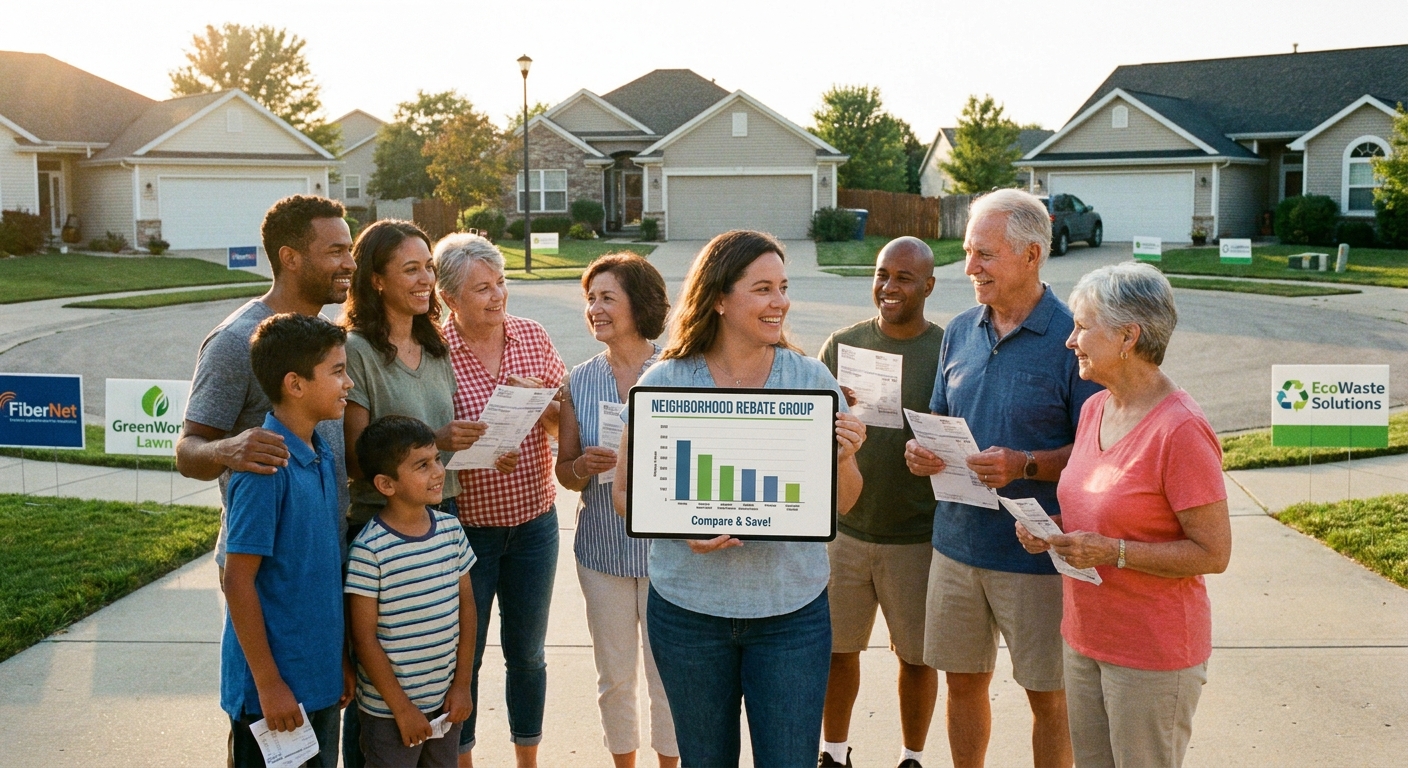
You can feel the pattern, even if nobody says it out loud. The HOA email thread fills up with complaints about trash fees. Nextdoor has three different posts about internet price hikes. Someone mentions a new “admin fee” from a lawn service. Everyone is annoyed. Nobody actually compares bills, asks for bids, or pushes for a better group rate. So the grumbling keeps going, and the overpaying does too.
The good news is this is one of the easier money problems to fix, because your neighbors are already gathered in one place. If you have ever wondered how to start a neighborhood rebate group, you do not need a formal club, a fancy app, or 100 households. You need a small, organized bill-swap with clear privacy rules, then a simple message to local vendors that says, “We have a cluster of homes ready to compare offers.” That is often enough to turn scattered complaints into actual rebates, waived fees, and better monthly rates before the next bill lands.
⚡ In a Hurry? Key Takeaways
- Yes, you can start a neighborhood rebate group with just 5 to 15 households sharing basic bill details for the same service.
- Use a simple spreadsheet or form that collects provider name, monthly cost, contract status, and service level, not full account numbers or private documents.
- Vendors care about clusters of nearby customers, so a small block-level group can often get better pricing faster than one household negotiating alone.
Why neighborhood complaints rarely turn into savings
Most neighborhood threads are built for venting, not action. That is not a criticism. It is just how they work.
One neighbor says their internet jumped by $22. Another says trash pickup added a fuel surcharge. A third says lawn care got worse and more expensive. Useful information is there, but it is buried in side comments, jokes, and unrelated replies about barking dogs or recycling bins.
Companies love that kind of chaos. Not because they are evil. Because it means customers are isolated. If ten people on one street are paying ten different prices for nearly the same service, the vendor keeps control.
Your job is to make the mess readable.
What a neighborhood rebate group actually is
Think of it as a mini buying club for monthly bills. Neighbors share a few facts about what they pay. The group spots big price gaps. Then one person, or a small volunteer team, asks current or competing vendors to bid for that pocket of homes.
That is it.
You are not starting a legal co-op. You are not collecting money for the whole block. You are not promising everyone the exact same result. You are just turning local price confusion into a simple market signal.
The basic ingredients
A working group usually needs:
- 5 to 15 interested households
- One shared category to start, like internet, trash, lawn care, or pest control
- A privacy-safe comparison sheet
- A short deadline, ideally 3 to 7 days
- One message to vendors asking for group terms
Start small. One category is enough. Internet and lawn care are often the easiest because pricing varies a lot and vendors compete hard in dense neighborhoods.
How to start a neighborhood rebate group without making it weird
This is the part that matters. If you ask neighbors to “upload your full bill,” many people will vanish. If you make it easy and safe, they will join.
Step 1: Pick one bill people already complain about
Do not launch with five services at once. Pick the one already causing the most irritation.
Good choices:
- Internet
- Trash pickup
- Lawn care
- Pest control
- Pool service, if your neighborhood has pools
Bad first choices:
- Electricity, if rates are mostly utility-controlled
- Complex insurance products
- Anything with too many custom add-ons at the start
Step 2: Post a simple invite
Here is a message style that works well in HOA email groups or Nextdoor:
“A few of us noticed we may be paying very different prices for the same services. I am putting together a quick, privacy-safe comparison for internet and trash this week. If you want in, send only these four details: provider, monthly price, plan/service level, and whether you are under contract. No account numbers, no bill screenshots required. If we get enough homes, I will ask vendors for a neighborhood rate quote.”
Notice what this message does. It sounds organized, not pushy. It also lowers the privacy fear right away.
Step 3: Collect only the data you actually need
You do not need a full bill. You need enough to compare apples to apples.
Ask for:
- Street or block name, not full address if people are hesitant
- Provider name
- Monthly total
- What the service includes
- Contract end date, if any
- Recent price jump or extra fee, if one appeared
Do not ask for:
- Account numbers
- Full screenshots with personal details visible
- Payment method info
- Login credentials, obviously
Step 4: Put it in a very plain chart
You are looking for patterns, not perfection.
For example:
- Provider A, 500 Mbps, $79
- Provider A, 500 Mbps, $62
- Provider A, 500 Mbps, $91 after promo ended
- Provider B, fiber, $70 with no contract
Once neighbors see the side-by-side numbers, motivation changes fast. It stops being a vague complaint and becomes proof.
The privacy-safe rule that keeps people participating
Here is the golden rule. Share ranges and patterns publicly. Share exact bills privately, if needed, with one organizer.
For the neighborhood post, you might say:
“We have 11 homes reporting internet bills from $58 to $94 for similar speed tiers. Three homes are out of contract this month. Two others had recent equipment or service fees added.”
That is enough to get attention from both neighbors and vendors.
If you need bill proof later, collect it one-on-one and let people redact personal details. Keep the process boring and secure. Boring is good here.
How to ask vendors to bid on your block
This part sounds intimidating, but it is basically a short sales email in reverse. You are the customer bringing a small batch of business.
What to say
Try this format:
“I am coordinating a group of 9 households in [neighborhood name] comparing internet options before next month’s billing cycle. We currently have customers with [Provider A], [Provider B], and residents ready to switch if there is a better offer. Please send any neighborhood pricing, waived install offers, bill credits, contract flexibility, or referral rebates available for a concentrated group of nearby homes.”
That message works because it is specific. Not too long. Not angry. It tells the vendor there is a real cluster of buyers close together, which lowers their marketing cost.
What to ask for besides a lower monthly rate
Many people fixate on the sticker price. Fair enough. But group offers often show up in other forms too.
- Waived installation fees
- Free equipment for 6 to 12 months
- Bill credits
- No contract requirement
- Price lock for a year
- Faster service tier for the same price
- Seasonal service add-ons at no charge
Sometimes the best deal is not the cheapest monthly number. It is the offer with fewer surprise charges and a cleaner contract.
Where this works best
Neighborhood bill-swap groups tend to work best when:
- Homes are geographically close
- People use the same 2 to 4 vendors
- There is visible price inconsistency
- The service is easy to compare
- Switching is realistic within 30 days
Trash, lawn care, pest control, cleaning services, and internet are strong starting points. Dense pockets of customers are valuable to local providers. They can schedule more efficiently, reduce travel time, and win several accounts at once.
Where people mess this up
Trying to organize the entire neighborhood at once
You do not need 80 homes. You need a starter group. Five homes on two nearby streets can be enough to get useful quotes.
Making the data collection too complicated
If your form looks like a mortgage application, people will ignore it.
Turning it into a complaint club
Keep the tone practical. Vendors respond better to “we are comparing offers” than “everyone is furious.”
Forgetting timing
Ask neighbors when contracts end. A great group quote means less if nobody can switch for eight months.
A smart way to keep momentum after the first win
Once one category works, neighbors get it. The group feels real. Then you can expand carefully.
Maybe your internet comparison gets three households a lower rate and two more a bill credit. Great. Next month, do lawn care. After that, maybe pest control or cleaning services.
This is very similar to how local buying groups grow in other categories. If you want a good example of that idea in a different setting, this piece on The ‘Neighborhood Bulk‑Buy Shortcut’: Turn Local Food Co‑ops Into Real Rebate Clubs You Can Actually Join shows how everyday community chatter can turn into organized savings without becoming a part-time job.
A quick script you can use tonight
If you want the shortest possible version, post this:
“Several of us have noticed rising bills for internet, trash, and yard service. I am starting a simple neighborhood rebate group to compare what we pay and see if vendors will offer a block rate or bill credits. If you want in, reply with provider, monthly price, service level, and contract status. No account numbers or private bill images. I will share the price ranges and ask vendors to bid for our area by the end of the week.”
That is enough to get the ball rolling.
At a Glance: Comparison
| Feature/Aspect | Details | Verdict |
|---|---|---|
| Startup effort | Usually just a short post, a basic form or spreadsheet, and 5 to 15 neighbors sharing limited bill details. | Low barrier. Easier than most people think. |
| Savings potential | Best for internet, trash, lawn care, and similar services where vendors compete and rates vary by customer. | High upside, especially when several homes are ready to switch. |
| Privacy and safety | Works well if you collect only provider, price, service level, and contract status, while keeping account numbers and personal details private. | Safe if organized with simple ground rules. |
Conclusion
You do not have to wait for some giant consumer movement to fix a $20 hike here and a $35 fee there. Right now, local home-service costs are quietly climbing while vendors still want dense pockets of customers. That makes neighborhood bill-swap groups one of the fastest ways for regular people to get some pricing power back. A handful of households sharing what they pay for trash, internet, or lawn care can create the kind of real market data companies actually respond to. Then you turn that data into a clean, simple “bid on our block” request. No coupon circus. No mystery app. No sketchy deal forum. Just neighbors comparing notes in a privacy-safe way and using the numbers to ask for better terms. If you have been wondering how to start a neighborhood rebate group, the best answer is simple. Start with one bill, one post, and one week. That is often all it takes to turn complaints into cash back.