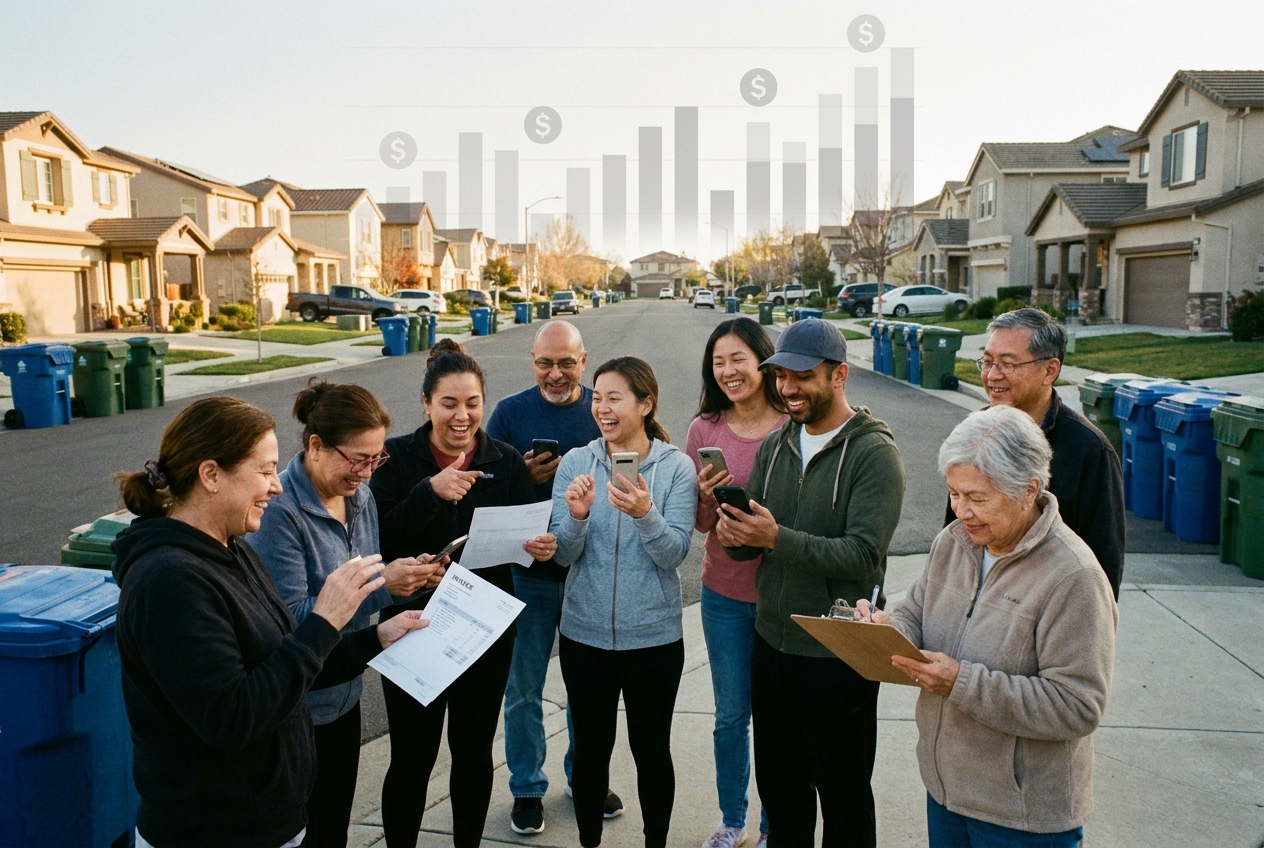
Your trash bill goes up. Your internet promo ends. Lawn care quietly costs more than it did last spring. Meanwhile, two houses over, someone is paying less for the exact same service. That is the part that really gets under your skin. The good news is this is not magic, and it is not reserved for HOAs or coupon super-users. Vendors for recurring services love tight neighborhoods because clustered customers are cheaper to serve and less likely to cancel. That gives regular neighbors real bargaining power. If you have ever wondered how to start a neighborhood group buying rebate club for trash and utilities, the simplest answer is this: gather a small group, compare real prices without oversharing personal info, then ask providers to bid on the whole block instead of one home at a time. It sounds formal. It is actually very doable, and you can start with a five-minute walk on trash day.
⚡ In a Hurry? Key Takeaways
- You can start a neighborhood rebate club for trash, internet, lawn care, and similar bills with just 8 to 20 interested homes and a simple price survey.
- Use a privacy-safe signup sheet, collect current rates and contract dates, then ask 3 to 5 local providers for group pricing based on your street or subdivision.
- Do not collect account passwords, full bills, or banking details. Keep it simple, neighborly, and focused on rates, service terms, and rebate options.
Why this works better than calling for a “loyalty discount”
One customer asking for a break is easy to brush off. Fifteen homes on the same route are not.
That is the basic idea. Trash companies, internet resellers, pest control outfits, and lawn crews make more money when jobs are packed close together. Less driving. Fewer missed appointments. Lower marketing costs. Lower churn.
In plain English, your block is worth more as a bundle than as scattered one-off customers.
That is why neighborhood and subdivision based group buying for recurring services is growing so fast right now. The discount can land in the 15 to 35 percent range, and sometimes the better deal is not even the monthly rate. It can be a sign-up rebate, free upgrades, no fuel surcharge, locked pricing for 12 months, or better service terms.
What a neighborhood rebate club actually is
Do not picture meetings, bylaws, or somebody printing name tags.
A rebate club can be very simple. It is just a loose group of neighbors who agree to compare prices, ask vendors for block-level pricing, and join the best offer if it makes sense.
You do not need any of these to get started
You do not need HOA authority. You do not need nonprofit status. You do not need a giant app. You do not even need everybody to switch.
You just need enough interested homes that a provider sees an efficient route and steady business.
The best services to start with
Start with the bills where route density matters most:
- Trash and recycling
- Lawn mowing
- Pest control
- Snow removal
- Pool service
- Internet, especially if multiple resellers serve your area
Trash is often the easiest first win because everyone can literally see who uses which company.
The “trash day” shortcut
This is the low-drama, weekend-friendly way to begin.
Step 1: Take a five-minute walk on pickup day
Walk your street or a few nearby streets when bins are out. You are not snooping. You are just noting which providers already serve the area and how dense each route looks.
Write down:
- Company names on bins or trucks
- How many homes appear to use each company
- Whether some homes still use city service or private service
This tells you who is already nearby and who might sharpen a pencil to win more homes on the same route.
Step 2: Do a privacy-safe price check
Now ask a few neighbors a very specific, low-pressure question:
“A few of us are comparing trash and utility rates on the street. Would you be open to sharing your monthly price, contract end date if there is one, and whether you would switch for a better block rate?”
That is it. No full bill copy required. No account number. No payment info.
People are far more willing to answer when the ask is small and the privacy line is clear.
Step 3: Use a simple interest list
You can do this on paper, in a basic Google Form, or in a neighborhood Facebook group post if your block actually uses one. Keep the form short:
- Name
- Street only, or house number optional
- Best contact method
- Current provider
- Current monthly or quarterly price
- Contract end date, if known
- Interested in a group deal? Yes, maybe, no
If you are collecting online, make it clear that you are not creating a public spreadsheet. You are simply counting interest and comparing rates.
How many homes do you need?
Less than most people think.
For trash or lawn care, 8 to 12 homes on one street can be enough to get a serious quote. For internet, it depends on who serves your address and whether installation work is needed, but 15 to 30 homes can still get attention, especially in a newer subdivision or a dense older neighborhood.
More matters, of course. But the key is concentration, not just raw numbers.
How to run a mini request for proposals without sounding like a city government
“Request for proposals” sounds fancy. Here it just means sending the same short note to several providers so you can compare apples to apples.
What to include in your message
Keep it brief and practical:
- Your neighborhood or street name
- Rough number of interested homes
- Service you want quoted
- Any must-haves, like weekly pickup or no contract
- Deadline for quotes
- Ask for pricing, fees, term length, and any group rebate
Here is a sample:
“Hi, I am coordinating interest from about 14 homes on Oak Ridge Lane for weekly trash and recycling service. We are comparing providers for a possible neighborhood group rate. Please send your best pricing for 10, 15, and 20 homes, including cart fees, fuel/environmental fees, contract length, cancellation terms, and any sign-up rebates or referral credits. Thanks.”
Send it to 3 to 5 providers
That is enough to create competition without turning it into a part-time job.
Try a mix of bigger names and smaller local companies. The local provider is often the one most willing to make a creative offer if your route is attractive.
What to compare besides the sticker price
This is where people get tripped up. A lower monthly number is nice, but it is not the whole story.
Look closely at these items
- Setup fees
- Cart rental fees
- Fuel or environmental surcharges
- Price lock period
- Auto-renew terms
- Missed pickup policy
- Cancellation fee
- Rebate or referral credit structure
For internet, also compare upload speeds, equipment fees, promo expiration dates, and whether the quoted rate requires autopay or paperless billing.
How rebates can work on a block
There are a few common setups.
Option 1: Lower rate for every home
This is the cleanest and often the best. Everybody simply pays less each month.
Option 2: Sign-up bonus or bill credit
The provider offers a one-time credit if a certain number of homes join.
Option 3: Coordinator credit shared with the group
Sometimes a company offers the organizer a referral bonus. If you want to keep trust high, be transparent and suggest one of three approaches:
- Split it among all participating homes as a rebate
- Use it for a neighborhood need, like block event supplies
- Keep it only if everyone is told up front and agrees
If you hide side incentives, the club will fall apart fast.
Privacy and trust rules that keep this from getting weird
This part matters.
Do collect
- General prices
- Provider names
- Contract end dates
- Interest level
Do not collect
- Full account numbers
- Photos of complete bills unless necessary
- Social Security numbers
- Payment card details
- Passwords or login info
Also, do not post everybody’s rates publicly with names attached. Share results in summary form. For example: “Current trash pricing on our street ranges from $23 to $41 a month.” That gives the group useful information without putting anyone on display.
A simple weekend plan you can actually follow
Friday
Pick the service. Trash is usually easiest. Draft a short neighbor message.
Saturday
Talk to 5 to 10 neighbors or drop a note at doors. Create the interest list.
Trash day
Walk the block. Count existing providers and route density.
Monday
Email 3 to 5 providers with the same quote request.
Wednesday
Put the quotes into one simple comparison sheet.
Thursday
Share the top two offers with neighbors and ask who is ready to join.
That is the whole play. It is much smaller and more realistic than people expect.
What if not everyone wants to participate?
That is normal. You do not need unanimous support.
Some neighbors are under contract. Some hate change. Some are too busy. Fine.
Build around the willing middle. If 10 homes join and save money, the holdouts often come around at the next renewal cycle.
Common mistakes that sink these deals
Starting too big
Do not launch with the whole subdivision unless you already have a strong communication channel. One street or one cluster of homes is easier.
Being vague with providers
If you say, “We have lots of people interested,” you will get mushy quotes. Give a realistic number range.
Ignoring contract dates
A great group rate does not help much if most people are locked in for 10 more months. Track timing.
Picking only the cheapest offer
Reliable recurring service is worth something. The lowest price with lousy support can become a neighborhood headache.
Acting like an unofficial billing middleman
Do not collect money on behalf of the group. Each home should still contract and pay the provider directly.
How this can grow beyond trash
Once neighbors see one real win, the club becomes easier to reuse.
Maybe the next target is lawn care. Then pest control. Then internet. The hardest part is not the spreadsheet. It is proving that a handful of neighbors can act together without drama.
After that, you have a repeatable model. A standing rebate club. Not a formal institution. Just a practical habit.
At a Glance: Comparison
| Feature/Aspect | Details | Verdict |
|---|---|---|
| Best first service to group-buy | Trash and recycling are easy to survey because providers are visible and route density matters a lot. | Best place to start for most neighborhoods |
| Minimum group size | Often 8 to 12 homes for route-based services, more for internet depending on local options. | Smaller than most people assume |
| Privacy and admin burden | Keep data to rates, provider names, and contract dates. Do not handle payments or collect sensitive account details. | Very manageable if you keep the process simple |
Conclusion
You do not have to sit there and accept rising household bills like the weather. Neighborhood and subdivision based group buying for recurring services like trash, internet and lawn care is exploding right now because vendors want dense, low-churn routes, and many will trade that for 15 to 35 percent off plus rebates. The big surprise is how ordinary this can be. No nonprofit. No HOA title. No giant app. Just a five-minute walk on trash day, a privacy-safe price survey, a small interest list, and a simple quote request to local providers. That gives you a practical play you can run this weekend. If it works, you cut real monthly costs, keep more money with good local providers, and turn a bunch of isolated bill-payers into a standing rebate club that can negotiate future services together. That is the part worth remembering. Your block has more buying power than any one household does alone.